I am a Teacher of History working part time as I consider options for my future. For many years I have been a Teacher-Librarian at a small regional cooeducational college. While now working with three classes of History I continue to develop information literacy and digital skills as a Microsoft IEE and also a Fellow. It is critical ifor educators to keep tabs on new technology and its educational application. I am lucky to work in a school where technology is supported.
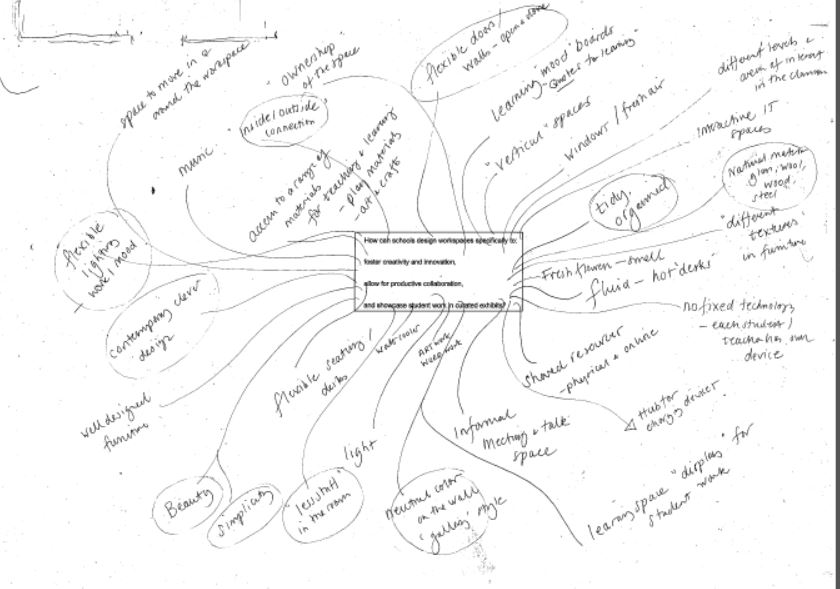
How can schools design workspaces specifically to:
foster creativity and innovation,
allow for productive collaboration,
and showcase student work in curated exhibits?
This was the starting point for the adult Creative Coffee sessions that were held Friday 12th September. Given that I had interested people who could not make the same venue and time simultaneously, I chose to use the same framework to give the conversations cohesion. The framework was deliberately left broad in order to tap into as many aspects as possible. 5 people joined the discussion overall: a PhD student and English teacher, a Science teacher, a librarian, an Art teacher and a Special Education/English teacher. None currently work with me, but all have done so at some point, and know the school that I work in well.
The most detailed response
The responses were given initially as a written brainstorming, followed by a conversation about the common themes and concepts that were raised. Responses, and discussions were very broad, but the following commonalities were raised:
Lots of space, preferably flexible, with appropriate furniture (that adds and subtracts) to suit formal and informal interactions, and ample storage (5/5).
Natural light, display cabinets/spaces (some mentioned lockable) and curated Art/student work (3/5).
3 people wanted the space to be clean and uncluttered, and the same number referred to equipment and resources. These respondents also mentioned colour, but the discussion in relation to this aspect was interesting as all believed different colours to be the best. This fits with the research coming from Blackmore et al, who indicate a range of responses to colours, but which are often contradictory (is blue better for younger or older students, or should it never be used)? (Blackmore, Bateman, Loughlin, O’Mara, & Aranda, 2011, pp. 25-26)
Interactive ICT was specifically mentioned by 2 people, with a third mentioning interactive whiteboard/permanent whiteboard as important. Charging devices was identified by 1 respondent.
In terms of “feel”, safety, knowledgeable staff, and a mix of private/public spaces were suggested (3/5).
The context of the individual’s workspaces/places came through in a number of ways, with a number of people from the same school highlighting a need for respect.
Three phrases really resonated: “having tasks that challenge, and encourage enquiry and experimentation”, “different textures”, and “staff/student input”. It is critical that users of the space are involved in its development, and that all share a common understanding of the intended teaching and learning outcomes sought by developing a physical or virtual learning environment. Tapping into the clientele through a design thinking process through collaborative methodology in which every voice is heard, is the best way to avoid design disasters of varying kinds (Brown, 2009, pp. 26-28).
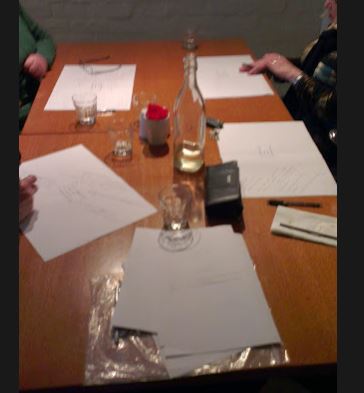
Everyone hard at work – but photoshy!
The adult Creative Coffee meetings were used to guide the school based meeting set up for the 15th at lunchtime. More on this later!
Badke-Schaub, P., Roozenburg, N., & Cardoso, C. (2010). Design Thinking: A Paradigm On Its Way From Dilution To Meaninglessness. Design Thinking Resource Symposium 8: Interpreting Design Thinking (pp. 39 – 50). Sydney: Faculty of Design, Architecture & Building University Of Technology Sydney.
Brown, T. (2009). Change by Design How Design Thinking Transforms Organizations and Inspires Innovation. New York: Harper Collins.
Burdick, A., & Willis, H. (2010). Digital Learning, Digital Scholarhip And Design Thinking. Design Thinking Resource Symposium 8: Interpreting Design Thinking (pp. 89-98). Sydney: University of Technology Sydney.
Grift, G., & Major, C. (2013). Teachers As Architects Of Learning: Twelve Considerations For Constructing A Successful Learning Experience. Moorabbin: Hawker Brownlow Education.
Melles, G. (2010). Curriculum Design Thinking: A New Name For Old Ways Of Thinking And Practice? Interpreting Design Thinking, 299-308.
Surveying the literature constructed around design thinking, reveals few direct intersects between theories of design and theories of learning, particularly in designing real and virtual spaces for learning enrichment through best practice. Design thinking has evolved to augment innovation, intending to enhance life itself (Pilloton, 2009, p. 6). Consequently there have been numerous attempts to describe a formula which will enable such thinking, particularly for professionals, including teachers, who are not explicitly trained in design. The question is, how applicable is design thinking to education, and in what context? Whether design thinking is part of design theory, or something different there has been little practical adoption within Australian schools.
The selected titles entail varied definitions for a mixture of design theory, process, thinking, pedagogy. They reveal a range of methodologies applied by design thinkers working in numerous fields, and educators approaching learning design from different perspectives. The literature enables engagement with the cognitive aspects of design, especially as applicable to innovative change. Theoretical structures underpin all titles, and deep thinking is unanimously viewed as important. The overall impression is piecemeal, leading to tensions, contradictions and discord, which hamper the adoption of design thinking as a practice. Confusion defining design theory compared to design thinking, potentially restricts the adoption of relevant aspects to non-design fields including education.
The first key tension arises from analysing the varying definitions and processes presented in the texts. Brown recommends diffusing design thinking through organisations by presenting a number of mental matrices outlining the flow of processes (Brown, 2009, pp. 62-86). He draws the path through the “feel” of the different and overlapping spaces he defines, showing the changes in levels of hope, confidence and insight as the process unfolds (Brown, 2009, p. 65). He then delineates the divergence and convergence of creating and making choices, in which the flow moves from a broad concept into a narrower concentration which leads to prototyping and solutions (Brown, 2009, p. 67).
In contrast, the model proposed by Hatchuel et al is constructed as a design square, where concepts and knowledge interact with each other. (Hatchuel, Le Masson, & Weil, 2004, pp. 1-4). They suggest two typical innovative contexts: scientific and creative. Their design square appears to be all encompassing, whereas Brown acknowledges the need to revisit and reframe any or all parts of the process he outlines. Indeed, he notes that integrative thinkers (essential to this process) see non-linear and multidirectional relationships as a source of inspiration (Brown, 2009, p. 85).
The model presented by IDEO in their toolkit for educators has education as a specific focus. Their process is represented as sinuous and organic, with a broad starting point, a narrow waist, another bulge and a further narrowing indicating forward flow and narrowing of considerations leading towards a solution (IDEO, 2012, p. 15.). Brown is the chief executive officer and president of IDEO, and yet the process is not identical in both publications, causing further confusion.
Badke-Schaub et al, create more tension by questioning whether the design thinking paradigm has become diluted to the point of meaninglessness. They criticise Brown’s construct as prescriptive, idealistic and without empirical supporting evidence (Badke-Schaub, Roozenburg, & Cardoso, 2010, p. 41). They challenge Brown’s methodology, stating that three issues need reconsideration: the roles of emotion and motivation; focus on teams of designers rather than individuals, and use of case studies and protocols as evidence of a successful design thinking pattern (Badke-Schaub, Roozenburg, & Cardoso, 2010, p. 47). Their own processes are multiple, and more complex than Brown’s. A semantic approach is taken by Lindburg et al, who avoid this paradox by referring to working modes rather than process steps (Lindburgh, Gumieny, Jobst, & Meinel, 2010, p. 243).
The writings of Burdick and Willis, Melles and IDEO, all specifically apply design thinking concepts to education; these writings move from concepts towards educational practice. Burdick and Willis triangulate concepts: digital learning, digital scholarship and design thinking (Burdick & Willis, 2010, p. 90). These issues are pertinent to digital pedagogy, which must cater for strong visual communication skills, in addition to servicing generations accustomed to inductive discovery (Burdick & Willis, 2010, p. 90). Interestingly, Melles questions whether any of the current design propositions actually improve or innovate curriculum design, or whether they are all semantics (Melles, 2010). He does concede however, that many aspects of visualisation co-design can lead to a better environment and thence to quality outcomes (Melles, 2010, p. 301).
The final title, by Grift and Major, builds on the work of renowned educators, and is focussed on centralising the students in intended curriculum design (Grift & Major, 2013). They raise the dichotomy between Marzano’s intended, implemented and attained curriculum and outline twelve considerations which they recommend as the basis for pedagogical design (Grift & Major, 2013, p. 12). Their strategies are based on three fundamental goals: successful student learning, the role of teachers’ mindfulness, and learning through action and reflection (Grift & Major, 2013, p. chp 1). Recent views of learning are presented as tabulated summaries and compared to optimal learning outcomes (Grift & Major, 2013, pp. 24-29). Their design provocations indicate loose relationship to the design theories and processes described by the other authors (Grift & Major, 2013, p. chp 15).
While definitions of design are important, they need to avoid oversimplifying the amazing richness of multiple perspectives; the conceptual framework needs to be fundamental enough to provide an anchor for the broad extant descriptions that abound (Dorst, 2010, p. 131). The most important consideration, therefore, is whether broad aspects of design as presented in this literature have been, or should be, adopted for education in terms of process, and spaces in order to improve learning outcomes. It is also important to ascertain and evaluate any examples of implementation.
Innovative teachers are skilled at applying appropriate concepts from almost anywhere to a lesson, a unit of work, redesigning their classroom (or library) space, or layout of a virtual space. They often work in collaborative teams, additionally making the best of time and budgetary constraints. One focus of modern teaching is aimed to empower the learners, and typically many teachers draw on esoteric sources to improve their practice. For example, a book focusing on products that empower people, may resonate (Pilloton, 2009). Teachable moments arise from than just the educational tools section (Pilloton, 2009, pp. 152-183). Individuals in almost all schools are able to apply concepts like this to innovate in their own lessons, but for adoption to be effective, a strong understanding of purpose is vital. Many teachers would consider the design thinking concepts and structures espoused by most of the selected authors as too esoteric. They are naturally confusing and complex, although they can also be exhilarating. Conversely, the range of definitions and processes is positive for education as it leaves room to adapt and adopt, rather than needing to master a specific set of steps.
Educators consider deep thinking, as referred to by all selected texts, to be one of the most critical aspects of their work. There is a significant intersect between design thinking and teaching. Brown resonates with teachers planning a unit of work by outlining everything that is pertinent to a topic, then narrowing the focus to fit a range of criteria or constraints (Brown, 2009, p. flyleaf). Constraints include the age of students, the physical and virtual teaching spaces and time available. There is also some value in the design square, as educators work in both the scientific and creative realms (Hatchuel, Le Masson, & Weil, 2004, pp. 1-4). Referring to integrative thinkers and inspiration, Brown is applicable to the ebb and flow of curriculum design, innovating in teaching processes and considering learning spaces. Ideation is one area of overlap with the practice of teaching synthesis and evaluation, particularly relevant for History (Simkin, Designing Thinking Tasks, 2014).
Brown also refers to constraints, desirability, viability and feasibility (Brown, 2009, pp. 18-19), concepts familiar to educators, but the generalisations preclude large scale educational application. Educators require concepts that specifically translate to classroom and or learning design because any discussion that falls outside the parameters of student learning is a distraction from the teacher’s core work (Grift & Major, 2013, p. 1). Teachers generally have many such “distractions” prohibiting them from conquering one process and then embedding it in practice.
From the plethora of new pedagogies, modern teachers increasingly aim to develop collaboration fluency, especially important in a century of ubiquitous digital tools (Crockett, Jukes, & Churches, 2011, pp. 69-78). The role of the group as accepted as more important than the individual. Consequently, unlike Badke et al, few teachers would argue with Brown in terms of this aspect of his design thinking construct (Badke-Schaub, Roozenburg, & Cardoso, 2010, p. 41).
Assessing practise through case study is also considered powerful by most educators. Brown’s requirement for nimbleness, reinforces a degree of inherent value in applying design thinking to education (Brown, 2009, pp. 16-18). University research is definitely enhanced through knowledge networking and digital innovation, with collaboration improving learning (Simkin, Collaborative Ideation, 2014). Collaboration may also lead to additional research possibilities for learning improvement.
Design thinking is a useful basis for implementing a change in practice, or in applying innovation to education. It has been introduced in varied formats by individual teachers to enable productive collaboration and brainstorming (Simkin, Designing Thinking Tasks, 2014). This works really well for subjects where a range of interpretations is vital. Brown’s rules: defer judgement, encourage wild ideas, and stay focussed encourage active participation by all. (Brown, 2009, p. 78).
Design specialists such as Brown are of lesser value for individual educators, schools and school systems by virtue of their focus on broad definitions of design processes. In evaluating and potentially adopting design thinking, educators therefore may consider Burdick and Willis, Melles and IDEO who specifically apply concepts to education. They are more likely however, to prefer resources such as Project Zero which look at thinking processes from a purely educational perspective (Harvard Graduate School Of Education, n.d.).
There is obvious discord within the design literature, broad educational theories and also between the literature under consideration and aspects of educational practice. Extrapolating the common themes indicates that applying broad design principles can benefit education. There are too many recent examples of significant expenditure intended to create major disruptive change for improving learning actually having the opposite effect due to no application of broad design thinking to the process.
Physical buildings usually begin with a design brief. Brown comments that a well-constructed design brief allows for serendipity, unpredictability and capricious whims of fate – all of which are familiar to teachers (Brown, 2009, p. 23). Many teachers are engaging in redesigning their physical learning spaces and measuring the impact of their actions on their students’ learning, utilising a range of techniques and learning beliefs (Simkin, Further changes To Our school Library, 2014). Some are working with a design brief of some sort, while others are brainstorming and prototyping. These examples are isolated in terms of one teacher, department or one school rather than pervasive in education.
Planning for a new or renovated building usually commences strategically, ensuring needs are on the grid for further development in the next master plan. Strategic design briefs are based on big ideas, and spell out the needs with a broad brush rather than in fine detail (Simkin, Submission To The Strategic Planning Architect For the Next Series Of Capital Planning, 2014). The number of people involved in this process depends on the nature of the school’s management team. Once the proposal becomes imminent, fine details will be discussed and a detailed brief prepared.
In many cases, this second design brief is actually created in isolation from the clientele. Finished buildings fall short of educational needs and practical inclusions: a bench designed for four computers has two power points; laptop storage spaces built into student lockers do not enable charging; an orchestra pit has no capacity to illuminate the music during a production. Need-finding often resides in executive only; classroom teachers, students and parents are not included in ideation processes. Excluding most of the stakeholders, omissions become the norm. Too many new buildings of recent time do not lead to improved educational outcomes. This occurred at a large scale with the Australian Building the Education Revolution (Karooz & Parker, 2010, p. chp. 9). In stark contrast, The Works utilised a holistic approach to developing their future school, involving teachers, parents, the community and the architects in the planning (The Works At Walker) . Their process considered all wants and needs, leading to a unified report covering both physical and virtual spaces (The Works At Walker, pp. 7-28). Starting from their ethos and proceeding to what they therefore needed to provide, a coherent design brief, based on people and processes resulted. Their elaboration of the process reveals elements of both design theory and thinking applied as part of a four step theoretical framework (The Works At Walker, pp. 14-15). This appears to be a rare example of a multidisciplinary approach.
Another major consideration for education is tapping into the affordances of the digital age. This resonates with 21st Century Fluencies (Crockett, Jukes, & Churches, 2011), a crucial focus in many of today’s schools developing their 1:1 computing programs. This is another government initiative resulting in minimal pedagogical change and innovation in learning and teaching. At present there is a number of schools changing the device they want students to use, not because a better outcome can be achieved but because teachers have not embraced the power offered by the device currently supplied. The desired outcome of any device is not the starting point. Any device will fail with lack of professional learning opportunities and real support at a practical level.
New media educators prefer interpretive, rhetorical, networked, user oriented and solution focused learning design (Burdick & Willis, 2010, p. 91). In practice, despite devices being issued free to teachers by many schools, there has been little improvement to learning outcomes in the last ten years. Schools prepared to take risks such as Northern Beaches Christian School, home to the Sydney Centre for Innovation in Learning are still too rare (SCIL Home, n.d). To hear a Principal speak passionately about encouraging his staff to take chances with their spaces and their concepts is most unusual.
Education is design dependent in terms of lesson and unit planning, attention to national curriculum, and learning space set up. This is where Grift’s work is inherently more valuable for most teachers (Grift & Major, 2013). Too many school managers engage teachers in constant acts of creative destruction – imposing the latest theory without embedding the concepts to ensure measurable improvement from adopting one new practice before introducing the next. Grift is critical of the many major distractions within the profession; the focus should be specific to the intended outcome and implemented and embedded before moving to the next initiative (Grift & Major, 2013, p. 3). Well-designed professional learning activities, particularly if design thinking processes were applied in their construction. The work of The Australian Institute for Teaching and School Leadership provides exemplars for pedagogical design throughout professional advancement and may foster improvement in adopting relevant aspects of design processes (Education Services Australia, 2014).
Whilst many schools are attempting to undertake some form of ideation process using post it notes, wonder walls and prototyping, very few have the physical space to donate a whole wall, let alone a room, to allow for shared reflection, refocus and reorganisation of concepts. The Stanford Design School has several floors of such space allowing it to be an ongoing prototype of the educational process itself (Brown, 2009, p. 224). The best that most schools can offer is a short term planning time (maybe a couple of days) for teachers to participate in such a process. There is also a great reluctance to include the entire teaching staff in such a process, let alone parents, students and community members (Simkin, What Is Your School’s Innovation Strategy?, 2014). This is a serious concern as “there is nothing more frustrating than coming up with the right answer to the wrong question” (Brown, 2009, p. 237). All design thinking literature supports the power gained by including strangers in the process. Strong educational leadership identifies who should be involved at any given point in the process.
So, there is a degree of concept transfer from the literature critiqued, but there is an unacceptably large gap between systems, schools and individuals that have applied such theories to demonstrably improve student learning outcomes, and those that function disconnected from educational research. New buildings have led to some changes, but in many settings teaching is very traditional, indicative of the absence of educational design thinking. Any new building or renovation should be planned backwards from the desired end point, a How Might We.. focus and involve all stakeholders at some point in the process (Method Card: How Might We Questions). Current educational research should also be incorporated in the preparation phase.
Access to the Internet has impacted some educators and some administrative practises, but many teachers are afraid of taking a step into virtual teaching spaces. Pre-service teacher training is also lacking as many graduates are not strong in their content methodology, and appear to have little practical exposure to digital technology for delivering lessons. More research is required into gains achieved by Australian virtual learning spaces. The resources being developed by The Australian Institute for Teaching and School Leadership offer hope, describing and illustrating the standards expected from each level of experience, and consider professional learning as vital (Education Services Australia, 2014). This website should be utilised by every school to further all aspects of teaching. This site fulfils Grift and Major’s desire for teaching to be the focus.
Many older schools consist of spaces that were designed for the days when teachers did try to push knowledge and wisdom in one direction, when connection to wireless was unheard of, and there was little need to connect to electricity beyond lighting the space. Learning gains provided by spaces that foster curiosity, creativity and collaboration need to be further investigated. Improvements should lead to better teaching and learning, and preparing for renovation or renewal can only benefit from a degree of application of design thinking. The same applies to virtual learning spaces, which should be increasingly part of our pedagogy. The broad concepts presented by this literature can improve educational processes but the links need to be more clearly defined for specific academic application.
References
Badke-Schaub, P., Roozenburg, N., & Cardoso, C. (2010). Design Thinking: A Paradigm On Its Way From Dilution To Meaninglessness. Design Thinking Resource Symposium 8: Interpreting Design Thinking (pp. 39 – 50). Sydney: Faculty of Design, Architecture & Building University Of Technology Sydney.
Brown, T. (2009). Change by Design How Design Thinking Transforms Organizations and Inspires Innovation. New York: Harper Collins.
Burdick, A., & Willis, H. (2010). Digital Learning, Digital Scholarhip And Design Thinking. Design Thinking Resource Symposium 8: Interpreting Design Thinking (pp. 89-98). Sydney: University of Technology Sydney.
Crockett, L., Jukes, I., & Churches, A. (2011). Literacy is Not Enough, 21st-Century Fluencies for the Digital Age. Corwin.
Dorst, K. (2010). The Nature Of Design Thinking. Design Thinking Resource Symposium 8: Interpreting Design Thinking (pp. 131 – 140). Sydney: Faculty of Design, Architecture And Building, University of Technology Sydney.
Grift, G., & Major, C. (2013). Teachers As Architects Of Learning: Twelve Considerations For Constructing A Successful Learning Experience. Moorabbin: Hawker Brownlow Education.
Hatchuel, A., Le Masson, P., & Weil, B. (2004). C-K Theory in Practice: Lessons From Industrial Practice. International Design Conference – Design 2004, (pp. 1-13). Dubrovnik.
Harvard Graduate School Of Education. (n.d.). Project Zero. Retrieved August 31, 2014, from Harvard Graduate School Of Education: http://www.pz.harvard.edu/
Karooz, C., & Parker, S. (2010). The Education Revolutionary Road: Paved With Good Intentions. In C. Aulich, & E. Mark, Australian Commonwealth Administration 2007 – 2010; The Rudd Government: (p. Chapter 9). Canberra: A.N.U Press.
Lindburgh, T., Gumieny, R., Jobst, G., & Meinel, C. (2010). Is There A Need For A Design Thinking Process? Design Thinking Resource Symposium 8: Interpreting Design Thinking (pp. 243 – 254). Sydney: Faculty of Design, Architecture And Building, University of Technology Sydney.
Melles, G. (2010). Curriculum Design Thinking: A New Name For Old Ways Of Thinking And Practice? Interpreting Design Thinking, 299-308.
Along with four other teachers from my school, I was lucky enough to attend the Ewan McIntosh Masterclass run by Pearson and held in Melbourne last May. We were selected primarily because our middle years (Years 6 – 8) students were about to move into a brand new building which our school is naming the Positive Education Centre. We didn’t really have an opportunity for a briefing before we came and no -one really knew what to expect or what we were intended to bring back to school. Ewan conducted the PL as a design activity, showing us some examples of what is being done in a variety of settings, and the type of outcomes that are being achieved. He then worked us through a range of activities: story telling to consider different mind sets; needfinding issues with education; ideating using hexagons, sticky noting concepts et cetera. To complete these tasks we were divided into groups and worked with people we had not met before, some of whom were not based in schools. The processes were interesting and thought provoking and the themes that arose were common across all groups. When we got to the hexagon stage of telling the story of how we could innovate and what blocks were preventing innovation in our workplaces a few things became really clear. Individual teachers in most schools have very little chance of being able to innovate unless their concept is adopted by those in the high level positions of authority. I was in a group with someone in such a position, who said they would never undertake this type of activity with their whole staff, only with selected personnel.
This, to me is the nub of the problem with design thinking application. By excluding people from such a process you don’t know what you might be missing. The wider the variety of brainstormers, the less likely you are to miss an important factor in the product or service you are trying to create. Brown and IDEO both refer to the power of the brainstorming process (Brown, 2009, IDEO, 2012) and The Works at Walker (The Works At Walker n.d) benefits from engaging in such a practice. In the latter case students past and present, parents, employers, local community, teachers and architects developed a holistic vision for the building and the learning that will take place within it, both face to face and virtually. Too often, finished buildings fall short of educational needs and practical inclusions: a bench designed to hold computers has two power points where four are necessary; laptop storage spaces built into student lockers cannot accommodate charging facilities; an orchestra pit designed for musical performances has no lighting capacity to illuminate the music on stands during a production. Virtual spaces contain content but do not link to belief systems or consider learning needs.
The world is full of unknowns and the best way to avoid missing things that may be known to some people in any process is to involve more people. How might we questions enable breadth of thinking, and broadening the knowledge base should be seen as positive. Resolving any design requirement is more likely to please more people and there should be fewer “how did they miss that?” moments.
What did we five get from our experience with Ewan’s professional learning session? For us as a group, it might have been of more immediate value if part of the day had been spent together so we could prepare some work on a specific issue relevant to us. We did learn some great ideas for using with our students, a sense of what could be if we were allowed to try the process “for real” and an experience which we are still processing months later.
Brown, T. (2009). Change by Design How Design Thinking Transforms Organizations and Inspires Innovation. New York: Harper Collins.
Design thinking is best effected as a team activity and building the team is valuable (Eden, Elliott, Matzke, & Wu, p. 3). Sharing immersion notes with two Teacher-Librarian colleagues, and considering the observations recorded to date, has enabled identification of a couple of “rich seams” waiting for further investigation and ultimately improvement. The observations have been translated into insights, then into alterations and services and thence to the following design brief (Brown T. K., 2011, p. 382).Pilloton describes a ready (context) set (toolbox) go (actions) style of design brief (Pilloton, 2009, pp. 11-12).
the context in which the brief is set
Ready – Context:
A more user-centric physical environment is required. Things requiring adjustment relate to replacing the old-fashioned layout and styles of seating and work space and addressing a lack of possession storage available to students.
the tool box applied to the context
Set: the toolbox:
To ascertain a design brief it has been important to experience the physical space through the eyes of the students, teachers and parents who access our building. Unlike the example of crawling under tables to see a child’s eye view (Bennett, 2007), a range of methods has been applied to the task, commencing with an observation http://thinkspace.csu.edu.au/msimkin/2014/08/06/observation-entering-our-library/ . Using discussion, usually with small groups and individuals, as well as ideating with my CSU team members, there has been an attempt to ascertain what needs to occur, as well as tapping into co-creation processes (McIntosh & O’Connell, 2014).
As our Library does not operate in isolation of other services and environments, members of the Library team have spent time walking through the two newest buildings on our campus. Positive notes reflect colour schemes, some of the furnishings, and the degree of natural light in these newer buildings. Comparing our forty plus year-old surroundings has led to a degree of envy, a list of aspirations, and noting short comings that would need to be avoided when our planned renovation and extension is designed.
Within the constraints of budget, staffing and building, the four rules of designing have been considered: human, ambiguity, re-design and tangible (McIntosh & O’Connell, 2014).
“How Might We” (HMW) questions were applied: (Method Card: How Might We Questions).HMW make immediate change to improve engagement?
HMW raise curiousity?
HMW stay within the financial constraints?
Ways researched for this design brief
Conclusions acknowledged that some alterations can be effected now with little cost, and several of these have been implemented already as can be seen at http://thinkspace.csu.edu.au/msimkin/2014/08/05/further-changes-to-our-school-library/. Change must result in improvement of teaching and learning outcomes similar to that described by 360 Steelcase in their white paper on engagement in new classroom settings (360 Degrees, n.d)
Comparing new spaces to old in terms of engagement by stakeholders
Source: (360 Degrees, p. 4)
actionable tactics
Go – actions:
Steelcase offers a range of furniture solutions allowing for flexibility. Their Node furnishings, as shown in the image below centre, seem to offer much,including somewhere for the problematic possessions bags, which students sometimes need to bring with them (360 Degrees, n.d). The cost of this specific furniture currently prohibitive.
Chair, desk and bag storage all in one!
Implementation:
Low cost measures have been implemented involving:
Purchasing “ghost stools” from Aldi.
Repurposing a bench table by adding 300mm to its height to suit the stools. (This releases the foyer for bag racks, which can be built on site).
Moving tables to a combination of clusters, individual and communal spaces.
Swapping a block shelf that was used for reference material with 5 spinners that housed biographies – freeing up floor space.
While most of the consideration to date has related to physical spaces, there is also a need for the virtual spaces set up by as part of our information services, as this is one way of supporting all stakeholders anywhere and anytime. Prototyping for service solutions, which rely on more complex social interactions, is far more difficult (Brown T. , 2009, p. 98). Iterations have the advantage of zero budget implications (Brown T. , 2009, p. 99).
At times the volumes of necessary changes seem overwhelming but one just needs to stop and consider the potential of our students to become passionate learners through the avenues we create for them as part of their educational journey (Ripp, 2014, p. 118).
Much of our reading to date has been about physical space, but there are also circumstances where we may be revamping virtual spaces. For example I have two blogs, one for each campus of the school, which we started several years ago. We have had several new staff members for short terms so the workload has fallen on my shoulders – hence the sites are well out of date. I am very conscious that I need to revamp them and ensure that the design meets the learning needs.
The Primary Campus Blog is in the worst condition because I don’t actually teach there any more. The Secondary Campus Blog is marginally better. I also have a wiki for our staff where I collect and very loosely curate information to assist with teaching, which has been neglected lately. Once the physical space has been dealt with to the best of the budgetary and time constraints, I am aiming to apply some of our design processes from this course to these.
Simultaneously with the physical space I am implementing some ideation into my Year 12 History Revolutions class. I have been concerned since my professional learning session with Ewan earlier this year about the amount of paper that can be used ideating for design. After testing a number of solutions I stumbled onto a really good one which had spin off learning that was completely unexpected, and could not have been planned.
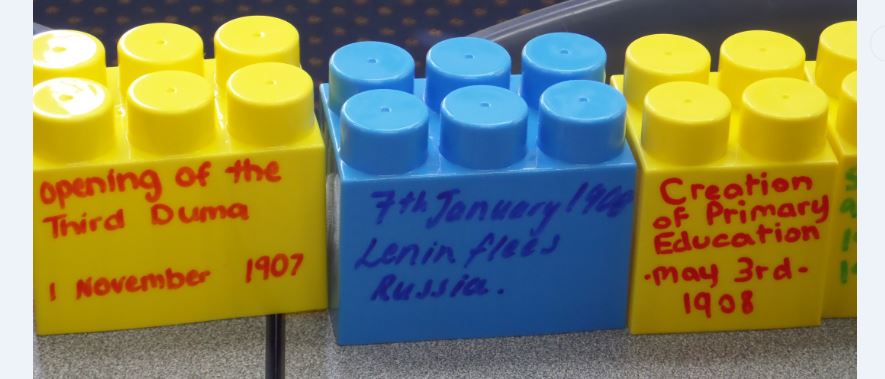
I bought a box of 40 big plastic blocks from the local toyshop. I grabbed a pile of whiteboard markers and I headed for class. Once the excitement settled, this is what we did:
Write events from the timeline
In two groups (I only have 7 students) they were given half the set of blocks. They were told to write on one face of the blocks only, and to use the bigger block (the size shown in the image above) for major events and the smaller blocks (half the size) for less significant events. They were then told to make a timeline like their typed timeline with the chronological basis of first event at the top and last at the bottom. One group used all their blocks, the other one didn’t.
this group used all their blocks
And this group didn’t:
This group also wrote on the other side (naughty!) by putting the social pyramid onto the block, with the Tsar at the top and the peasants at the bottom.
The next task was to re-order the blocks so that the most significant events leading to the 1917 revolution were at the top and the least significant at the bottom. The group that used all their blocks then asked if the combined impact of a number of smaller events (smaller blocks) was greater than the impact of some of the bigger one off events.
Their second construction looked like this:
Note the rows of small blocks deemed more significant than some of the bigger blocks
The other group found when they reordered their chronological constructions that the social pyramid, which should not have been on the other side, ended up with the tsar on the bottom! Sheer fluke but very true. I will be using this again with my Year 12 class. I think it would have application for processes that can be linear. In terms of Library lessons we’re thinking we might use it to teach basic Dewey.
The Ordrup School is described in terms of innovative design in the educational design section of Design Revolution (Pilloton, 2009, p. 176).
At about the 1 minute mark in this clip there is reference to “the type of school where knowledge and wisdom has to be pushed into students’ heads.” Knowledge and Wisdom is our school motto!
The challenges I am facing with the layout of the Senior Campus Library are to convert spaces that were designed for the days when teachers did try to push knowledge and wisdom in one direction, when connection to wireless was unheard of, and there was little need to connect to electricity beyond lighting the space, into spaces that foster curiosity, creativity and collaboration, while maintaining the integrity of the collections and the current usage needs.
I have also been frustrated by the large number of video clips included in each module of this subject given generally slow (sometime no) Internet connectivity. Even at school there is a noticeable slow down at about 1pm every day.
When I can get a clip to run I have been able to use VideoAnt http://ant.umn.edu/ to annotate, and would welcome any addition to my comments on these two:
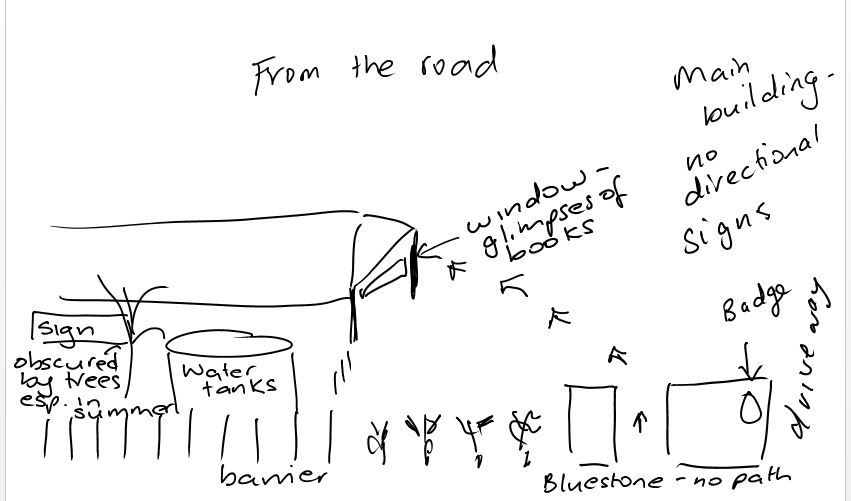
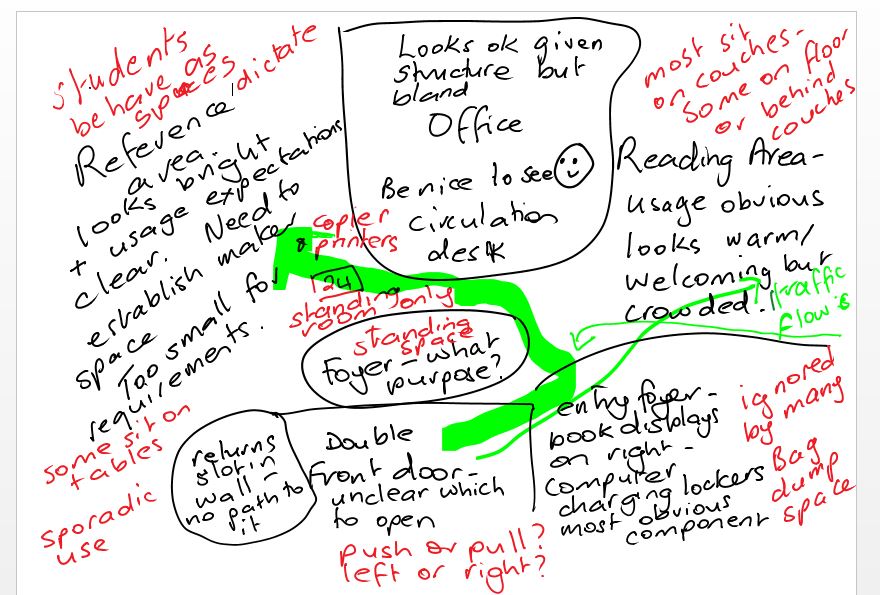
A visitor is given no directional signage to reception or anywhere else from the gate on the main driveway. There is no path through the “walk” gate and between the gateway and the edge of the library is slushy at this time of the year. I pass a large glass door before I reach the “main” entrance. It has two doors, and it is not clear which door is the one that opens. Parent visitor arrived during my observations and kept pushing the wrong door (and it’s a pull door).
Observations on the way to work
The entry foyer is in many ways dead space. Junior students, who should enter with their teacher during class time, often wait here out of the weather – which blocks the entry. Sometimes it is a place for finishing lunch as the current policy is no food. Is it welcoming?
Next entry space fronts the visitor with lap top charging lockers, and a book display.
The path to the “Reading” area is obvious, warm and inviting.
The “Reference” area has a less obvious a pathway.
A welcoming face at the circulation desk would be nice addition, but staffing circumstances make that difficult to achieve.
Potential family tour groups are brought through another door, which brings them straight into the “Reading” area; first impression is warm, welcoming and easy to navigate.
Limited options for collaborative space in reference end; no individual options in reading area.
Information screens generally appropriately sited except for 24 hour news screen.
On Friday, I approached the workmen about moving shelves for me. This was greeted with “Not again!” Then they came and had a look, and within 2 hours all the shifting was done. Still not quite sure about what we call the “Reference” area but it will evolve as different groups offer feedback. The VCE Drama class working in period 1 were complimentary, so that’s a start.
I have been inspired by Matt Ives to film a walk through – I don’t think I have as steady a hand, but it will give you an impression of the space and the improved openness. Any comments will be very welcome.
Design affects all aspects of an organisation in ways that are both seen and clearly understood, and also unseen, unclear and pervasive. It can be the latter that has the greatest impact on the people who work in an organisation, those who visit it, or those who might walk past on the street.
What are the core reasons for which we need a design process?
A design process is needed to ensure that the end result really does fulfil a need, ideally to the best extent possible. Design thinking charges us with being given the white pages of history on which to create beauty for the future (Starck, 2007). It entails needfinding, brainstorming and prototyping preferably in multidisciplinary teams (Seidel & Fixson, 2013, pp. 19-21) . Without interdisciplinary teams the hope of enriching a human experience is seriously challenged (Buchanan, 1992, p. 6).
What might be the role of design when we think about learning spaces?
The aim of utilising a design thinking process for learning space development is to build the learning capacity of students and enhance the teaching practitioner’s role. Design thinking is strategic because it unleashes the disruptive, game changing potential that is latent in everything (Brown, 2009, p. 7).
References
Brown, T. (2009). Change by Design How Design Thinking Transforms Organizations and Inspires Innovation. New York: Harper Collins.
Buchanan, R. (1992). Wicked Problems in Design Thinking. Design Issues Vol 8 No 2, 5-21.
Seidel, V., & Fixson, S. (2013). Adopting Design Thinking In Novice Multidisciplinary Teams: The Application ans Limits of Design Methods and Reflexive Practices. Journal Of Product Innovation Management, 30, 19-33.
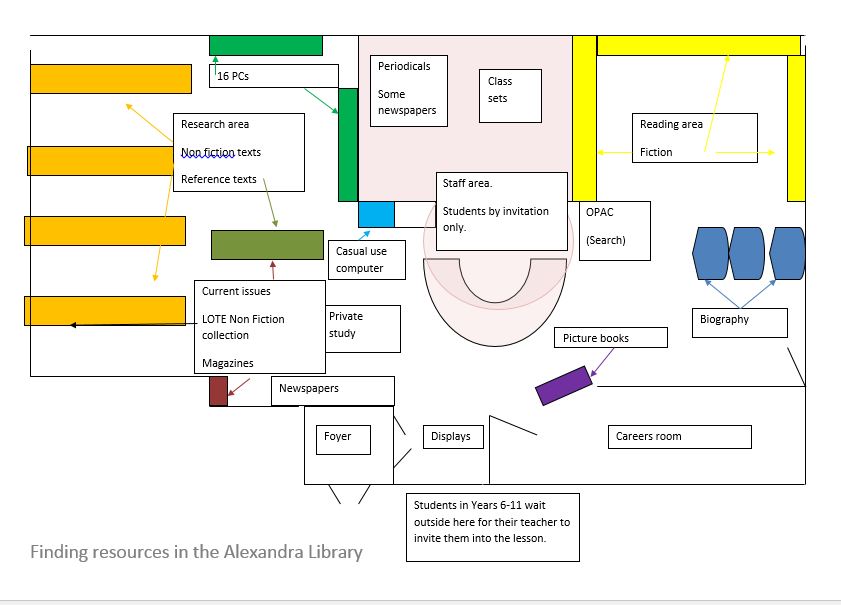
The Senior Campus “Reference area” (see left of map below) is not serving the purpose of enhancing learning. It needs to cater for multiple groups ranging from Year 6 (11 year olds) to Year 12 (18 year olds) simultaneously in any school day. It is currently very traditional in layout, partly due to elderly infrastructure.
The challenges of design in all its breadth are outlined in the introductory video for this course (MacIntosh, 2014):
The joys of considering future possibilities allows a broad range of potentially transformational divergent thinking (Brown, 2009) in stark contrast to the frustrations of the real-world limitations.
The space highlighted in this post is far too small for current needs, and the building was constructed well before the Internet. Capacity to fulfil current needs falls well short of requirements.
An immediate need arises due to recent and impending changes to resource provision. These are summarised in the image below:
The issues surrounding our Reference space.
The challenge posed in Design and Destiny is to raise the angle at which the world is viewed, and use the resulting observations to create beauty within reason and invent a new story (Starck, 2007). Most working in this area acknowledge multidisciplinary teams as providing the best outcomes, both in terms of the ideation process, but also in terms of producing an innovative result that is collectively owned and for which all are responsible (Brown, 2009, p. 28) . Such development also allows for greater divergence in the brainstorming phase (Seidel & Fixson, 2013, p. 21).
The process for changing this space commenced with a consideration of the various needs presented in relation to the physical constraints and in terms of improving teaching and learning outcomes. The brainstorming identified a number of potential solutions and there is the potential for immediate improvement, as well as a more futuristic scenario in the result envisaged.
As with any transformation that requires physical relocation of objects, the importance of working through a design process is critical for three reasons:
Allowing for full consideration of the needs and the effects of the possible solutions
Moving heavy furniture or removing fixtures involves other people’s time
Educational budgets are always limited
When some administrators are questioning the need to have a school library in the future, success is critical.
The changes:
Move most of the Reference books either into general non-fiction or onto different shelving. Move the current Reference shelving to the Reading Area to house Biography. This will open up the floor space in the reference area and add display space to the reading area, which making Biographies easier to find. Spinners currently housing Biographies to be dotted through the Reference space and contain encyclopedias. Status – in train and awaiting workmen.
Purchase some alternative seating to allow for different groupings. Status – commenced with purchase of 6 “ghost stools” from Aldi.
Move current table layout into a variety of layouts across the wider space. Status – awaiting workmen.
Set up mini maker space near available power point – where the magazines are now sited. Status – as above.
References
Brown, T. (2009). Change by Design How Design Thinking Transforms Organizations and Inspires Innovation. New York: Harper Collins.
Seidel, V., & Fixson, S. (2013). Adopting Design Thinking In Novice Multidisciplinary Teams: The Application and Limits of Design Methods and Reflexive Practices. Journal Of Product Innovation Management, 30, 19-33.












 Margaret Simkin