PKM

This post assesses the ways in which personal knowledge management works according to Jarche, H. (2013). PKM in 2013 [Blog post]. Life in perpetual beta. Retrieved March 8, 2014, from http://www.jarche.com/2013/01/pkm-in-2013/ viewed 9 May 2015

“This is not a linear process, as in from information we get knowledge, which over time becomes wisdom. Gaining knowledge is much messier than that. …

Even today, we cannot become complacent with knowledge and just store it away. It has a shelf life and needs to be used, tested and experienced….

Knowledge shared inflows over time can help us create better mental pictures than a single piece of knowledge stock, like a book, can ever do.”

 From <http://jarche.com/2013/01/pkm-in-2013/>

Scott Anthony, author of The Little Black Book of Innovation, identifies four skills exhibited by innovators: Observing; Questioning; Experimenting; Networking. These directly align with the PKM framework of Seek, Sense, Share. It is quite likely that innovation in organisations can be improved with individuals practising PKM.
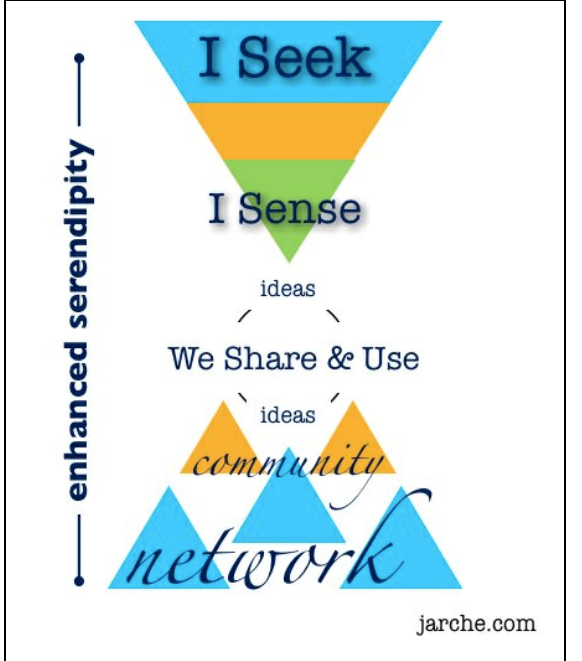
Enhancing serendipity

Collecting and curating knowledge is only part of the equation. In order for knowledge to become wisdom it must be used, compared against other sources of information related to the same topic, experienced. Developing a sense of knowledge flow within a classroom, school, or business can assist all co-workers to create a better understanding of the issue at hand.

This sense of creating a knowledge network (or ideas network, or a community of practice) will lead to enhanced serendipity and increase the value of personalised information seeking and understanding.

Goals or opportunities, what are your drivers?

This diagram is interesting because it  indicates that some modes of information sharing may be more valuable to organisations.

Collaboration is seen by Jarche to be goal oriented and structured, communities of practice combine collaboration and cooperation; social networks are more informal and are based on cooperation. Jarche contends that innovation thrives in environments where social connections are weak and diverse. Strong social ties, on the other hand, enable the sharing of complex knowledge.

Some critical questions to consider: Are innovation and goal orientation mutually exclusive?

1. Are innovation and goal orientation mutually exclusive?

2. Are innovation and goal orientation mutually exclusive?

3. Does being driven by opportunity preclude innovation?

K. C in a C. A

Knowledge Construction in a Connected Age:

 How is knowledge constructed?

Knowledge is not a lean-back process; it’s a lean-forward activity” (Popova, 2011)

Knowledge development, as well as knowledge management, is a social and connective activity that is no longer easy for organisations to control. In this digitally connected world, anyone can gather content, curate it according to their own needs and share it with others regardless of where people live or work. Company (or school) control over information is almost impossible to achieve, even if it is still seen to be desirable.

Collecting and Connecting

Source: McInerney & Koenig. p. 10

For most schools the situation varies from classroom to classroom, teacher to teacher and subject to subject. Traditional learning/teaching models fall very strongly into the top left-hand space, and the continuing dependence on textbooks, and focus on content, ensures that this will continue for many colleagues and their classrooms.

Giving students the power to find and evaluate information results in a much richer learning environment, in which the teacher becomes a co-learner, both modelling information that is considered reliable and ethical, questioning what makes such sources valuable; and additionally, it allows for the vibrancy of serendipitous encounters.

Reference:

McInerney, C. R., & Koenig, M. E. (2011). Knowledge management (KM) processes in organizations theoretical foundations and practice. San Rafael, Calif. (1537 Fourth Street, San Rafael, CA 94901 USA): Morgan & Claypool. Retrieved from: http://reader.eblib.com.ezproxy.csu.edu.au/(S(gviqgukar2zhosdvwh11anqt))/Reader.aspx?p=881112&o=476&u=75%2bPOA257%2f1ZaNWG7TLUwA%3d%3d&t=1395028466&h= ABCC76461B2C7E39317217DE63C2FE194451C0E9&s=21866167&ut=1443&pg=1&r=img&c=-1&pat=n#

Filter Bubbles

The digital artefact:

Beware online “filter bubbles” by Eli Pariser

Published on Mar 22, 2013

examines these issues closely.

Retrieved: http://youtu.be/4w48Ip-KPRs viewed 9 May 2015

Relevance?
Relevance?

0.28

Invisible algorithmic editing of the web.

Personalisation or control???

There is no standard Google anymore:

Collecting information

2.20

Controlled consumerism?

3.58

These concepts present us with a great learning idea – having students search the same keyword and comparing what they get back could be very powerful.

Where is your personalisation coming from?

4.35

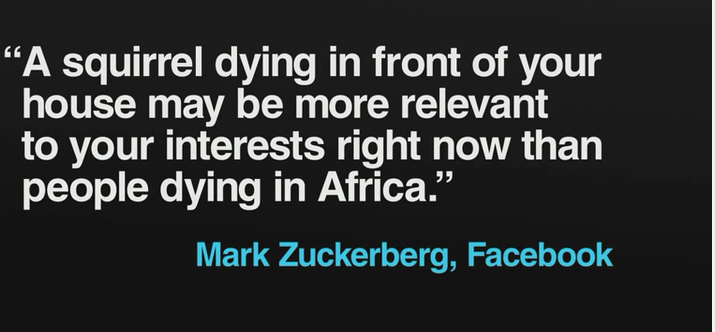
Problem with filter bubbles problem is we don’t get to choose what gets in and we don’t even know when things are being collected.

Should we be grateful or concerned?

6.20

How do we decide?
How do we decide?

6.54 We are now back in 1915 on the web because we are being exposed to a selection of information over which we have no real input.

Information curation and knowledge networks could either enable filter bubbles or break through them.

It is our role to educate our students so that they know how these websites work and what they collect and present to each one of us separately. The way in which our actions are summarised and utilised differs  depending on the website we are using. Comparing this to the way in which our library catalogues respond is a worthwhile educational exercise. The speed at which information is being added to the web in combination with these mining algorithms is a critical C21st skill, and one we should be including in our overall education programs.

To balance information or to personalise it?

The issue of who has control is the answer to this question.

Survey results

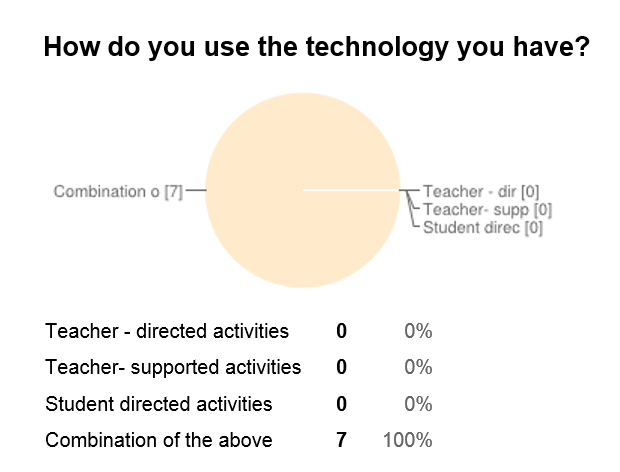
Current technology use in the classroom

This question did not give me any indication of what aspect of technology to target for my artefact.

2
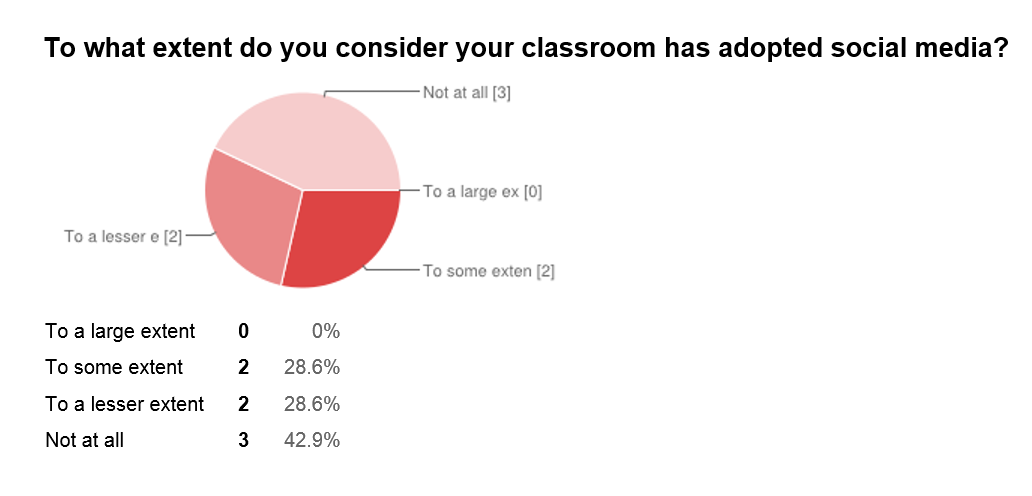
Adoption of Social Media

This supported my personal observations and discussions with teachers and students.

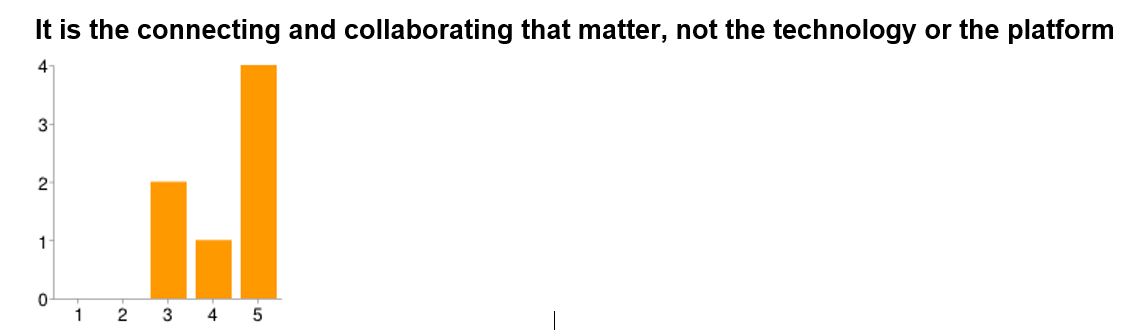
6
1 = not at all 5 = to a great extent

This indicated that there was some understanding of what could be achieved by developing some social media components for teaching.

7
1 = not at all 5 = to a great extent

Of all the possibilities blogging seemed to be the most likely target social media to succeed in classrooms.

1 = not at all 5 = to a great extent

Teachers at my school are generally very disinterested in Twitter. Only two others that I am aware of have accounts.

10
1 = not at all 5 = to a great extent

This gave me confidence to proceed with my proposal for the artefact.

1 = not at all 5 = to a great extent

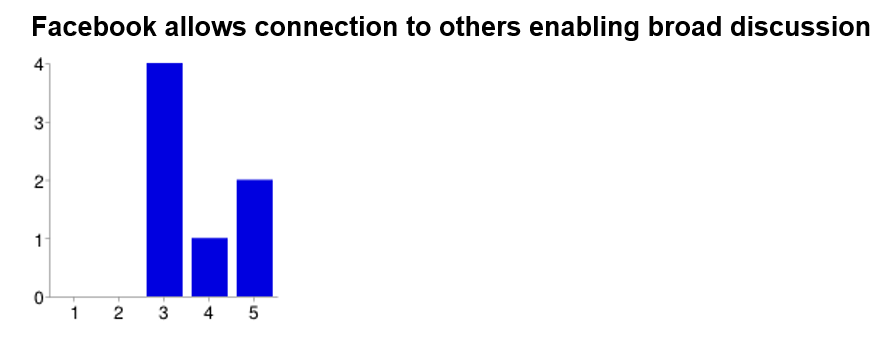
Like me, my colleagues use Facebook more for personal connection rather than professional.  Interestingly our school has a very active Facebook following which the marketing review realised was well worth tapping into. Some teachers use closed Facebook groups through this medium, but many students are not comfortable sharing this space with their teachers.

3 4 5 11 12

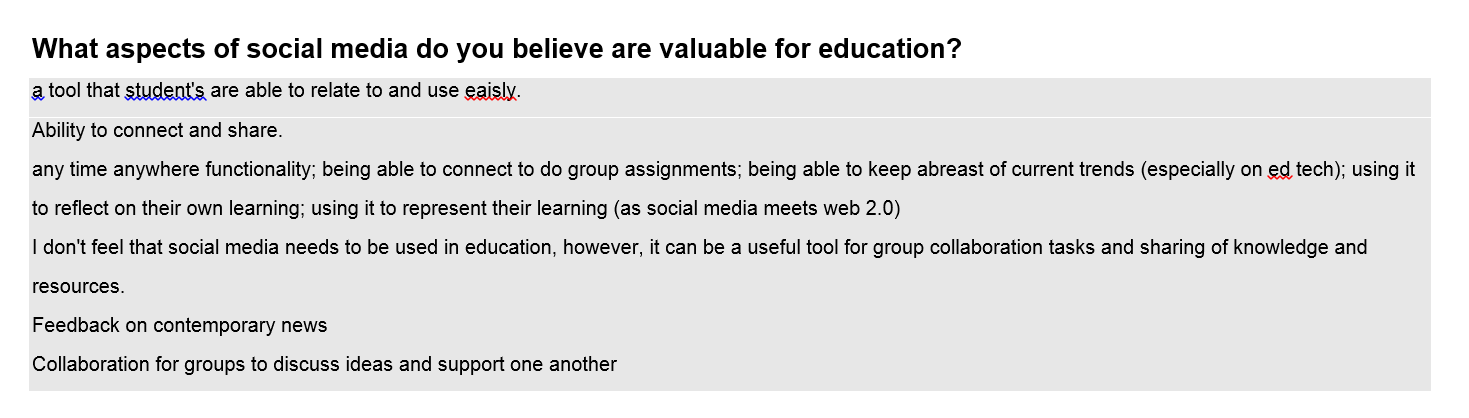
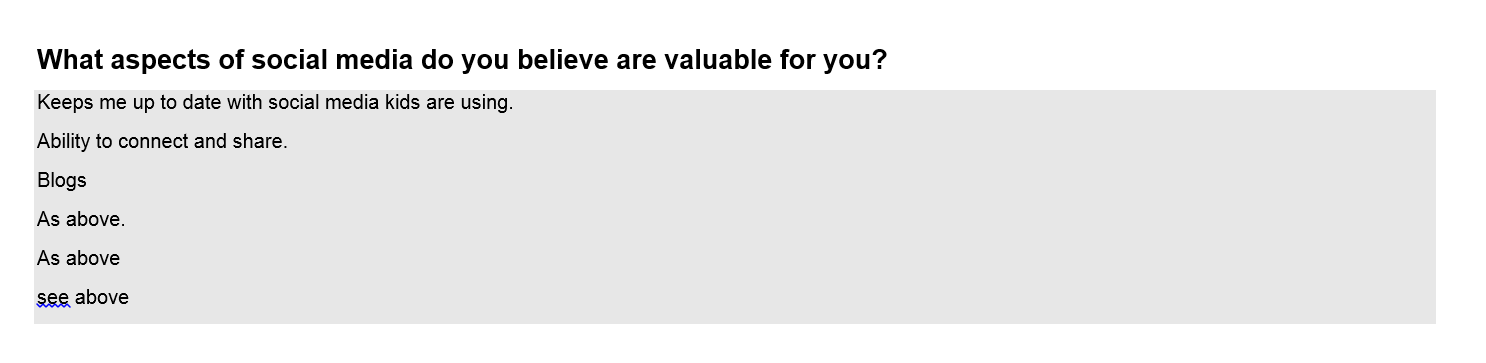
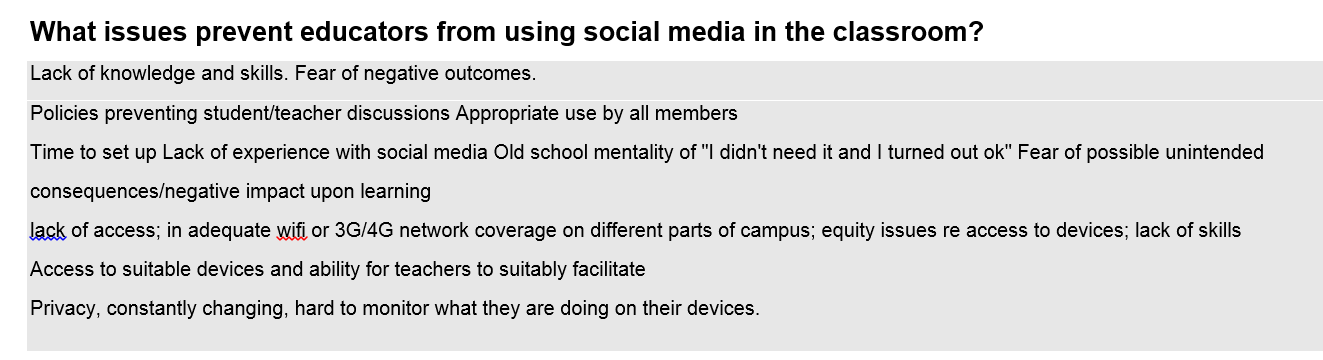
The answers overall confirmed that Social Media was an appropriate focus for the artefact, and blogging was the best platform to emphasise.

The next phase was to consider the best platform to use for artefact creation – a time consuming and frustrating process! Products evaluated are presented here.

Here is the artefact.