I am a Teacher of History working part time as I consider options for my future. For many years I have been a Teacher-Librarian at a small regional cooeducational college. While now working with three classes of History I continue to develop information literacy and digital skills as a Microsoft IEE and also a Fellow. It is critical ifor educators to keep tabs on new technology and its educational application. I am lucky to work in a school where technology is supported.
There are too many teachers who believe that their role is to direct learning from the front of the classroom and keep control over everything that occurs. (In my first Hamilton school (1980) there was a real “stage” at the front of each classroom, and you taught from behind a big desk which sat on the stage between you and the blackboard – one of those new roller based ones that gave you almost endless space to deliver your words of wisdom – and well separated from the students, who were way down on the lower deck). I hated it – and quickly created opportunities for students to be on the stage, at the board or for me to join them “down below”. Today, minus the board and the stage, this is what I still see in so many room as I move (occasionally) around the school.
Modern concepts of flipped classrooms focus on the sage role but place it outside the classroom, and leave class time for interaction around the information gained. This still leaves me uneasy.
The main reason I question the sage approach is that there are many things that my students know that I do not, and they are all individuals, not a homogenous body. If I assume the guru position, am I not locking them into the knowledge I have and not extending them beyond it?
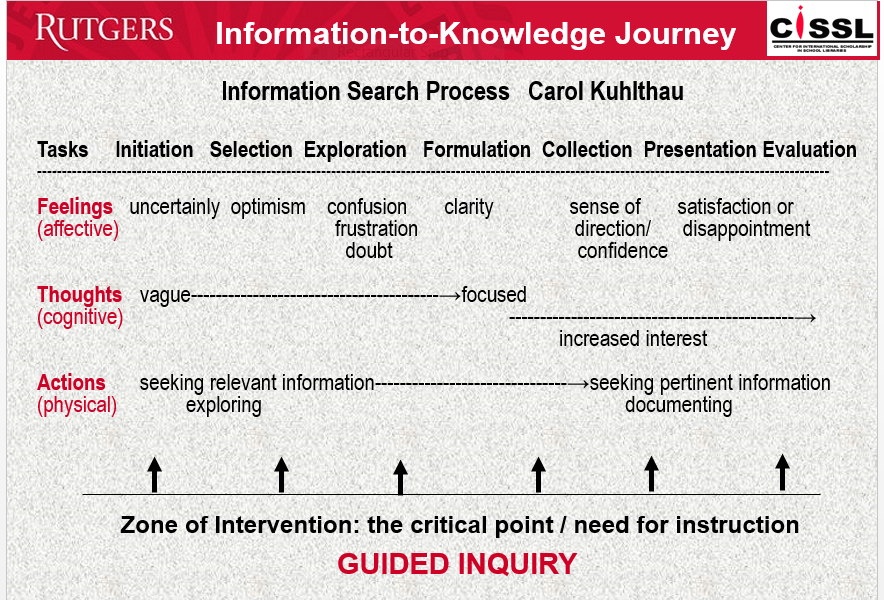
The main reason I do assume the sage role at times is because, with 6 years of tertiary education and many, many years of teaching experience there must be things that I know that they can’t know, or fully understand without some intervention on my part. In both my History teaching, and my Teacher-librarian role, I tend to work along the lines of Ross Todd and Carol Kuhlthau’s zone of intervention: Google this to download a Ppt on guided inquiry which covers this topic – tldl.pbworks.com/f/Ross+Todd+Guided+Inquiry+Web+2.0.ppt
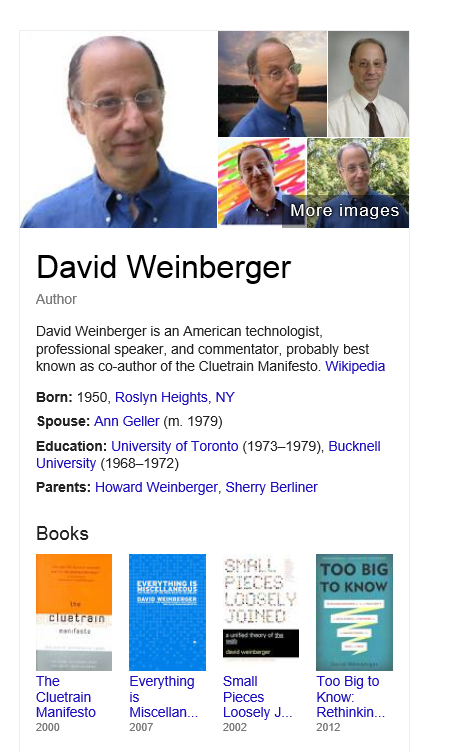
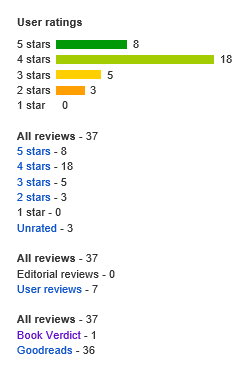
An interesting man but a not so interesting book. I ordered four books and decided that the one that arrived first would be the one I read for my scholarly book review. By the time it arrived we had to commit on the Google doc. If I had not duly committed, I doubt I would have finished the book.
Reviews found by Googling include:
and I found one review in Primo (CSU Library):
http://www.kirkusreviews.com/ “Weinberger, David: TOO BIG TO KNOW.” Kirkus Reviews 1 Jan. 2012. Expanded Academic ASAP. Web. 9 Apr. 2014
and it was brief!
One Review by Cory Doctorow:
“David Weinberger is one of the Internet’s clearest and cleverest thinkers, an understated and deceptively calm philosopher who builds his arguments like a bricklayer builds a wall, one fact at a time.
Weinberger wants to reframe questions like “Is the Internet making us dumber?” or “Is the net making us smarter?” as less like “Is water heavier than air?” and more like “Will my favored political party win the election?” That is, the kind of question whose answer depends on what you, personally, do to make the answer come true.
Ultimately, Weinberger treats the net as a fact, not a problem. It exists. It has remade our knowledge processes. It has bound together communication, information and sociability so that you can’t learn things without communicating, and so that every communication brings the chance of a human encounter. In a closing chapter of recommendations, he talks about how we treat the fact of the net as a given, and work from there to try and use it to make us smarter. The concluding chapter is a set of eminently reasonable recommendations on policy, technology, administrations and mindset, expressed with admirable brevity”.
I held such high hopes for this title but sadly they were not realised. If I was to have my time to invest in a book over again I would choose another.
Sigh!
And yes, this post is not official or scholarly. Sorry!
In this information age in which we live, which is exciting, fast-paced and scary all at the same time a range of definitions need to be examined, elaborated on and finally agreed to by enough educators to be meaningful in terms of our profession and to impact on student learning outcomes.
Much of the terminology being developed comes from quite different areas, for example, ecology is usually a term used by Biologists. When it is applied to Information and Communication Technology those of us working in this sphere need to pause and consider what the implications are for us.
Educators and information professionals view the world through numerous lenses, unlike some professions where the focus can be more one dimensional. This image, of the historical Kingscote Lighthouse light, represents the varied ways educators have to adapt concepts and theories to their role in guiding student learning.
Photo M Simkin
Digital Media and Learning is a phrase used by Gee (DMAL) (Gee, 2010). Gee argues that the “learning” aspect will not evolve until real coherence of terminology and practice develops through collaboration and the ‘accumulation of shared knowledge’. (Gee, 2010, p. 6) He acknowledges the importance of this as:
‘a truly important and yet tractable theme around which the area can organize. Does digital media and learning have such a theme? One candidate would be this: the ways in which digital tools have transformed the human mind and human society and will do so further in the future. This certainly seems a big and important theme. The question, then, becomes whether there are shared tools and perspectives we all can develop to study it and whether it is tractable, that is, whether deep study will lead to real results’. (Gee, 2010, p. 6)
While we are referring to terminology, here’s another example: Gee quotes ‘Ong’s classic 1982 book … started the discussion of the effects of digital media on traditional literacy and said it constituted a form of “secondary orality’ (Gee, 2010, p. 7). Orality resonates with the concept that digital story telling is so valuable for assisting students to make sense of their world. It ties in with the work of Stephen Heppell and his students, which can be seen here: http://www.heppell.net/bva/ (Heppell, n.d.)
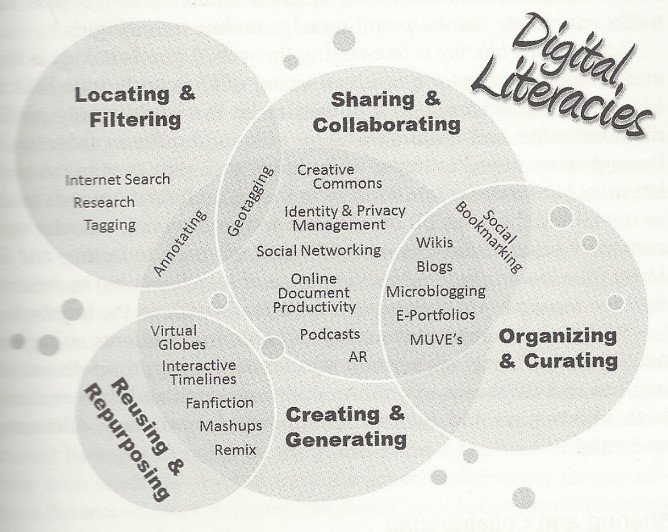
Beyond defining the terminology, there is benefit to educators perusing models and translating words to action in the classroom.
Digital Literacy Model
(Hague & Paton, 2010)
This diagram reminds teachers of why it is important for them to be present and active in their lessons (whether as sage on the stage, guide by the side, or as co-learner). Students cannot be expected to just know the implications of the qualifying words such as critical, effective, functional and utilised here. In order for projects such as Stephen Heppell’s to be quality educational end products, deep understanding of these 8 areas is necessary. Students may achieve that through effective collaboration and networking with each other, but having the teacher as co-learner is the most effective way of achieving this.
Summey (2013, p 15 cited in (M, 2014) provides a diagrammatic representation of these:
Helen Haste’s concept of people as problem solvers rather than tool users resonates with me. I have long held the belief that technology is only a tool and it is what we do with it that really matters. I struggle with the value of setting students a task and then mandating the output that proves the task e.g. create a PowerPoint. I try to encourage teachers to offer the task and a rubric and let the students design their own responses in any format that is accessible by the teacher.
In Curriculum meetings there is much frustrating discussion about mandating the way we write courses and the content that we have to teach, but it is impossible to move the discussion to C21st skill sets.
It seems obvious that, as Helen Haste says, students need a new brand of competencies to thrive within a changing environment. I really like Helen’s summative drawing of the potential power of collaboration :
Collaboration of problem solvers
Her diagram showing problem solver organisation has no arrows because the individual is constantly changing directions according to the process of their problem solving interactions – individual to society and back again.
This is a continual pyramid not a directional one.
dialogic This means that everything anybody ever says always exists in response to things that have been said before and in anticipation of things that will be said in response. In other words, we do not speak in a vacuum.
dialectic The dialectical method is discourse between two or more people holding different points of view about a subject, who wish to establish the truth of the matter guided by reasoned arguments.
Competence isn’t just about skill but about adaptation.
5 competences
managing ambiguity
Agency and responsibility
Finding and sustaining community
Managing emotion
Managing technological change
It is important for us to teach ambiguity so that students do not feel anxious by not knowing what the right answer is. They need to understand multiple perspectives.
Young people are encountering strangers and even non people in their online connections and we need to assist them with this process.
These competencies are what young people need for the future; they must be mandated within education.
Social change is not linear and everyone needs to work with that fact.
So…..
How do we bring our colleagues on board with these types of beliefs so that we are not creating classrooms as Nathaniel Bott describes: in the early part of this clip: “ boredom and disengagement is too big a part of the modern classroom” http://youtu.be/UI9TiuVHc0A ?
Interesting to see, courtesy of Twitter, how many people viewed my posts this week. According to Twitter
the number of views on the posts tagged #INF530 was 60, 66 and 78.
This is what I posted and was hoping for some feedback on:
1. So are we seeing the death of edited and curated content in this era of Internet? This is one of Weinberger’s contentions.
2. Read David Weinberger “too big to know”? Interested in opinions/comments about the power of crowdsourcing & knowledge thru Internet #INF530
I would have liked some responses, but I plan to copy David Weinberger into the next one! Connectivity is one thing, but to have two way communication is the ultimate as it helps you expand your thinking and take in other perspectives on the same topic. Intellectual debate makes learning so much more valuable. Anybody want to trial a collaborative tool to collate some thoughts based around texts we are reading for our scholarly book review? (I don’t have a specific tool in mind but happy to suggest something).
It is interesting pondering the future work skills 2020 image in our module 1.3 (http://www.iftf.org/futureworkskills/) and comparing it to the book Too Big to Know by David Weinberger where the contention seems to be that the digital world is without structure and something of which it is almost impossible to make sense. (I haven’t finished the book yet, but this is my summation at this point).
To what extent is there no structure, or is it that the organisation is too big to recognise? Is all knowledge considered equal, or do most people acknowledge that some people are in a more informed position to pass comment than others?
Does computer processing power and speed equal improved understanding and lead to increased knowledge?
Does the number of Google searches bear some relevance to an increase in the total data base of human knowledge? Does the Knowledge Graph http://www.google.com.au/insidesearch/features/search/knowledge.html actually improve knowledge access or growth or is it just an attractive interface? Do the many random, poorly thought out and casual searches each day impact on the serious academic type content sought by the minority?
While sites like http://21cif.com/rkit/actionzone/index.html educate students to search more effectively it is crucial to question how many students are exposed to such sites, and what proportion of teachers actually teach such skills. This is more important than the digital native vs immigrant debate. If those with experience and understanding of quality of result are not part of the conversation then all student learning is compromised.
Teachers need to inhabit the same spaces and model their use. They need to incorporate these things into their subject area all the time, not just as one off, special activities. This is the digital divide that really concerns me.
This is my 7th year teaching VCE History Revolutions. This year’s class is small but focused and the students participate in the learning process, with each other, and with me. The year most of my current students were in Year 9, I took two classes of Year 9 History (Australian Curriculum). This was also the first year that our school had 1:1 devices and year 9 was the first year level targeted for their adoption. I documented this whole learning journey at a blog that was shared with these students at the time: http://9hist2012.wordpress.com/ . Luckily for me this was also the first year we could allow mobile phones to be used in class – but only when we had an explicit task in mind. I had students collaborating with absent peers on their phones through Facebook chat, active participation in finding relevant information on an at-need basis and experimenting digitally. My class, in many ways, is my testing ground.
Teacher-Librarian related – 60%
A great role that fills most of my working week and waking hours, and gives me licence to dabble in all curriculum areas in our school (and beyond) – and which is only limited by the time I have available. I can develop skills and use them to assist all members of our college community, create web sites, curate web links, teach, purchase resources etc. I can also share professionally with my teacher-librarian colleagues.
I am looking to learn more about why I do what I do and how this impacts on pedagogy. Some interesting reading I have come across already since we commenced our learning journey in INF530 is:
Figure 1: knowledge tools -an important consideration for learning. (Pang, A 2008)
Like so many things we come across as educators, the consideration really needs to be the learning outcomes that such discoveries empower in our students. Figure 1 links to an article (Pang, 2008) which makes for interesting reading in terms of our course material. (It is downloadable as a PDF also).
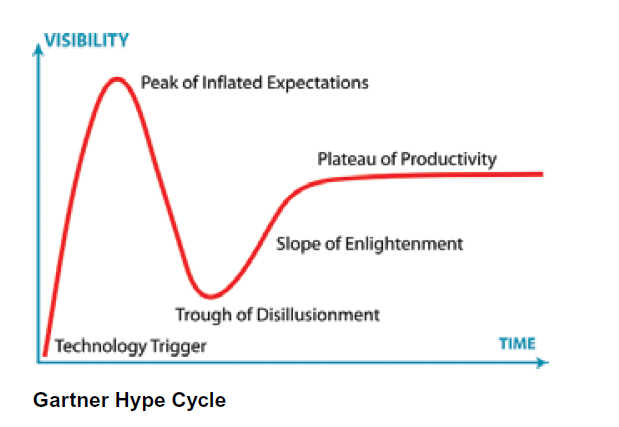
Information that we come across needs to be considered in the light of the Gartner Hype Cycle:
Figure 2: A visual reminder of how many educators view technological innovation. (Sharples et al., 2013 p. 6)
Figure 2 refers to educators’ reactions to educational innovations such as educational television, integrated learning systems and virtual worlds (Sharples et al., 2013 p. 6) . MOOCs are currently considered to be at the peak of inflated expectations. (Sharples et al., 2013 p. 6)






 Margaret Simkin