2013 Submission to the strategic planning architect for the next series of capital planning.

With great excitement I responded to the Principal’s request to make contact with the architect and indicate the Information Services needs for the future.

This is what I wrote (minus a few specific details):

October 2013

It is very difficult to predict the exact nature of school libraries in the future.  Even in as short a time frame as five to ten years, it is hard to know what types of resources will be required. While books may not be part of the landscape, other educational resources will replace them. Certain functions will, therefore, be ongoing, and that is the premise on which I have based this outline.

Geographically, the ideal location for an Information Services centre is central for ease of access for all the learning community. The location of the current libraries on both campuses is therefore less than ideal.  At the Senior Campus, it will be even worse from the middle of 2014, when the MYPEC opens.

Philosophically a school library underpins the curriculum of all year levels, and should cater to their diverse needs in the broadest sense. Diverse uses are currently made of both libraries, and this will (and should) be an underlying premise for future planning.

Functional requirements:

A school library in an academically focussed college such as ours needs to cater for all students and teachers serviced by the campus. There are multiple demands, some of which are conflicting. As an example of such divergence, places where students can work quietly for sustained reading or studying, and places where lively educational debate can occur.

To this end a renewed Alexandra Library building would need to:

  • Cater for students from Year 6 to Year 12.
  • Cater for individuals, as well as potentially simultaneous classes of up to 25 students in size.
  • Allow line of sight supervision from offices, preferably throughout the entire building
  • Provide flexible spaces for most of the building
  • Be fully cabled to allow the best power and technology solutions for the time
  • Support learning in all its manifestations as well as streamline work flow for those functioning within the spaces.

See: La Marca, S: Rethink!: Ideas for Inspiring School Library Design, School Library Association for Victoria, Melbourne, 2007

http://books.google.com.au/books/about/Rethink.html?id=qVscGgAACAAJ&redir_esc=y

and the Raeco Lookbook which can be downloaded free here: http://www.raeco.com.au/custompage.aspx?custompage=Lookbook

Space requirements:

Large spaces:

  • With seating and tables to suit whole classes of up to 25 students (formal) engaged in class type activities and need the same provision as classrooms, but with added access to shared resources that single classrooms cannot accommodate
  • With comfortable furniture adaptable to whole class silent sustained reading, and individual leisure reading at recess and lunchtime
  • Equipped as a “maker space” fitted out with tables large enough to construct robotics and the like and fitted out with storage to contain the products and parts required.

See:

http://coolcatteacher.blogspot.com.au/2013/08/sylvia-martinez-and-maker-movement.html

Medium spaces:

  • For medium sized classes of either type described above.
  • For engaging in round table debating
  • For teleconferencing; professional learning activities and tutorials
  • Careers advice and research – requiring a combination of formal and informal space with storage, display space, connectivity and adjoining staff office (separate external door an advantage)
  • Office space for Library services (requiring neat and tidy storage, enabling workflow, with reachable sections for different types of resources). This needs to allow for collaborative meetings between teacher-librarian and teachers, either within the office or in a separate meeting room.
  • An AV/ recording space sound proof for  podcasting, vodcasting, and film production
  • A news room (soundproof) to run ABC News24 and allow reading of current affairs magazines and digital news. Many schools have this set up as a space where coffee can be enjoyed as part of the process.

See: Learning for the future: developing information services in schools (Second edition) Australian School Library Association and Australian Library and Information Association, 2001 This publication provides a detailed outline of space requirements for traditional library type activities on page 45:

        Enrolment    301-400 (Senior Campus) 378 square metres minimum

This is further broken down into size allocations for various uses.  I can provide further details if that would be helpful.

Smaller spaces:

  • Other staff offices disbursed throughout the entire space for ease of supervision. Depending on the envisaged use of the space this would include the IT Specialist Teacher office and could include the Head of Senior Years/Head of Year 12
  • Several Cubicles fitted out for  online testing but big enough to be used as study carrels if required for example by students undertaking  Distance Ed &  Languages Other Than English

Other Important considerations:

  1. Computers:  There will continue to be a need for high end computers for teachers and students to use for tasks that require either larger screens or significant RAM.  There would need to be enough overall to meet the needs of more than one class of students at a time and also to cater for drop in printing, or polishing of work, or students who have issues with their individual device.
  2. Shelving and furniture in the main body of the building should allow for easy mobility to cater for different or changing needs.

Award winning school libraries include:

Bialik College http://www.bialik.vic.edu.au/facilities/libraries/

429 Auburn Road
East Hawthorn, Victoria, 3123

Aquinas College http://www.aquinas.vic.edu.au/web/index.cfm?pid=About.Facilities#arc

46 Great Ryrie St
Ringwood, Victoria, 3134

These are both very different in appearance but provide an interesting perspective on possibilities.

A renewed Handbury Library building would need to:

  • Cater for students from ELC to Year 5.
  • Cater for individuals, as well as potentially classes of up to 25 students in size. A re-envisioned programme may allow for simultaneous classes with two class teachers and one teacher-librarian functioning in the same space.
  • Allow line of sight supervision from a lockable office
  • Provide flexible spaces for most of the building
  • Be fully cabled to allow the best power and technology solutions for the time
  • Support learning in all its manifestations as well as streamline work flow for those functioning within the spaces.

Space requirements:

Large spaces:

  • With seating and tables to suit whole classes of up to 25 students (formal) engaged in class type activities and need the same provision as classrooms, but with added access to shared resources that single classrooms cannot accommodate
  • With comfortable furniture adaptable to whole class silent sustained reading, and individual leisure reading at recess and lunchtime
  • Equipped as a “maker space” fitted out with tables large enough to construct robotics and the like and fitted out with storage to contain the products and parts required.  This cloud be done in the main body of the library if lockable storage solutions were provided
  • A number of high end desk top computers (assuming all students have an individual device of some sort in their hands) for reasons outlined above. There would be less demand for these at the Junior Campus.

Medium space:

  • Office space for Library services (requiring neat and tidy storage, enabling workflow, with reachable sections for different types of resources). This needs to allow for collaborative meetings between teacher-librarian and teachers, either within the office or in a separate meeting room.
  • An AV/ recording space sound proof for  podcasting, vodcasting, and film production

See: Learning for the future: developing information services in schools (Second edition) Australian School Library Association and Australian Library and Information Association, 2001 This publication provides a detailed outline of space requirements for traditional library type activities on page 45:

        Enrolment 101-200 (Junior Campus) 156 square metres minimum

This is further broken down into size allocations for various uses.

I can provide further details and information if that would be helpful.

Module 1.1

Ideas fizzing around like bubbles in a fast running stream

The first part of Module 1 is appropriately titled “The Challenges”. I knew this subject would be engaging, inspiring and potentially make my brain spin – but I may have underestimated the effects.

The readings and subject notes raise a number of issues, and require a substantial amount of brain processing time, hence the time taken between setting up the blog for INF536 and now.

Considering the concepts of posture, surface, ambience and density (Witthoft & Doorley, 2011), in conjunction with the physical and budgetary constraints in which we operate, has been both uplifting and frustrating. The excitement of thinking about vertical surfaces in addition to horizontal, and a broad range of seating, standing room, group and individual space has led to much re-evaluation of what is possible.

The jump from reading about the variety of challenges, while still working on understanding the definitions, to a practical application, was not as difficult as I first thought it would be. It also gave me an opportunity to present an issue to the Library team (and an English teacher who fortuitously walked in during the action) and involve them in some of the processes which have formed part of our reading investigations.

In this case the first stage, the needfinding stage, (Seidel & Fixson, 2013) found us, rather than us designing or brainstorming to define a need. The brainstorming occurred in parallel with the prototyping, and the time allowed was defined in that we had a spare half hour between meetings and required a solution for the next day.

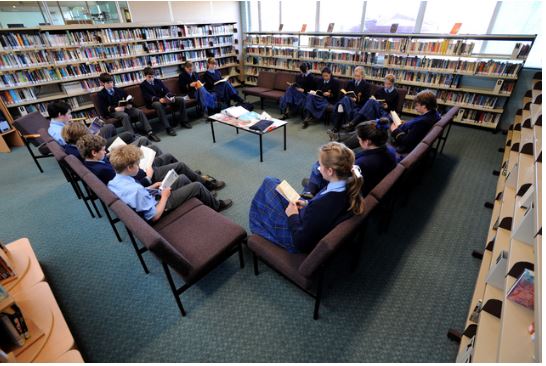
The space before our solution was implemented looked like this and offered 21 seats including the one usually occupied by the teacher: (it’s the one with the arms on the far left).

This is how the reading area has traditionally appeared.

This is how the reading area has traditionally appeared.

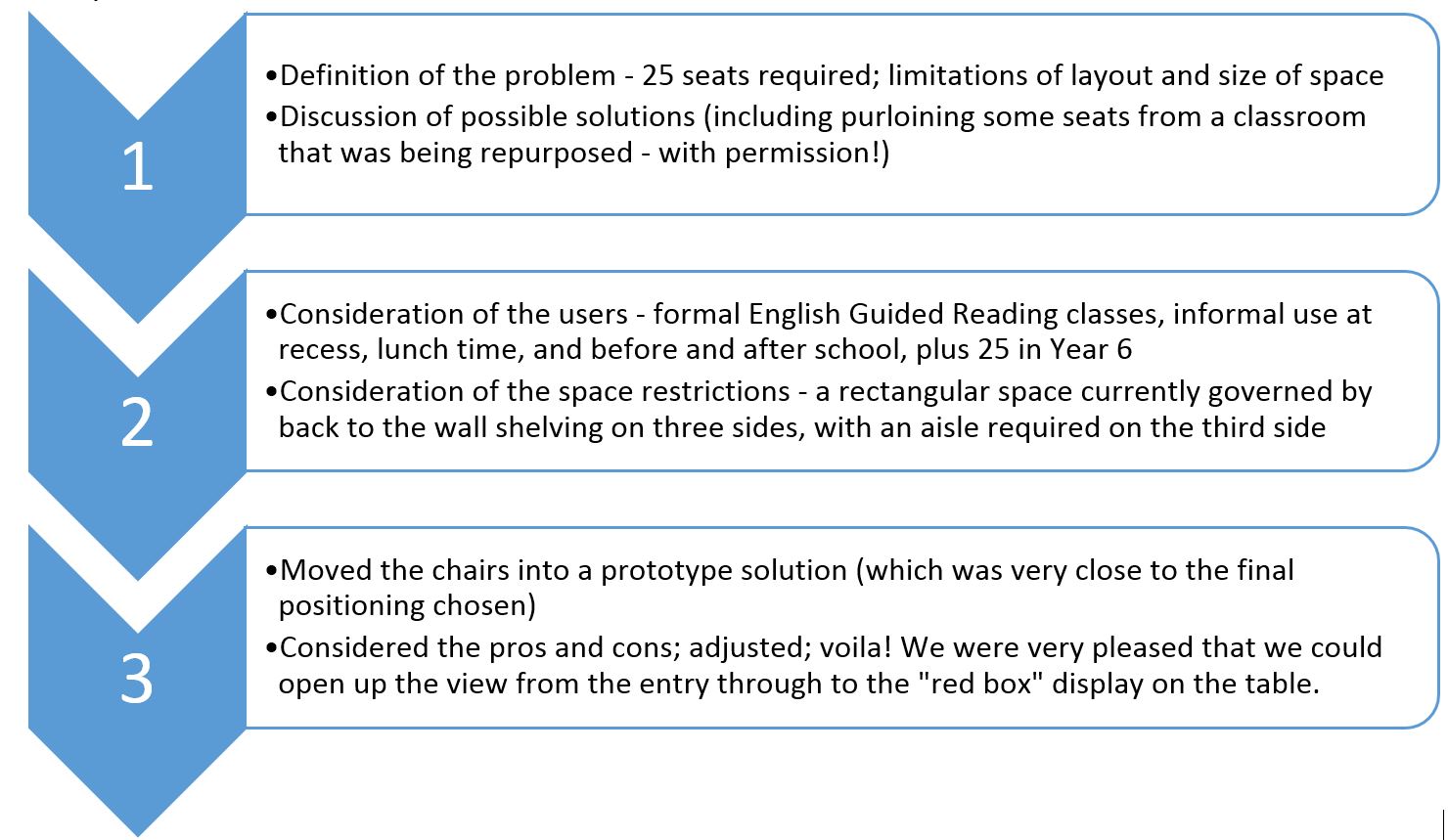
The process we followed was:

A diagram showing the design thinking process.


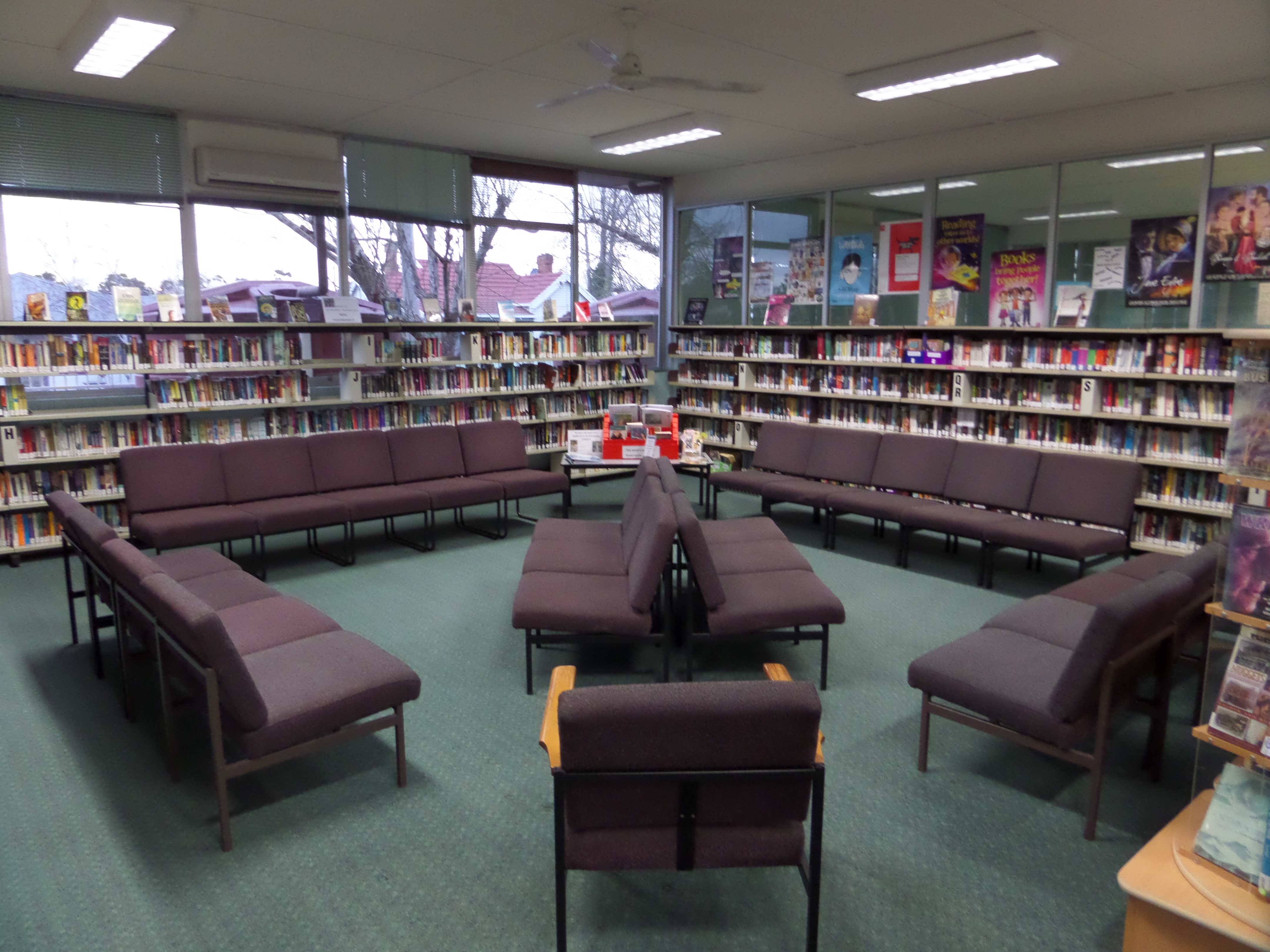
The end result was this:SAMSUNG CAMERA PICTURES

 
Cosier and also able to be shared by more groups at recess or lunch

Cosier and also able to be shared by more groups at recess or lunch

The result has been well received by almost everyone, with the most enthusiastic being the students (even the older students who can be conservative about changes to their space!). As each class has come in for a lesson, the seats in the middle of the space have been first occupied. There has only been one negative comment, from a Mathematics teacher who was taking a reading class for an absent teacher. He thought the students had been messing things up! He condoned the change once I explained that we had done it and why.

The dangerous thing is that we are now looking to move some other items around – and for those we will need the workmen!

References

Seidel, V., &   Fixson, S. (2013). Adopting Design Thinking In Novice Multidisciplinary Teams: The Application and Limits of Design Methods and Reflexive Practices. Journal   Of Product Innovation Management, 30, 19-33.

Witthoft, S.,   & Doorley, S. (2011, November 7). Cultivating innovative behavior using   design. TEDxManhattanBeach. Retrieved July 13, 2014, from https://www.youtube.com/watch?v=aqjXs0fNxYQ

Acknowledgements:

Photographs are my own with the exception of the “before photo” which has been copied from The College website: www.hamiltoncollege.vic.edu.au and was taken by our official photographer, Liz Crothers.


Starting Design Thinking

Having started reading and exploring has been quite exciting in terms of concepts. For this post however I would like to share two new tools which others may find helpful.

The first is Videoant  http://ant.umn.edu/ a website that allows you to annotate YouTube clips as you watch them. You can use it without joining, or join using your Google or Facebook accounts for example. I tested it today on this clip which links to module 1.1:


You can see how it looks here:

https://ant2.cehd.umn.edu/kiiydvbeoa

or you can add your own annotations to mine here: https://ant2.cehd.umn.edu/pzdghhudls

The second discovery is Pocket:

http://getpocket.com/a/ This is a web and mobile (multi-platform) based product that allows you to collect links to interesting things you find, tag them and read them at your leisure. It is fantastic for me because I spend time every weekend in an Internet “black hole” so I can collect when I’ve got connection and read when I have time but no connection. A great improvement to my work flow.

I started using it two days ago. It is intuitive and has exceeded my expectations!


References

Witthoft, S.,   & Doorley, S. (2011, November 7). Cultivating innovative behavior using   design. TEDxManhattanBeach. Retrieved July 13, 2014, from   https://www.youtube.com/watch?v=aqjXs0fNxYQ


Critical reflection

INF530 has presented wide ranging, far-seeing, ideologically challenging and educationally inspiring material. The content modules have provided extensive opportunities for professional growth.

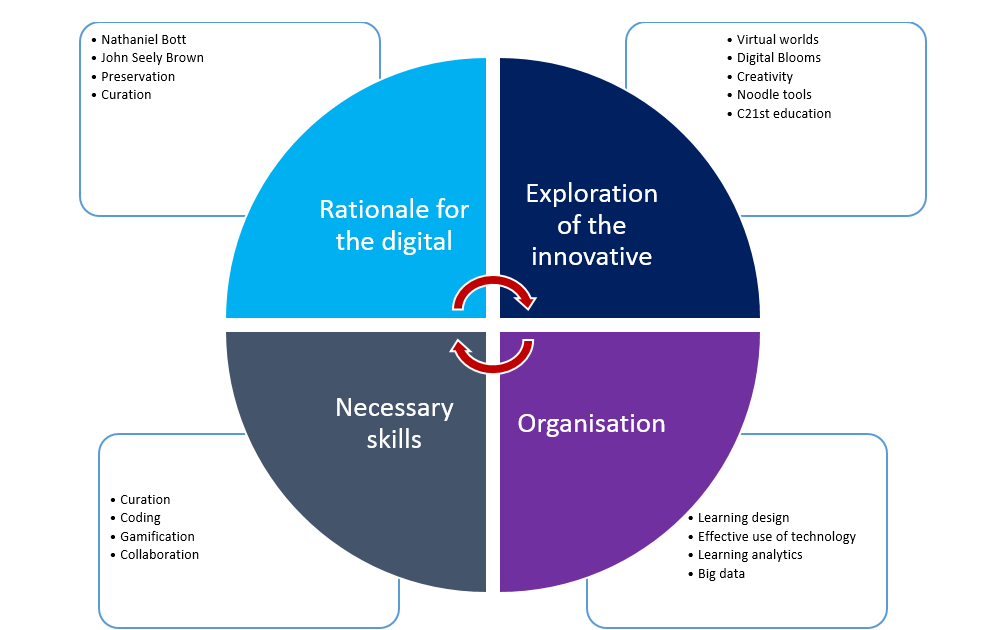
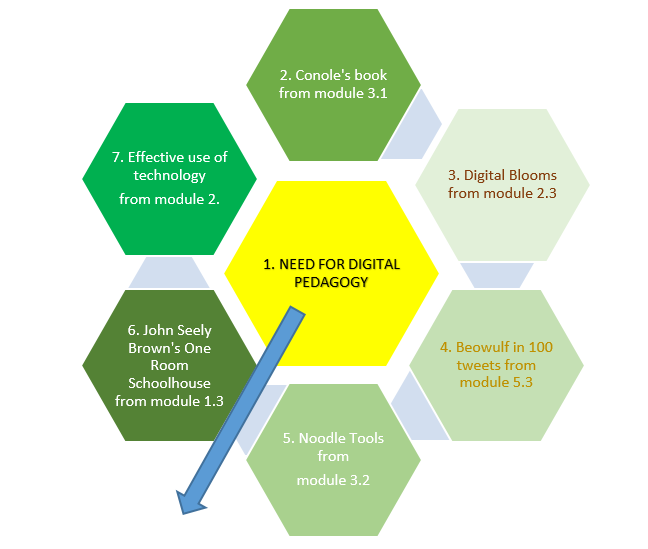
A summary diagram of this course might look like this:

Summary pf my learning


Each segment draws  together my learning from the subject modules.. The interweaving and interaction of the various topics  has combined into a powerful ideology of knowledge networks and digital innovation applicable to my practice. The pedagogy within each module has been delivered in a multimodal manner, where the modality has resulted in an ensemble of connected parts, in comparison to the linear mode of traditional academic discourse  (Kress, 2010, p. 93).

References and key learnings for this diagram:

Rationale for the digital:

  •   Nathaniel Bott   School is boring  (21st century learning: Nathaniel Bott at TEDxLaunceston, 2013)

https://www.youtube.com/watch?v=UI9TiuVHc0A&feature=youtu.be

  •   John Seely Brown: Teachers need to create epiphanies for kids (Brown,    2012)

http://youtu.be/fiGabUBQEnM

  •   Preservation is vital (even for Tweets!) (Allen,    2013)

http://blogs.loc.gov/loc/2013/01/update-on-the-twitter-archive-at-the-library-of-congress/

  •   Curation needs teaching (Conole, 2012, p. 48)
Exploration of the innovative:

  •   Virtual worlds:   Student  metaverse experiences versus ours (O’Connell    & Groom, 2010, p. 40)
  •   Digital Blooms:  ties it all together (Iowa State University Center for Teaching and Learning Excellence, 2011)

http://www.celt.iastate.edu/teaching/RevisedBlooms1.html

  •   Creativity (Bellanca & Brandt, 2010): referred to by most contributors.
  •   Noodle tools (Abilock,    2014)
  •   C21st education (Crockett,  Jukes, & Churches, 2011)
Necessary Skills:

  •   Curation (Conole, 2012, p. 48)
  •   Coding: “The next Darwin is more likely to be a data wonk” (Weinberger, 2011, p. 195)
  •   Gamification: the ultimate conversion of C21st skills  (O’Connell    & Groom, 2010, p. 48)
  •   Collaboration  ubiquitous recommendation (Bellanca    & Brandt, 2010) (Crockett,    Jukes, & Churches, 2011)
Organisation:

  •   Learning design: Compendium LD etc. from Chapter 9 (Conole, 2012)
  •   Effective use of technology: focuses on the desired outcome

http://blog.williamferriter.com/2013/07/11/technology-is-a-tool-not-a-learning-outcome/  (Ferriter, 2013)

  •   Learning analytics and big data: powerful combination for refining learning experiences and outcomes


The Internet  provides a pivotal platform for innovative teaching, yet too many teachers are not investing in a meaningful manner. Effectively utilising this limitless and powerful resource would solve Nathaniel Bott’s boredom at school (21st century learning: Nathaniel Bott at TEDxLaunceston, 2013) https://www.youtube.com/watch?v=UI9TiuVHc0A&feature=youtu.be and enable the development of C21st skills: collaboration, creativity, digital literacy, solution fluency and information fluency (Crockett, Jukes, & Churches, 2011, p. 16). However, the new should not be confused with the effective: http://thinkspace.csu.edu.au/msimkin/2014/05/17/confusing-the-new-with-the-effective-brabazon-dear-greene-purdy-2009-p-170-blog-post-4/

This reluctance to implement technological solutions in the classroom is leading to a professional “digital divide” which is of enormous concern as discussed at: http://thinkspace.csu.edu.au/msimkin/2014/03/22/a-very-big-hurdle/ . Further investigations within the learning modules indicated the range of tools available to teachers to design, plan and deliver meaningful C21st lessons (Abilock, 2014). Ultimately, education needs to develop a philosophy of practice based on the new paradigm: a digital pedagogy.

Choosing a digital essay topic


Choosing a digital essay topic


Digital essay: http://pedagogyfornow.weebly.com/

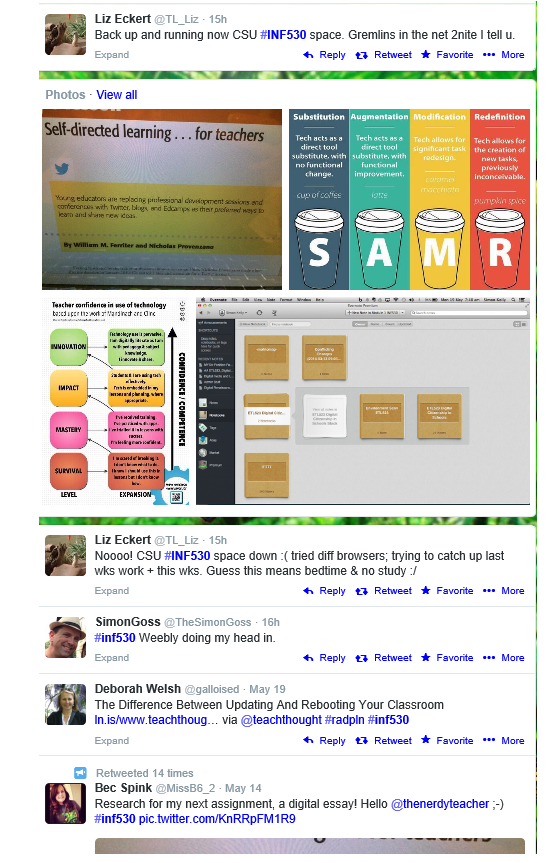
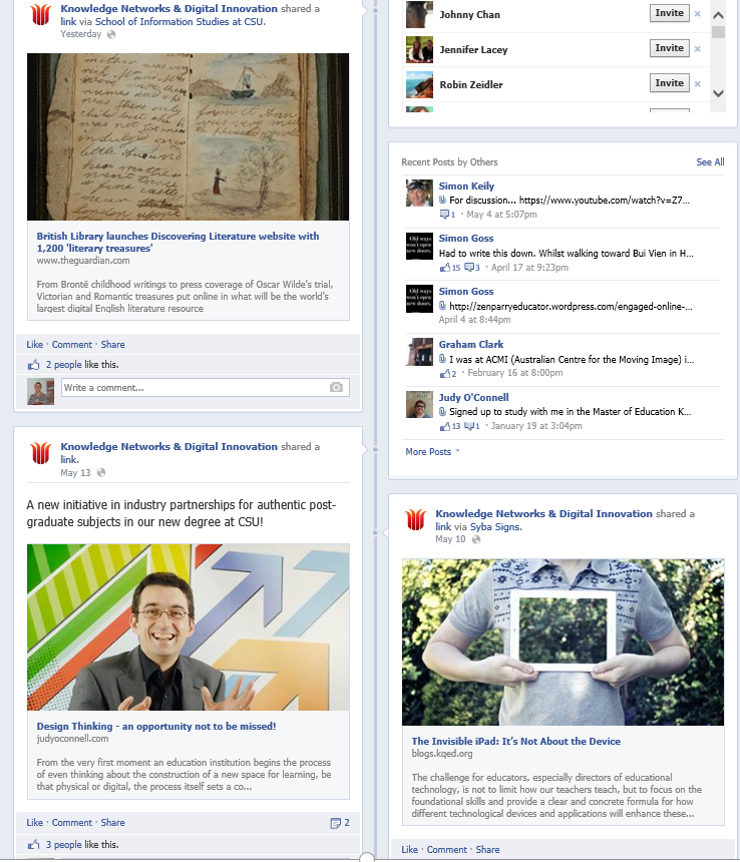
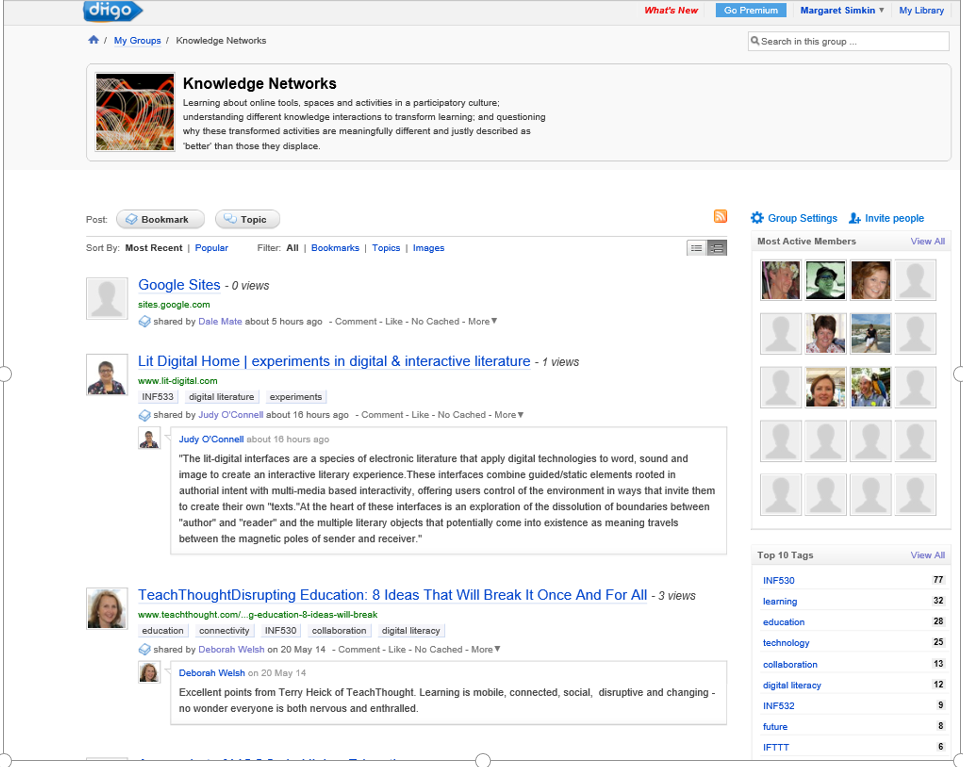
The practical application our learning has resulted from participatory practice: blogging, forums and collaborative curation. The subject has enabled transfer of developing skills to the range of work places represented by the student body. The power of the INF530 professional learning networks can be demonstrated by these screen shots of our networked practice:

Twitter connections
Twitter connections


Facebook interaction
The most powerful of all - the blog roll
Resource sharing Resource sharing with Diigo
The most powerful of all - the blog roll
The most powerful of all – the blog roll

Taking such infinite issues and converting them into one digital essay has been a challenge, and the end product is controlled by the restraints of the chosen medium (Weebly) and the word limit. The same frustrations arise with preparing this critical reflection.

These are the realities we, in turn, impose on our students. The opportunities for immersion in one sphere of inquiry, the need to brush off the skills of referencing and citing, and the need for sustained reading of a range of information has all promoted personal growth, as can be seen in the peer to peer “discussions” and the development of my skill set as evidenced within my thinkspace blog. The challenge now is to apply my newfound knowledge to improve education beyond my  own teaching, because I have been given some wonderful keys to unlock the potential of C21st students.


References

21st century   learning: Nathaniel Bott at TEDxLaunceston. (2013, December 5).   Retrieved March 10, 2014, from You Tube:   https://www.youtube.com/watch?v=UI9TiuVHc0A&feature=youtu.be

Abilock, D.   (2014, January 29). Information Literacy. Retrieved March 23, 2014,   from Noodle Tools: http://www.noodletools.com/debbie/literacies/information/1over/infolit1.html

Allen, E. (2013,   January 4). Update on the Twitter Archive. Retrieved March 16, 2014,   from Library of Congress Blog: http://blogs.loc.gov/loc/2013/01/update-on-the-twitter-archive-at-the-library-of-congress/

Anderson, M.   (2013, September 8). ICT Evangelist. Retrieved April 24, 2014, from   Teacher Confidence In Using Technology:   http://ictevangelist.com/teacher-confidence-using-technology/

Bellanca, J.,   & Brandt, R. (Eds.). (2010). 21st Century Skills: rethinking How   Students Learn. Bloomington, United States.

Brown, J. (2012,   September 18). The Global One Room Schoolhouse: John Seely Brown (Highlights   from JSB’s keynote at DML 2012). Retrieved March 16, 2014, from https://www.youtube.com/watch?v=fiGabUBQEnM&feature=youtu.be

Conole, G.   (2012). Designing for Learning in an Open World. New York, United   States of America: Springer.

Crockett, L.,   Jukes, I., & Churches, A. (2011). Literacy is Not Enough, 21st-Century   Fluencies for the Digital Age. Corwin.

Ferriter, W.   (2013, July 11). Technology is a Tool, NOT a Learning Outcome.   Retrieved May 26, 2014, from The Tempered Radical:   http://blog.williamferriter.com/2013/07/11/technology-is-a-tool-not-a-learning-outcome/

Iowa State   University Center for Teaching and Learning Excellence. (2011). A Model of   Learning Objectives. Retrieved March 17, 2014, from Iowa State University   Center for Teaching and Learning Excellence: http://www.celt.iastate.edu/teaching/RevisedBlooms1.html

Kress, G. (2010).   Multimodality, A Social Semiotic Approach To Contemporary Communication.   Abingdon, Oxon, United Kingdom: Routledge.

O’Connell, J.,   & Groom, D. (2010). Virtual Worlds: Learning in a Changing World.   Camberwell, Victoria, Australia: ACER Press.

Weinberger, D.   (2011). Too Big To Know: Rethinking Knowledge Now That The Facts Aren’t   Facts, Experts Are Everywhere, And The Smartest Person In The Room Is The   Room. New York, New York, United States Of America: Basic Books.


Confusing ‘the new’ with ‘the effective’ (Brabazon, Dear, Greene, & Purdy, 2009, p. 170) Blog post #4

This post is an attempt to clarify my thinking around the topic of digital pedagogy, which I have chosen for my digital essay. Much of this post is framed around the readings stemming from Module 3.1, beginning with “Why the Google Generation Will Not Speak: The Invention of Digital Natives” (Brabazon, Dear, Greene, & Purdy, 2009).

In this work the authors outline 7 issues affecting learning:

1. Age is NOT a proven variable.

2. …‘mis-information’ has been perpetrated about how young people behave in online environments.

3. All researchers – not only ‘young people’ are skim-reading research. This behaviour is understandable due to time restraint, but dangerous in terms of learning.

4. Society is ‘dumbing down’ not just young people. (Is this due to a dense of being overwhelmed by information access – as is debated in “Too Big To Know” (Weinberger, 2011).

5. “The information literacy of young people, has not improved with the widening access to technology: in fact, their apparent facility with computers disguises some worrying problems.” This is certainly easy to observe in 1:1 classrooms, especially where ICT as a subject has been removed from the curriculum on the erroneous belief that all teachers can teach ICT these days.

6. “Young scholars are using tools that require little skill: they appear satisfied with a very simple or basic form of searching”.

7. “Digital literacies and information literacies do not go hand in hand.” It is this point that is the focus of my essay: planned and widely implemented digital pedagogy is crucial (Brabazon, Dear, Greene, & Purdy, 2009, p. 171).


They go on to say that the abilities required to assess information are complex and costly. Their suggested solution is multi-faceted:

  • Students require time, care, energy and good assessment to improve their digital

academic research.

  • Teachers require professional development in library studies, internet

studies and literacy theory.

Without such a solution it will impossible to create a worthwhile intellectual journey through this new…landscape (Brabazon, Dear, Greene, & Purdy, 2009, p. 181).


People such as ourselves, who are studying the implications of living in a time of knowledge networking and digital innovation, realise that the persistent allure of technology clouds the ability of devices to greatly improve learning outcomes, and that many examples of use are more aligned to entertainment rather than education.


“Technology has been proffered as a tool that ensures that teachers teach students in the right way” (Philip & Garcia, 2013 83, p. 301). Such a view is too often predicated on caricatures of teachers, rather than a serious understanding of the successes of so many modern practitioners (Philip & Garcia, 2013 83, p. 305) The breadth of the work required to successfully educate students for the C21st is one of the reasons that some teachers are not willing to engage with the new paradigms, falling into the category of late majority (or conservatives) in Moore’s Technology Adoption Lifecycle,  or even worse, laggards (Moore, 2002, p. 12).


So this is the direction that my thinking is heading in establishing my contentions about the urgent need for a digital pedagogy which encompasses  these serious issues relating to our profession. What do you think?


References

Brabazon, T.,   Dear, Z., Greene, G., & Purdy, A. (2009). Why the Google Generation Will   Not Speak: The Invention of Digital Natives. Nebula, 163-181.   Retrieved April 16, 2014, from http://www.iiav.nl/ezines/IAV_607294/IAV_607294_2010_3/BDGP.pdf

Moore, G. A.   (2002). Crossing the Chasm; Marketing and Selling Disruptive Products to   Mainstream Customers (Revised ed.). New York, United States: Harper   Collins.

Philip, T. M.,   & Garcia, A. D. (2013 83). The Importance of Still Teaching the   iGeneration: New Technologies and the Centrality of Pedagogy. Harvard   Educational Review(83), 300-305.

Weinberger, D.   (2011). Too Big To Know: Rethinking Knowledge Now That The Facts Aren’t   Facts, Experts Are Everywhere, And The Smartest Person In The Room Is The   Room. New York, New York, United States Of America: Basic Books.


Envisaging a new future

So much of my thinking and reading keeps coming back to the way in which we design the tasks we as educators set to empower the learners for whom we share or take responsibility in our classrooms. I reflect back on our early module 1.5 where we listened to Nathaniel Bott: ” boredom and disengagement is too big a part of the modern classroom”

I also reflect on all the extra reading I did for module 3:

and the wonderful work of people like Graine Conole in relation to learning design (Conole, 2012) and I try to isolate the things that matter most to include in my digital essay on Digital Pedagogy! Even with  “affordances of the web” I am struggling with the restrictions of a word limit because teachers need to know all this NOW!

I have decided that the following references are critical to my task (and every time I think I need to stop finding new resources I damn well find more!). So this list is a starting point of material that is very useful for our subject (each of these titles really links our work as educators to our practice.

References

Bellanca, J., & Brandt, R. (Eds.). (2010). 21st Century Skills: rethinking How Students Learn. Bloomington, United States.

Brabazon, T., Dear, Z., Greene, G., & Purdy, A. (2009). Why the Google Generation Will Not Speak: The Invention of Digital Natives. Nebula, 163-181. Retrieved April 16, 2014, from http://www.iiav.nl/ezines/IAV_607294/IAV_607294_2010_3/BDGP.pdf

Chase, Z., & Laufenberg, D. (2011, April). Embracing the Squishiness of Digital Literacy. Journal of Adolescent and Adult Literacy, 535-537. doi:10.1598/JAAL.54.7.7

Conole, G. (2012). Designing for Learning in an Open World. New York, United States of America: Springer.

Crockett, L., Jukes, I., & Churches, A. (2011). Literacy is Not Enough, 21st-Century Fluencies for the Digital Age. Corwin.

Cronin, J. G. (2010). Too Much Information: Why Facilitate Information and Media Literacy. International Journal Of Humanities & Arts Computing, 4 (1/2), 151-165. doi:10.3366/ijac.2011.0014

O’Connell, J., & Groom, D. (2010). Virtual Worlds: Learning in a Changing World. Camberwell, Victoria, Australia: ACER Press.

Reviewing the Trajectories of e-learning. (2014, January 15). Retrieved May 13, 2014, from e4innovation.com: E-Learning innovation; research, evaluation, practice and policy: http://e4innovation.com/?p=791


My Scholarly Book Review

David Weinberger’s intriguingly titled: Too Big To Know: Rethinking Knowledge Now That The Facts Aren’t Facts, Experts Are Everywhere, And The Smartest Person In The Room Is The Room is a 231 page paperback (also available as an e-book) published in 2011 by Basic Books, New York, ISBN: 9780465085965 (Weinberger D. , 2011).

This relatively recent publication includes many brief commentaries such as those provided within it (Weinberger D. , 2011, pp. i-vi).  Few reviews are locatable, mostly popular, and some formal – detailing contents without evaluation (Kirkus Reviews, 2012). It received two international awards in 2012, details of which are retrievable from the author’s blog (Weinberger D. , 2009). A brief quote from John Seely Brown proclaims that the work is a true tour-de-force (Weinberger D. , 2011, cover). With such enticing recommendations, expectations are raised that the discourse that follows will fulfil the academic needs of a scholar of Knowledge Networks and Digital Innovation by meeting the following criteria:

  • provoking deep thinking about the content,
  • broadening educational perspectives,
  • engaging the reader in debate,
  • encouraging or enabling practical change in an educational setting.

Weinberger’s prologue outlines his underlying contention that there is a crisis of knowledge in terms of volume, quality, context and sub-text (Weinberger D. , 2011, pp. vii – xiv). It contains a barrage of questions: “How wide is the inevitable gap between our perfect theories and their mechanical imperfection? …How much does accuracy matter? What are the positive aspects of the fallibility of human knowledge? (Weinberger D. , 2011, pp. vii-viii). This frenetic flurry of questions is followed by more perplexing queries relating to what knowledge actually is and postulating that there is no longer any authority deciding what constitutes “knowledge” and what does not. These questions are given lengthy rather than deep consideration throughout the remaining pages and enabling some deep and educationally meaningful thinking.

The impact of the Prologue’s fourteen pages is almost overwhelming.  The overall premise for this work: “The smartest person in the room is the room itself: the network that joins the people and ideas in the room, and connects to those outside of it” is superficial as the network obviously joins the people not the room itself. At this stage Weinberger is meeting the criterion of engaging the reader in debate to some extent, but in a frustrating rather than captivating or enlightening manner.

Weinberger proceeds by establishing today’s information ecology in comparison to that of the past. He uses unnecessarily lengthy segments to prove this point. The first two chapters, “Knowledge Overload” and “Bottomless Knowledge”, assess a number of aspects of traditional mediums of reporting and recording knowledge (Weinberger D. , 2011, pp. 1-43). It takes ten pages to develop the premise that there is too much knowledge for humans to know. This is indisputable, and widely reported by other authors over the last two decades (Starkey, 2011, p. 21). Lack of elaboration in relation to: “filters are crucial content. …they reveal the whole deep sea” is disappointing (Weinberger D. , 2011, pp. 11-13). An author involved with ShelfLife and LibraryCloud should have elaborated further (Harvard University, 2012).

To prove his point about bodies of knowledge in the past differing from those in the present, Weinberger compares the painstaking investigative work of Charles Darwin to the website hunch.com (now part of ebay): (Hunch.com – This Website Helps You Make Decisions, 2007).  Comparing the incomparable, he comes up with such points of difference as: Darwin’s work is hard won and finite in topic, while Hunch is fast and fun (asking twelve questions per minute) and purposefully unconstrained (Weinberger D. , 2011, pp. 31-35).

“An Introduction to the Rest of the Book” provides more detailed elaborations on “The Body of Knowledge”, (Weinberger D. , 2011, p. 43). While this may broaden educational perspectives to some extent, a scholar of information and communication technologies does not encounter conceptually new material. Never-the-less there is academic value in continuing to read.

“The Expertise of Clouds”, and “A Marketplace of Echoes?” broaden the discussion into the new spaces and connections that The Internet allows (Weinberger D. , 2011, pp. 47-93). Weinberger offers some interesting insights into the dynamics of, and changes to methods of working, sharing and saving knowledge. This becomes thought-provoking when the danger of echo chambers is raised and elaborated on throughout the rest of the book. (Weinberger D. , 2011, pp. 81-)

Echo chambers develop when like-minded people always work together, therefore limiting their own knowledge. This consequently diminishes overall contributions to the world’s knowledge banks; an idea worthy of consideration. Avoiding echo chambers should be considered as an underlying principle by educators developing curriculum in the twenty first century. Their relevance to creating and performing collaborative tasks cannot be overlooked. This is one aspect of this work that meets the criteria of provoking deep thinking and encouraging practical educational change.

There is a more effective commentary on echo chambers in Rewire, Digital Cosmopolitans in the Age of Connection, written by Weinberger’s colleague, Zuckerman (Zuckerman, 2013, pp. 260-262).  In addition, this information is transmitted within three pages than Weinberger’s twenty four.

Comparatively, these Harvard professional collaborators, present opposite views. Weinberger presents issues and concerns, focusing on the problematic. Where Weinberger’s book spends many pages detailing problems from all angles and giving many ad hoc examples, Zuckerman focuses on recommending actions that result in positive outcomes, explaining when and where these solutions have worked. Zuckerman utilises an optimistic and solution based approach, far more valuable in broadening educational perspectives and potentially improving teaching and learning.

“Long Form, Web Form” gives an interesting comparison of the structure that books force knowledge into, compared to the shapelessness of the Internet. This is engaging, and covers an aspect of information that seems to be obvious once the chapter is read, but which may be novel for graduates of book-based education (Weinberger D. , 2011, pp. 93-104). In a section sub-titled Book-Shaped Thought, the author is forced by his own arguments to justify his choice of format for this work. (Weinberger D. , 2011, p. 101). He acknowledges his own hypocrisy, then apologises, citing his age (sixty), generation (one “that takes the publication of a book as an achievement”), “book publishers still pay advances”, and “the privilege of holding the floor for … 70,000 words” as his excuses (Weinberger D. , 2011, p. 97). This levity permits a view of Weinberger’s sense of humour and encourages perseverance in reading. It also challenges the paradigms of current educational methodology.

Fortunately “Too Much Science” does not labour the points as much as much as his early chapters. For example, it includes another aspect of Darwin’s work, but this time it fits into a page (Weinberger D. , 2011, p. 153).  Weinberger also addresses his claim, that “the smartest person in the room is the room” (a point which should contain the obvious qualifier that the room needs to be networked) (Weinberger D. , 2011, p. title). The “final product of Science is now neither final, nor a product. It is the network itself – the seamless connection of scientists, data, methodologies, hypotheses, theories, facts, speculations, instruments, readings, ambitions, controversies, schools of thought, textbooks, faculties, collaborations, and disagreements that used to struggle to print a relative handful of articles in a relative handful of journals” (Weinberger D. , 2011, p. 156).

Specific suggestions, which may be appropriate to educational practice, occur in the final two chapters. The mysteriously titled “Where the Rubber Hits the Node” (Weinberger D. , 2011, pp. 159-171) presents the benefits of hyper-connectivity, referring to the examples of West Point (Weinberger D. , 2011, p. 161) and Wikipedia (Weinberger D. , 2011, p. 163).  Seven benefits of networking are strongly made on the basis of these two institutions’ work (Weinberger D. , 2011, pp. 169-170). These are potentially adaptable to teaching, thereby meeting another of the criterion of an educational researcher.

Finally, in the acknowledgements, there is another glimpse of the nature of the author. “All mistakes and errors are solely the responsibility of Wikipedia”; another example of humour from an author whose background is in philosophy (Weinberger D. , 2011, p. 167).

This book adds little that is new in relation to the role of the web, as Aitkenhead (2010) cited in Gonzalez’ chapter states: “Is the Internet a good thing or a bad thing?” We are done with all that. It’s just a thing (Gonzalez, 2013, p. 20). Neither does it add much innovative perspective to “Ideas about ‘knowledge’ [which] appear to be changing from something that is found in the heads of individuals or in books to something that is not fixed, is debatable, accessible through a range of media and created through networks, connections and collaboration (Bereiter, 2002; Gilbert, 2005; Siemens, 2004)” (Starkey, 2011, p. 21). Weinberger does outline some strategies for adoption, but only in the closing pages of the last few chapters, and not readily adaptable for education.

While small in size, this title encompasses a topic potentially as massive as it is long. Despite using too many words in so many chapters to make his contentions, Weinberger’s book, at times, meets the criteria for provoking deep educational thought. There are a few occasions when a broadening of educational perspective occurs, and there is some potential for practical changes to educational practice.  Many of his statements cause reflection and some lead to deep educational thinking.

This book is, however, too esoteric in style and wide ranging in content to be highly recommended. It provides minimal original material to the debates about our information-rich world, and, ironically, uses a very long-form manner of writing in which to do so. The style of writing does not flow as easily as many of the other books on this type of topic. The would have been more suitably presented as a blog, allowing hyperlinks to replace multiple pages of unnecessary information, and enabling debate to occur as points are raised. Cynically, and somewhat paradoxically, investigating many of the recommendations provided with this book, it seems that Weinberger could also be accused of working in echo chambers.

References

Gonzalez, F. (2013). Knowledge Banking for a   Hyperconnected Society. In How Internet is Changing Our lives (pp.   12-36). OpenMind. Retrieved April 7, 2014, from https://www.bbvaopenmind.com/en/book/19-key-essays-on-how-internet-is-changing-our-lives/

Harvard University. (2012). Retrieved April 10,   2014, from The Harvard Library Innovation Page: http://librarylab.law.harvard.edu/

Hunch.com – This Website Helps You Make Decisions. (2007). Retrieved March 30, 2014, from   KillerStartups : http://www.killerstartups.com/web20/hunch-com-this-website-helps-you-make-decisions/

Kirkus Reviews. (2012, January). Weinberger, David:   Too Big To Know. Expanded Academic ASAP. Retrieved April 9, 2014, from   http://www.kirkusreviews.com/

Starkey, L. (2011). Evaluating Learning in the 21st   Century: a Digital Age Learning Matrix. Technology, Pedagogy and Education(20:1),   19-39. doi:http://dx.doi.org/10.1080/1475939X.2011.554021

Weinberger, D. (2009, December 27). Too Big To   Know But Not Too Big to Blog About. Retrieved March 27, 2014, from Too   Big To Know But Not Too Big to Blog About: http://www.toobigtoknow.com/

Weinberger, D. (2011). Too Big To Know:   Rethinking Knowledge Now That The Facts Aren’t Facts, Experts Are Everywhere,   And The Smartest Person In The Room Is The Room. New York, New York,   United States Of America: Basic Books.

Zuckerman, E. (2013). Rewire: Digital Cosmopolitans   in the Age of Connection. New York, New York, United States of America:   W.W.Norton & Company Inc.


Reflecting on metadata

What’s the most important point that struck you in your readings?

Investigating RDA as the new cataloguing, and having a presentation from OCLC about their cataloguing system last year brought some of these concepts to my attention. There is a big difference between knowing something exists and understanding it and I am still struggling with that. I can see the value of where metadata is heading but I don’t fully understand how to create it for best effect. I also worry that there amount of data will become a problem for retrieval rather than assisting us to find things.

What is the value of Web 3 to your learning and teaching?

I think it is important to record or note the good things that we come across so that we can find them again. Collaboratively locating valuable sources is a great way to save time and energy while contributing to the learning process.

Do you engage in tagging, indexing, or any other information organisation strategy?

I have been a long time “collector” of sources adding them to a wiki for teachers at my school: http://www.esandbox.wikispaces.com/ but, like the Internet itself, my organization of the data is not the best as additions are made in spurts and often spasmodically while tagging tends to be overlooked. I add to my Diigo library often, usually by favouriting tweets, which automatically records them. I have good intentions of going in to Diigo and adding tags but often don’t get around to it. My library : https://www.diigo.com/user/msimkin has 3268 untagged items (which is rather embarrassing!)

Do you embed metadata into your pdf documents (for example)?

It has never occurred to me to embed metadata into documents that I produce, and frat this stage I am not sure how I could manage this.

Do you have an organised approach to organising metadata?

I am afraid that I am little ad hoc (unless I am actually cataloguing something in the formal sense).

Digital Essay proposal

The Topic:

Digital Pedagogy

An Investigation into digital literacy and its significance for improving teaching and learning outcomes.

The tools and spaces to be used:

Weebly – a web building site will be the host for embedding a range of tools enabling the essay to be presented in a manner that can be read traditionally in a long-form style, or through a multimedia offering that would be a connected series of offerings on the various aspects of this topic. Each offering would equate to a paragraph within the long-form option.

Rationale:

Contemporary educators should embrace C21st Century Skills: Rethinking How Students Learn (Bellanca & Brandt, 2010), and the 21st Century Fluency Project (Crockett, Jukes, & Churches, 2011) in order to create the best learning outcomes for their students.

Information and Communication Technology skills and devices supporting them have been available long enough to be moving long the slope of enlightenment in Gartner’s Hype Cycle (Sharples, et al., 2013).  However, the spread of teaching practices considered in the light of the Revised Technology Adoption Life Cycle (Moore, 2002, p. 17) is increasing, and the chasm between Innovators, Early Adopters and Early Majority teachers and the rest of their peers shows no sign of being reduced. This ‘Great Divide’ is a critical pedagogical concern raised in http://thinkspace.csu.edu.au/msimkin/2014/03/20/knowledge-searching-and-understanding-a-starting-point/ .

Today, access to quality free and open access resources to support Australian classrooms is easy. Such resources are a pressing reason to get more teachers on board with C21st skills. The work of Conole (Conole, 2012) highlights the importance of the design process for improved learning outcomes, and offers suggestions for how this can be achieved.

The worth of investing in redesigned curriculum to incorporate these skills will be outlined. Links will be prvided to examples, suggestions and evidence of improved learning to support the contention that digital pedagogy is vital, vibrant and able to be implemented now. Literacy is Not Enough (Crockett, Jukes, & Churches, 2011) highlights the dimensions added by utilising the power of interconnections afforded by the Internet for life long learning.

References

Will be based on such titles as:

Bellanca, J.,   & Brandt, R. (Eds.). (2010). 21st Century Skills: rethinking How   Students Learn. Bloomington, United States. Retrieved April 2014

Brabazon, T.,   Dear, Z., Greene, G., & Purdy, A. (2009). Why the Google Generation Will   Not Speak: The Invention of Digital Natives. Nebula, 163-181.   Retrieved April 16, 2014, from   http://www.iiav.nl/ezines/IAV_607294/IAV_607294_2010_3/BDGP.pdf

Conole, G.   (2012). Designing for Learning in an Open World. New York, United   States of America: Springer. Retrieved April 2014

Crockett, L.,   Jukes, I., & Churches, A. (2011). Literacy is Not Enough, 21st-Century   Fluencies for the Digital Age. Corwin. Retrieved from http://www.fluency21.com

M. (2014, January   5). Digital Literacy, Social Networking, Blogs, Wikis, Social Bookmarking.   Retrieved March 23, 2014, from M’s Multimedia Blog:   http://cbltmultimedia.wordpress.com/2014/01/05/digital-literacy-communities-of-practice-and-social-media/

Moore, G. A.   (2002). Crossing the Chasm; Marketing and Selling Disruptive Products to   Mainstream Customers (Revised ed.). New York, United States: Harper   Collins. Retrieved May 2, 2014

Pang, A. (2008). Knowledge   Tools for the Future. Retrieved March 2014, 2014, from Institute For The   Future: http://www.iftf.org/our-work/people-technology/technology-horizons/knowledge-tools-of-the-future

Sharples, M.,   McAndrew, P., Weller, M., Ferguson, R., Fitzgerald, E., Histr, T., &   Gaved, M. (2013). Innovating Pedagogy Report 2013; Open University   Innovation Report 2. Retrieved March 15, 2014, from Open Access UK:   http://www.open.ac.uk/personalpages/mike.sharples/Reports/Innovating_Pedagogy_report_2013.pdf

Weinberger, D.   (2011). Too Big To Know: Rethinking Knowledge Now That The Facts Aren’t   Facts, Experts Are Everywhere, And The Smartest Person In The Room Is The   Room. New York, New York, United States Of America: Basic Books.


Module 3.1 reflection

  • How would curriculum change if our priority approach was on critical, creative, and collaborative thinking?

Educators would realize the importance of curriculum design consciously based around C21st skills and objectives. Knowing something of Tara Brabazon’s work I was keen to read about the igeneration despite the reference to digital natives in the title, which may otherwise have put me off (Brabazon, Dear, Greene, & Purdy, 2009).  From this I liked these:

1. There are very few – too few – controlled studies of information seeking behaviour that is able to isolate age as a variable.

2. Speculation and ‘mis-information’ has been perpetrated about how young people behave in online environments.

3. All researchers – not only ‘young people’ are skim-reading research, reading abstracts rather than drilling deeper into the paper.

4. Young people are not ‘dumbing down.’ Society is ‘dumbing down.’

5. “The information literacy of young people, has not improved with the widening access to technology: in fact, their apparent facility with computers disguises some worrying problems.”

6. “Young scholars are using tools that require little skill: they appear satisfied with a very simple or basic form of searching.

7. “Digital literacies and information literacies do not go hand in hand” (Brabazon, Dear, Greene, & Purdy, 2009, p. 171).

  • What does the reality of the modern age of information– this age of Google –suggest that we “teach”?

Conole’s chapter excited me so much that I borrowed the book and read it very quickly. It is full of amazing suggestions for links (some of which are, unfortunately no longer active) to websites that guide curriculum design (Conole, 2012,  chapter 8). I am still working through the downloads but the idea of tapping into existing structures such as http://cloudworks.ac.uk/ or http://cosy.ds.unipi.gr/cadmos/index.php – (the email link they sent me on sign up didn’t work though 😦 ) or http://compendiumld.open.ac.uk/ is very appealing.

When I first started working as a qualified teacher-librarian SLAV had several CD based programs available to assist with cooperative teaching and learning, particularly planning research tasks, and these web based options seem to be similar to the principle but aimed at C21st skill development. I have also been exposed to assessing assignment design against C21st skills in my Microsoft 1:1 peer coaching course. For me, this is starting to bring my thoughts together in answer to “where to from here?” questions that I keep mulling over. I think my digital essay topic will probably be aiming to investigate some options in order to suggest pathways for reducing the digital divide and enabling reluctant educators to “have a go” in ways that may not be too threatening.

  • Can we simply “update” things as we go, or is it time for rethinking of our collective practice?

I do not believe that we can just update bits and pieces of curriculum as we go (although we do all have to start somewhere and that may be the only way). Just like the “backward by design” http://edutechwiki.unige.ch/en/Backwards_design  principles that so many schools are embedding at present – we need to know the end point before we start “renovating” so that we end up with a workable, learning-centred and sustainable system.

References

Brabazon, T., Dear, Z., Greene, G., & Purdy, A. (2009). Why the Google Generation Will Not Speak: The Invention of Digital Natives. Nebula, 163-181. Retrieved April 16, 2014, from http://www.iiav.nl/ezines/IAV_607294/IAV_607294_2010_3/BDGP.pdf

Conole, G. (2012). Designing for Learning in an Open World. New York, United States of America: Springer. Retrieved April 2014

Heick, T. (2014). Are You Teaching Content Or Teaching Thought? Retrieved April 16, 2014, from te@chthought: http://www.teachthought.com/learning/teaching-content-or-teaching-thought/>

Ito, M. (2013). Connected Learning Every One, Every Where, Anytime.  Digital Media and Learning Research Hub. Retrieved April 14, 2014, from http://youtu.be/viHbdTC8a90