1.1 Connected students

Being a student in the connected world.

Reflecting on the Slideshare put together by Penelope Coutas for her studies in 2010 – several sides resonated with both the subject readings we are undertaking at present, and also my lived experience in the connected world. The slides that impacted on my thinking the most were:

Slide 5
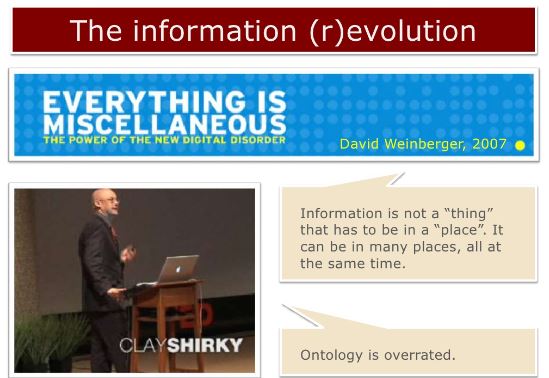
The Information revolution


It is interesting to muse on the fact that ontology deals with the nature of being, yet the “place” that comprises virtual reality is doubted in terms of its multi-locational presence, criticised for it’s apparent disorder, and challenged for its “authenticity. Compare the concepts of The dark Side of information overload, anxiety and other paraxes and pathologies (Bawden, D., & Robinson, L. 2009) with De Saulles more optimistic New Models of Information Production (De Saulles 2012)


Slide 12 Personal Learning Environment and Personal Learning Network

PLE and PLN
PLE and PLN

This slide shows the complete integration of peoples’personal learning  environment within a networked world. Technological tools and artefacts provide the link between the way information is able to be collated, recreated and used to create new information which is then, in turn, shared. The spirit that exists in a knowledge networked society is pervasive and encouraging, and subjects such as Knowledge Networking for Educators continue to demonstrate this in its full capacity. These learning realities are well summed up in Microsoft’s ATC21S (2014) and are gradually taking hold within Australian educational settings.

online friends
online friends


Part of slide 26, which is a diagrammatic representation of people’s interactivity. It shows names of people who have become experts in sharing information and modelling social learning interactivity. Among the names shown are: CSU’s Judy O’Connell, Victorian educator, Jess McCullogh, online content creator for education Bryn Jones from Perth, and Jim Mullaney, Google expert from RMIT university.
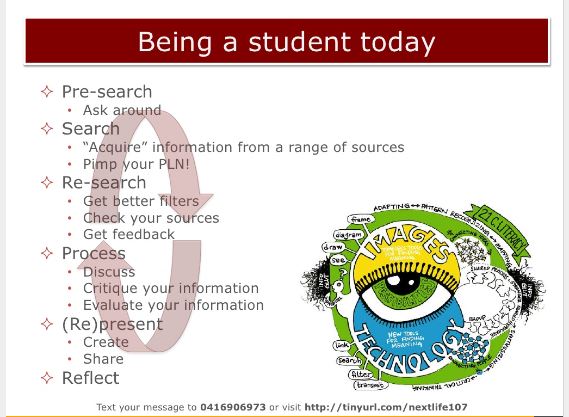
Study skills
Study skills

Slide 27 “Being a student today”  shows the skills and processes that must be worked through in order to produce successful results. Brown and Duguid spend much time analysing the limits, redefinition and oversimplification (as demonstrated by models such as the 6Ds described on page 22) of information in its broadest sense (Brown & Duguid, 2000 pp. 11-22)
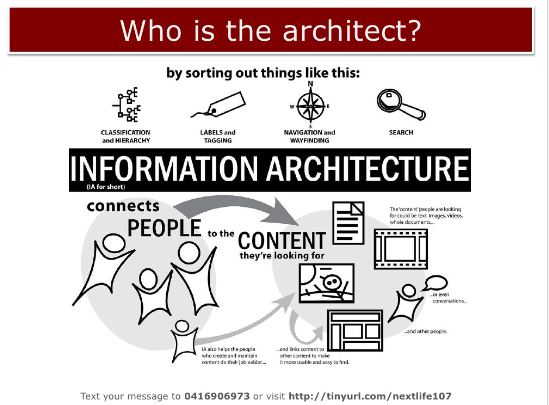
 

Who is the architect?

Slide 36 is the a valuable insight into the relationship between who is sorting things out and for what purpose. The focus has been on the tools for quite some time, but the tools are of lesser importance that the information provided by them, the connections they enable between people and the learning they facilitate. It is in the facilitation process that information specialists such as teacher-librarians have a clear role to play within twenty-first century schools, facilitating the cultivation of imagination through assisting learners of all ages to harness information appropriate to their quest (Thomas & Brown, 2011 p.31).


References

Assessment and Teaching of 21st Century Skills (ATC21S). (2014). Retrieved March 4, 2015, from Microsoft Education: http://www.microsoft.com/education/en-au/leadership/Pages/assessment.aspx

Bawden, D., & Robinson, L. (2009). The dark Side of information overload, anxiety and other paraxes and pathologies. Journal of Information Science, 35(2), 180-191.

Brown, J., & Duguid, P. (2000). Limits to Information. In J. Brown, & P. Duguid, Social Life of Information (pp. 11-33). Boston: Harvard Business School Press.

Coutas, P. (2010, October 8). New Sources of Information. Retrieved March 7, 2015, from Slideshare: http://www.slideshare.net/pcoutas/new-sources-of-information

De Saulles, M. (2012). New Models of Information Production. Information 2.0: New Models of Information Production, Distribution and Consumption., 13-35.

Thomas, D., & Brown, J. (2011). Arc-of-Life-Learning. A new culture of learning, 17-33.


1.2 Three challenges

Three challenges to educators:

Three challenges facing educators wishing to fully engage their students with aspects of the information society thus enabling knowledge networking, and thereby encouraging digital innovation are:

  1. The ability to look at the development of digital lives, personally, professionally and for the students I encounter in my work, beyond the techno-hype of the digerati (Lindsey, 2014). Too much concern about cyber safety by educational administrators often hampers educators’ ability to model and teach use and development of C21st skills (Assessment and Teaching of 21st Century Skills (ATC21S), 2014). The high level of concern about issues of authenticity and authority is extreme when consideration is given to the fact that humanity has been living in various kinds of information ages since writing began (Floridi, 2009, p. 153). Subsequently people have learned to access, select, utilise and adapt the work of those such as Gutenberg and Turing, to apply it to their own information needs and to create new information (Floridi, 2009, p. 154)
  2. The focus should be on celebrating that information is socially situated, is socially constructed, and, therefore, needs to be designed and utilised to empower people, as opposed to overwhelming them(Lindsey, 2014). The exponential growth of information in recent times has challenged the degree of subsurface root development to support the rapidly developing branches of humanities’ technological tree (Floridi, 2009, p. 154).
  3. Educators have a unique and critical role to play in assisting their students to develop skills that enable them to cope with Moore’s prediction that information will double every eighteen months (Brown & Duguid, 2000, p. 14).  While excitement is aroused in infoenthusiasts by this amazing amount of knowledge, students needs a means of redefining the masses of information comes to them as documents, stories, diagrams and images which convey knowledge and meaning (Brown & Duguid, 2000, p. 16). Users do not consider it to be made up of “quadrillions of packets of data (Gates, cited in Brown & Duguid, 2000, p. 11), they need mechanisms to sort, rework, recreate, use, and move to the solutions that such access brings, rather than focussing of the questions and issues (Brown & Duguid, 2000, p. 19). Our students need to be educated to participate in this sudden burst of global information societal action for the depth of understanding, networking and collaborative problem solving to which it is so well suited (Floridi, 2009, p. 154).

References

Assessment and Teaching of 21st Century Skills (ATC21S). (2014). Retrieved March 4, 2015, from Microsoft Education: http://www.microsoft.com/education/en-au/leadership/Pages/assessment.aspx

Bawden, D., & Robinson, L. (2009). The Dark Side of Information Overload, Anxiety and Other Paraxes and Pathologies. Journal of Information Science, 35(2), 180-191.

Brown, J., & Duguid, P. (2000). Limits to Information. In J. Brown, & P. Duguid, Social Life of Information (pp. 11-33). Boston: Harvard Business School Press.

Floridi, L. (2009). The Information Society and Its Philosophy: An Introduction to the Special issue on “The Philosophy of Information, Its Nature, and Future developments. The Information Society: An International Journal, 25, 153-158. doi:10.1080/01972240902848583

Lindsey, J. (2014). 1.1 Information environments. Retrieved March 4, 2015, from INF532 Knowledge Networking for Educators: https://interact2.csu.edu.au/bbcswebdav/pid-289790-dt-content-rid-490057_1/courses/S-INF532_201530_W_D/S-INF532_201530_W_D_ImportedContent_20150211062159/module1/1_2_Discover_philosophy_info_digital_environ.html

Final Assessment Part B


Studying Designing Spaces For Learning has been both challenging and invigorating, with the added bonus of allowing immediate practical application of the processes that have been encountered while exploring the eight modules.  Commencing the intellectual journey when attending a professional workshop with Ewan McIntosh (prior to the course) set the scene for the breadth and depth of potential design thinking process and goals, and the power of innovative and creative workplaces, but real understanding has only emerged from the maelstrom of ideas in recent weeks as the final responses have been formed. The timely arrival of Ewan’s book (unfortunately delayed due to a necessary reprint) has enabled the cognitive circle to be completed (McIntosh, How To Come Up With Great Ideas And Actually Make Them Happen, 2014).


Brown’s Change by Design (Brown, 2009) and the work done by Pilloton, both in education and more general design (Pilloton, 2009) stimulated initial cognitive processes that resulted in constant reflection and leading to practical application as described here .


Defining the differing concepts described as design thinking, exploring the discords and similarities, challenging the tensions and attempting to apply them to specific educational settings was summarised by writing the literature critique. Adapting this new knowledge to education required ongoing reference to conceptual overviews of the role of teachers in designing learning experiences (well summarised by Grift & Major, 2013).


From early in the course it was obvious that design did matter but articluating why and deciding which of the different definitions of design was challenging and a fluid situation arose in terms of resolving personal opinion. It is is only through empirical research that the impact of space on pedagogy can be unequivocally  appreciated (Walker, Brooks, & Baepler, 2011).


In terms of testing out the different processes in the real world, some were readily applicable to specific classroom teaching; others were better suited to implementing change in a physical space. Still others may work better for virtual spaces which are constrained by space, time or geography, so have had to wait (McIntosh, 2010, p. 33). Few places are as fortunate as The Works, where a holistic approach was undertaken to create a new virtual and physical educational experience.


Building collaborative relationships for the purpose of improving teaching and learning outcomes has enabled improved implementation. This was achieved through:


Involving members of the school community the rewriting of the “library story” has proven very powerful and has been successful in redesigning the library space for contemporary learning, as documented in this timeline of images.


Commencing the practical application with both written and filmed observations and making changes in stages has proven beneficial, allowing reflection and consideration before the next thing.


Personal pedagogy has improved due to adopting design thinking processes to lessons, creativity in class and in the library has blossomed, and the spread of innovation has moved from lone rooms within the school towards a sea filled with islands approaching excellence, of which the library space is now one (McIntosh, How To Come Up With Great Ideas And Actually Make Them Happen, 2014, pp. 22-23).


References:


Bennett, P. (2007, May 16). Design Is In The Details . Retrieved June 28, 2014, from https://www.youtube.com/watch?v=7g0O003kufA&feature=youtu.be


Brown, T. (2009). Change by Design How Design Thinking Transforms Organizations and Inspires Innovation. New York: Harper Collins.


Grift, G., & Major, C. (2013). Teachers As Architects Of Learning: Twelve Considerations For Constructing A Successful Learning Experience. Moorabbin: Hawker Brownlow Education.


Hunter, B. (2006). The Espaces Study: Designing, Developing and Managing Learning Spaces For Effective Learning. New Review Of Academic Librarianship, Vol 12, No 2, 61-81.


Locke, M. (2007, August 10). Six Spaces Of Social Media. Retrieved September 15, 2014, from TEST: Notes On How To Make Culture In The Age Of Digital Attention: http://test.org.uk/2007/08/10/six-spaces-of-social-media/


McIntosh, E. (2010). Clicks and Bricks: How School Buildings Influence Future Practice And Technology Adoption. Education Facility Planner Vol 45: Issues 1 & 2, 33-38.


McIntosh, E. (2014). How To Come Up With Great Ideas And Actually Make Them Happen. Edinburgh: NoTosh Publishing.


Pilloton, E. (2009). Design Revolution:100 Products That Empower People. New York: Metropolis Books.


Pilloton, E. (2010). Teaching Design For Change. Retrieved July 8, 2014, from http://www.ted.com/talks/emily_pilloton_teaching_design_for_change


Simkin, M. (2014, August 15). Collaborative Ideation. Retrieved August 28, 2014, from Digitalli: http://thinkspace.csu.edu.au/msimkin/?p=170


Simkin, M. (2014, August 15). Collaborative Ideation And Design Brief. Retrieved from Digitalli: http://thinkspace.csu.edu.au/msimkin/?p=197


Simkin, M. (2014, September 15). Creative Coffee – Inventive Format. Retrieved from Digitalli: http://thinkspace.csu.edu.au/msimkin/?p=211


Simkin, M. (2014, August 13). Designing Thinking Tasks. Retrieved from Digitalli: http://thinkspace.csu.edu.au/msimkin/?p=158


Simkin, M. (2014, July 30). Further changes To Our school Library. Retrieved August 27, 2014, from Digitalli: http://thinkspace.csu.edu.au/msimkin/?p=147


Simkin, M. (2014, August 2014). Inspirational Sites. Retrieved from Digitalli: http://thinkspace.csu.edu.au/msimkin/?p=154


Simkin, M. (2014, September 2). Literature Critique. Retrieved from Digitalli: http://thinkspace.csu.edu.au/msimkin/?p=197


Simkin, M. (2014, July 28). Module 1.1. Retrieved from Digitalli: http://thinkspace.csu.edu.au/msimkin/?p=111


Simkin, M. (2014, July 7). Module 1.2. Retrieved from Digitalli: http://thinkspace.csu.edu.au/msimkin/?p=144


Simkin, M. (2014, July 30). Using A Design Process To Implement A Change. Retrieved from Digitalli: http://thinkspace.csu.edu.au/msimkin/?p=132


Simkin, M. (2014, August 29). What Is Your School’s Innovation Strategy? Retrieved August 29, 2014, from Digitalli: http://thinkspace.csu.edu.au/msimkin/?p=193


The Works At Walker. (n.d.). Dear Architect: A Vision Of Our Future School. Retrieved July 25, 2014, from http://www.ournewschool.org/assets/pdf/Dear_Architect.pdf


Walker, J. D., Brooks, D. C., & Baepler, P. (2011, December 15). Pedagogy and Space: Empirical Research on New Learning Environments. Educause Review Online. Retrieved October 13, 2014, from http://www.educause.edu/ero/article/pedagogy-and-space-empirical-research-new-learning-environments


What is your school’s innovation strategy?

Along with four other teachers from my school, I was lucky enough to attend the Ewan McIntosh Masterclass run by Pearson and held in Melbourne last May. We were selected primarily because our middle years (Years 6 – 8) students were about to move into a brand new building which our school is naming the Positive Education Centre. We didn’t really have an opportunity for a briefing before we came and no -one really knew what to expect or what we were intended to bring back to school. Ewan conducted the PL as a design activity, showing us some examples of what is being done in a variety of settings, and the type of outcomes that are being achieved. He then worked us through a range of activities: story telling to consider different mind sets; needfinding issues with education;  ideating using hexagons, sticky noting concepts et cetera. To complete these tasks we were divided into groups and worked with people we had not met before, some of whom were not based in schools. The processes were interesting and thought provoking and the themes that arose were common across all groups. When we got to the hexagon stage of telling the story of how we could innovate and what blocks were preventing innovation in our workplaces a few things became really clear. Individual teachers in most schools have very little chance of being able to innovate unless their concept is adopted by those in the high level positions of authority. I was in  a group with someone in such a position, who said they would never undertake this type of activity with their whole staff, only with selected personnel.

Innovating with Ewan

This, to me is the nub of the problem with design thinking application. By excluding people from such a process you don’t know what you might be missing. The wider the variety of brainstormers, the less likely you are to miss an important factor in the product or service you are trying to create. Brown and IDEO both refer to the power of the brainstorming process (Brown, 2009, IDEO, 2012) and The Works at Walker (The Works At Walker n.d) benefits from engaging in such a practice. In the latter case students past and present, parents, employers, local community, teachers and architects developed a holistic vision for the building and the learning that will take place within it, both face to face and virtually. Too often, finished buildings fall short of educational needs and practical inclusions: a bench designed to hold computers has two power points where four are necessary; laptop storage spaces built into student lockers cannot accommodate charging facilities; an orchestra pit designed for musical performances has no lighting capacity to illuminate the music on stands during a production. Virtual spaces contain content but do not link to belief systems or consider learning needs.

The world is full of unknowns and the best way to avoid missing things that may be known to some people in any process is to involve more people. How might we questions enable breadth of thinking, and broadening the knowledge base should be seen as positive. Resolving any design requirement is more likely to please more people and there should be fewer “how did they miss that?” moments.

What did we five get from our experience with Ewan’s professional learning session? For us as a group, it might have been of more immediate value if part of the day had been spent together so we could prepare some work on a specific issue relevant to us. We did  learn some great ideas for using with our students, a sense of what could be if we were allowed to try the process “for real” and an experience which we are still processing months later.


Brown, T. (2009). Change by Design How Design Thinking Transforms Organizations and Inspires Innovation. New York: Harper Collins.

IDEO. (2012). Design Thinking For Educators 2nd Edition. Retrieved August 9, 2014, from Ideo: http://www.ideo.com/by-ideo/design-thinking-for-educators

The Works At Walker. (n.d.). Dear Architect: A Vision Of Our Future School. Retrieved July 25, 2014, from http://www.ournewschool.org/assets/pdf/Dear_Architect.pdf

Module 1.2

Why does design matter?

Design affects all aspects of an organisation in ways that are both seen and clearly understood, and also unseen, unclear and pervasive. It can be the latter that has the greatest impact on the people who work in an organisation, those who visit it, or those who might walk past on the street.

What are the core reasons for which we need a design process?

A design process is needed to ensure that the end result really does fulfil a need, ideally to the best extent possible. Design thinking charges us with being given the white pages of history on which to create beauty for the future (Starck, 2007). It entails needfinding, brainstorming and prototyping preferably in multidisciplinary teams (Seidel & Fixson, 2013, pp. 19-21) . Without interdisciplinary teams the hope of enriching a human experience is seriously challenged (Buchanan, 1992, p. 6).

What might be the role of design when we think about learning spaces?

The aim of utilising a design thinking process for learning space development is to build the learning capacity of students and enhance the teaching practitioner’s role. Design thinking is strategic because it unleashes the disruptive, game changing potential that is latent in everything (Brown, 2009, p. 7).

References

Brown, T. (2009).   Change by Design How Design Thinking Transforms Organizations and Inspires   Innovation. New York: Harper Collins.

Buchanan, R.   (1992). Wicked Problems in Design Thinking. Design Issues Vol 8 No 2,   5-21.

Seidel, V., &   Fixson, S. (2013). Adopting Design Thinking In Novice Multidisciplinary   Teams: The Application ans Limits of Design Methods and Reflexive Practices. Journal   Of Product Innovation Management, 30, 19-33.

Starck, P. (2007,   March). Design and Destiny. Philippe Starck Thinks Deep On Design.   Retrieved July 5, 2014, from http://www.ted.com/talks/philippe_starck_thinks_deep_on_design


Critical reflection

INF530 has presented wide ranging, far-seeing, ideologically challenging and educationally inspiring material. The content modules have provided extensive opportunities for professional growth.

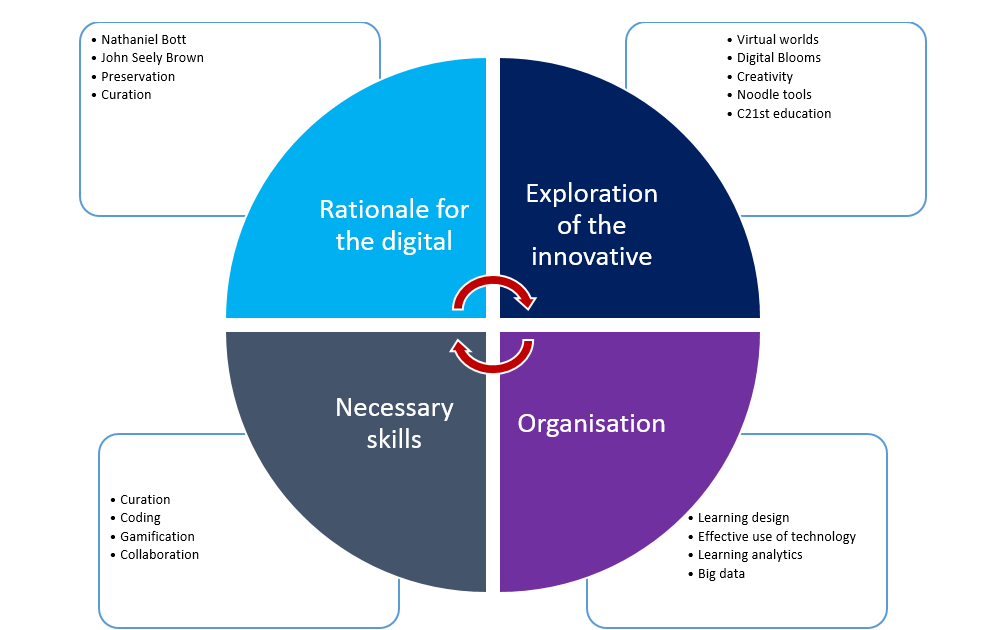
A summary diagram of this course might look like this:

Summary pf my learning


Each segment draws  together my learning from the subject modules.. The interweaving and interaction of the various topics  has combined into a powerful ideology of knowledge networks and digital innovation applicable to my practice. The pedagogy within each module has been delivered in a multimodal manner, where the modality has resulted in an ensemble of connected parts, in comparison to the linear mode of traditional academic discourse  (Kress, 2010, p. 93).

References and key learnings for this diagram:

Rationale for the digital:

  •   Nathaniel Bott   School is boring  (21st century learning: Nathaniel Bott at TEDxLaunceston, 2013)

https://www.youtube.com/watch?v=UI9TiuVHc0A&feature=youtu.be

  •   John Seely Brown: Teachers need to create epiphanies for kids (Brown,    2012)

http://youtu.be/fiGabUBQEnM

  •   Preservation is vital (even for Tweets!) (Allen,    2013)

http://blogs.loc.gov/loc/2013/01/update-on-the-twitter-archive-at-the-library-of-congress/

  •   Curation needs teaching (Conole, 2012, p. 48)
Exploration of the innovative:

  •   Virtual worlds:   Student  metaverse experiences versus ours (O’Connell    & Groom, 2010, p. 40)
  •   Digital Blooms:  ties it all together (Iowa State University Center for Teaching and Learning Excellence, 2011)

http://www.celt.iastate.edu/teaching/RevisedBlooms1.html

  •   Creativity (Bellanca & Brandt, 2010): referred to by most contributors.
  •   Noodle tools (Abilock,    2014)
  •   C21st education (Crockett,  Jukes, & Churches, 2011)
Necessary Skills:

  •   Curation (Conole, 2012, p. 48)
  •   Coding: “The next Darwin is more likely to be a data wonk” (Weinberger, 2011, p. 195)
  •   Gamification: the ultimate conversion of C21st skills  (O’Connell    & Groom, 2010, p. 48)
  •   Collaboration  ubiquitous recommendation (Bellanca    & Brandt, 2010) (Crockett,    Jukes, & Churches, 2011)
Organisation:

  •   Learning design: Compendium LD etc. from Chapter 9 (Conole, 2012)
  •   Effective use of technology: focuses on the desired outcome

http://blog.williamferriter.com/2013/07/11/technology-is-a-tool-not-a-learning-outcome/  (Ferriter, 2013)

  •   Learning analytics and big data: powerful combination for refining learning experiences and outcomes


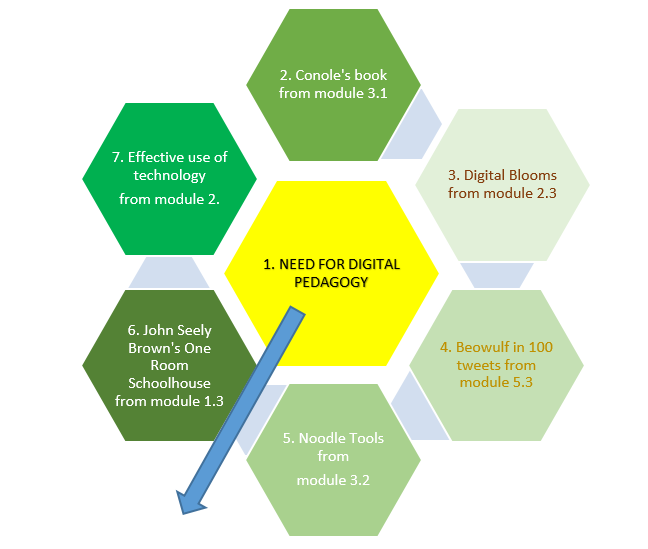
The Internet  provides a pivotal platform for innovative teaching, yet too many teachers are not investing in a meaningful manner. Effectively utilising this limitless and powerful resource would solve Nathaniel Bott’s boredom at school (21st century learning: Nathaniel Bott at TEDxLaunceston, 2013) https://www.youtube.com/watch?v=UI9TiuVHc0A&feature=youtu.be and enable the development of C21st skills: collaboration, creativity, digital literacy, solution fluency and information fluency (Crockett, Jukes, & Churches, 2011, p. 16). However, the new should not be confused with the effective: http://thinkspace.csu.edu.au/msimkin/2014/05/17/confusing-the-new-with-the-effective-brabazon-dear-greene-purdy-2009-p-170-blog-post-4/

This reluctance to implement technological solutions in the classroom is leading to a professional “digital divide” which is of enormous concern as discussed at: http://thinkspace.csu.edu.au/msimkin/2014/03/22/a-very-big-hurdle/ . Further investigations within the learning modules indicated the range of tools available to teachers to design, plan and deliver meaningful C21st lessons (Abilock, 2014). Ultimately, education needs to develop a philosophy of practice based on the new paradigm: a digital pedagogy.

Choosing a digital essay topic


Choosing a digital essay topic


Digital essay: http://pedagogyfornow.weebly.com/

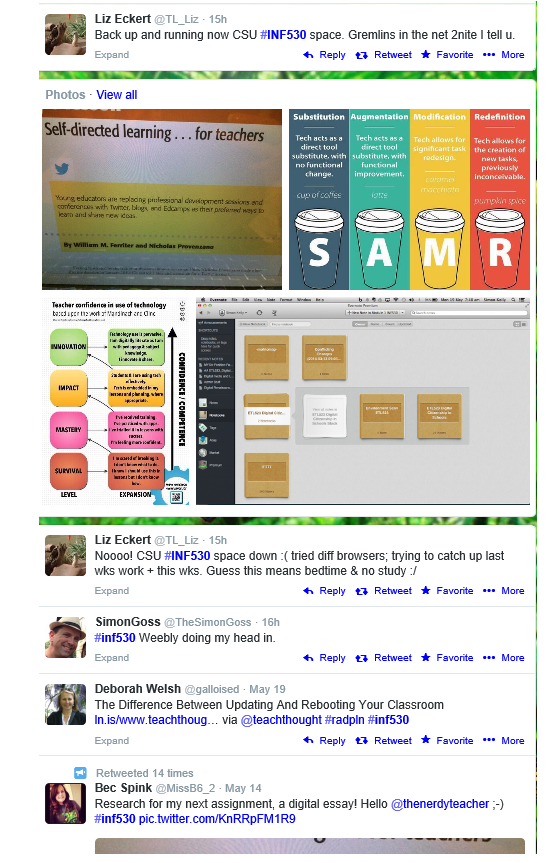
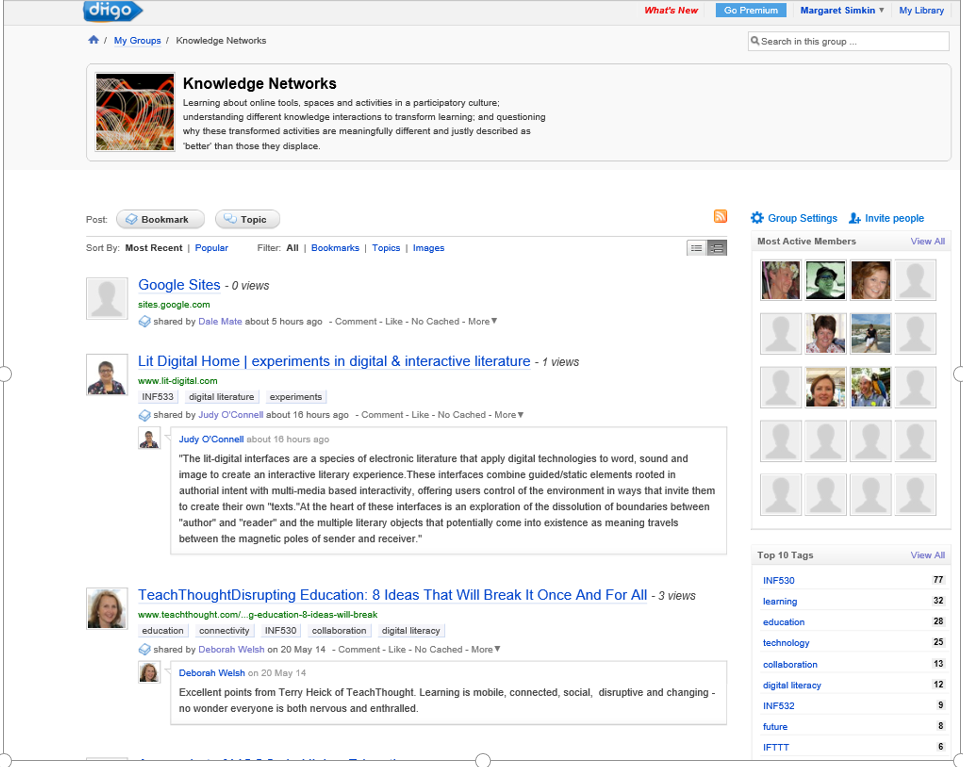
The practical application our learning has resulted from participatory practice: blogging, forums and collaborative curation. The subject has enabled transfer of developing skills to the range of work places represented by the student body. The power of the INF530 professional learning networks can be demonstrated by these screen shots of our networked practice:

Twitter connections
Twitter connections


Facebook interaction
The most powerful of all - the blog roll
Resource sharing Resource sharing with Diigo
The most powerful of all - the blog roll
The most powerful of all – the blog roll

Taking such infinite issues and converting them into one digital essay has been a challenge, and the end product is controlled by the restraints of the chosen medium (Weebly) and the word limit. The same frustrations arise with preparing this critical reflection.

These are the realities we, in turn, impose on our students. The opportunities for immersion in one sphere of inquiry, the need to brush off the skills of referencing and citing, and the need for sustained reading of a range of information has all promoted personal growth, as can be seen in the peer to peer “discussions” and the development of my skill set as evidenced within my thinkspace blog. The challenge now is to apply my newfound knowledge to improve education beyond my  own teaching, because I have been given some wonderful keys to unlock the potential of C21st students.


References

21st century   learning: Nathaniel Bott at TEDxLaunceston. (2013, December 5).   Retrieved March 10, 2014, from You Tube:   https://www.youtube.com/watch?v=UI9TiuVHc0A&feature=youtu.be

Abilock, D.   (2014, January 29). Information Literacy. Retrieved March 23, 2014,   from Noodle Tools: http://www.noodletools.com/debbie/literacies/information/1over/infolit1.html

Allen, E. (2013,   January 4). Update on the Twitter Archive. Retrieved March 16, 2014,   from Library of Congress Blog: http://blogs.loc.gov/loc/2013/01/update-on-the-twitter-archive-at-the-library-of-congress/

Anderson, M.   (2013, September 8). ICT Evangelist. Retrieved April 24, 2014, from   Teacher Confidence In Using Technology:   http://ictevangelist.com/teacher-confidence-using-technology/

Bellanca, J.,   & Brandt, R. (Eds.). (2010). 21st Century Skills: rethinking How   Students Learn. Bloomington, United States.

Brown, J. (2012,   September 18). The Global One Room Schoolhouse: John Seely Brown (Highlights   from JSB’s keynote at DML 2012). Retrieved March 16, 2014, from https://www.youtube.com/watch?v=fiGabUBQEnM&feature=youtu.be

Conole, G.   (2012). Designing for Learning in an Open World. New York, United   States of America: Springer.

Crockett, L.,   Jukes, I., & Churches, A. (2011). Literacy is Not Enough, 21st-Century   Fluencies for the Digital Age. Corwin.

Ferriter, W.   (2013, July 11). Technology is a Tool, NOT a Learning Outcome.   Retrieved May 26, 2014, from The Tempered Radical:   http://blog.williamferriter.com/2013/07/11/technology-is-a-tool-not-a-learning-outcome/

Iowa State   University Center for Teaching and Learning Excellence. (2011). A Model of   Learning Objectives. Retrieved March 17, 2014, from Iowa State University   Center for Teaching and Learning Excellence: http://www.celt.iastate.edu/teaching/RevisedBlooms1.html

Kress, G. (2010).   Multimodality, A Social Semiotic Approach To Contemporary Communication.   Abingdon, Oxon, United Kingdom: Routledge.

O’Connell, J.,   & Groom, D. (2010). Virtual Worlds: Learning in a Changing World.   Camberwell, Victoria, Australia: ACER Press.

Weinberger, D.   (2011). Too Big To Know: Rethinking Knowledge Now That The Facts Aren’t   Facts, Experts Are Everywhere, And The Smartest Person In The Room Is The   Room. New York, New York, United States Of America: Basic Books.


Reflecting on metadata

What’s the most important point that struck you in your readings?

Investigating RDA as the new cataloguing, and having a presentation from OCLC about their cataloguing system last year brought some of these concepts to my attention. There is a big difference between knowing something exists and understanding it and I am still struggling with that. I can see the value of where metadata is heading but I don’t fully understand how to create it for best effect. I also worry that there amount of data will become a problem for retrieval rather than assisting us to find things.

What is the value of Web 3 to your learning and teaching?

I think it is important to record or note the good things that we come across so that we can find them again. Collaboratively locating valuable sources is a great way to save time and energy while contributing to the learning process.

Do you engage in tagging, indexing, or any other information organisation strategy?

I have been a long time “collector” of sources adding them to a wiki for teachers at my school: http://www.esandbox.wikispaces.com/ but, like the Internet itself, my organization of the data is not the best as additions are made in spurts and often spasmodically while tagging tends to be overlooked. I add to my Diigo library often, usually by favouriting tweets, which automatically records them. I have good intentions of going in to Diigo and adding tags but often don’t get around to it. My library : https://www.diigo.com/user/msimkin has 3268 untagged items (which is rather embarrassing!)

Do you embed metadata into your pdf documents (for example)?

It has never occurred to me to embed metadata into documents that I produce, and frat this stage I am not sure how I could manage this.

Do you have an organised approach to organising metadata?

I am afraid that I am little ad hoc (unless I am actually cataloguing something in the formal sense).

Module 3.1 reflection

  • How would curriculum change if our priority approach was on critical, creative, and collaborative thinking?

Educators would realize the importance of curriculum design consciously based around C21st skills and objectives. Knowing something of Tara Brabazon’s work I was keen to read about the igeneration despite the reference to digital natives in the title, which may otherwise have put me off (Brabazon, Dear, Greene, & Purdy, 2009).  From this I liked these:

1. There are very few – too few – controlled studies of information seeking behaviour that is able to isolate age as a variable.

2. Speculation and ‘mis-information’ has been perpetrated about how young people behave in online environments.

3. All researchers – not only ‘young people’ are skim-reading research, reading abstracts rather than drilling deeper into the paper.

4. Young people are not ‘dumbing down.’ Society is ‘dumbing down.’

5. “The information literacy of young people, has not improved with the widening access to technology: in fact, their apparent facility with computers disguises some worrying problems.”

6. “Young scholars are using tools that require little skill: they appear satisfied with a very simple or basic form of searching.

7. “Digital literacies and information literacies do not go hand in hand” (Brabazon, Dear, Greene, & Purdy, 2009, p. 171).

  • What does the reality of the modern age of information– this age of Google –suggest that we “teach”?

Conole’s chapter excited me so much that I borrowed the book and read it very quickly. It is full of amazing suggestions for links (some of which are, unfortunately no longer active) to websites that guide curriculum design (Conole, 2012,  chapter 8). I am still working through the downloads but the idea of tapping into existing structures such as http://cloudworks.ac.uk/ or http://cosy.ds.unipi.gr/cadmos/index.php – (the email link they sent me on sign up didn’t work though 😦 ) or http://compendiumld.open.ac.uk/ is very appealing.

When I first started working as a qualified teacher-librarian SLAV had several CD based programs available to assist with cooperative teaching and learning, particularly planning research tasks, and these web based options seem to be similar to the principle but aimed at C21st skill development. I have also been exposed to assessing assignment design against C21st skills in my Microsoft 1:1 peer coaching course. For me, this is starting to bring my thoughts together in answer to “where to from here?” questions that I keep mulling over. I think my digital essay topic will probably be aiming to investigate some options in order to suggest pathways for reducing the digital divide and enabling reluctant educators to “have a go” in ways that may not be too threatening.

  • Can we simply “update” things as we go, or is it time for rethinking of our collective practice?

I do not believe that we can just update bits and pieces of curriculum as we go (although we do all have to start somewhere and that may be the only way). Just like the “backward by design” http://edutechwiki.unige.ch/en/Backwards_design  principles that so many schools are embedding at present – we need to know the end point before we start “renovating” so that we end up with a workable, learning-centred and sustainable system.

References

Brabazon, T., Dear, Z., Greene, G., & Purdy, A. (2009). Why the Google Generation Will Not Speak: The Invention of Digital Natives. Nebula, 163-181. Retrieved April 16, 2014, from http://www.iiav.nl/ezines/IAV_607294/IAV_607294_2010_3/BDGP.pdf

Conole, G. (2012). Designing for Learning in an Open World. New York, United States of America: Springer. Retrieved April 2014

Heick, T. (2014). Are You Teaching Content Or Teaching Thought? Retrieved April 16, 2014, from te@chthought: http://www.teachthought.com/learning/teaching-content-or-teaching-thought/>

Ito, M. (2013). Connected Learning Every One, Every Where, Anytime.  Digital Media and Learning Research Hub. Retrieved April 14, 2014, from http://youtu.be/viHbdTC8a90

A Very Big Hurdle

Helen Haste’s concept of people as problem solvers rather than tool users resonates with me. I have long held the belief that technology is only a tool and it is what we do with it that really matters. I struggle with the value of setting students a task and then mandating the output that proves the task e.g. create a PowerPoint. I try to encourage teachers to offer the task and a rubric and let the students design their own responses in any format that is accessible by the teacher.

In Curriculum meetings there is much frustrating discussion about mandating the way we write courses and the content that we have to teach, but it is impossible to move the discussion to C21st skill sets.

It seems obvious that, as Helen Haste says, students need a new brand of competencies to thrive within a changing environment. I really like Helen’s  summative drawing of the potential power of collaboration :

Collaboration of problem solvers

Collaboration of problem solvers                     

Her diagram showing problem solver organisation  has no arrows because the individual is constantly changing directions according to the process of their problem solving interactions – individual to society and back again.


This is a continual pyramid not a directional one.

This is a continual pyramid not a directional one.

From: http://www.gse.harvard.edu/news-impact/2009/06/technology-and-youth-a-remix-that-is-changing-the-education-landscape/#ixzz2przhEdQF

The two definitions are also very powerful:

  • dialogic This means that everything anybody ever says always exists in response to things that have been said before and in anticipation of things that will be said in response. In other words, we do not speak in a vacuum.
  • dialectic The dialectical method is discourse between two or more people holding different points of view about a subject, who wish to establish the truth of the matter guided by reasoned arguments.

From <http://digital.csu.edu.au/inf530/module-1-the-information-environment/1-5-global-connectedness/>

Competence isn’t just about skill but about adaptation.

5 competences

  1. managing ambiguity
  2. Agency and responsibility
  3. Finding and sustaining community
  4. Managing emotion
  5. Managing technological change

It is important for us to teach ambiguity so that students do not feel anxious by not knowing what the right answer is. They need to understand multiple perspectives.

Young people are encountering strangers and even non people in their online connections and we need to assist them with this process.

These competencies are what young people need for the future; they must be mandated within education.

Social change is not linear and everyone needs to work with that fact.

So…..

How do we bring our colleagues on board with these types of beliefs so that we are not creating classrooms as Nathaniel Bott describes: in the early part of this clip: “ boredom and disengagement is too big a part of the modern classroom”  http://youtu.be/UI9TiuVHc0A ?

This is one of our biggest hurdles as educators.

Knowledge, searching and understanding – a starting point.

It is interesting pondering the future work skills 2020 image in our module 1.3 (http://www.iftf.org/futureworkskills/) and comparing it to the book Too Big to Know by David Weinberger where the contention seems to be that the digital world is without structure and something of which it is almost impossible to make sense. (I haven’t finished the book yet, but this is my summation at this point).

To what extent is there no structure, or is it that the organisation is too big to recognise? Is all knowledge considered equal, or do most people acknowledge that some people are in a more informed position to pass comment than others?

Does computer processing power and speed equal improved understanding and lead to increased knowledge?

From http://en.wikipedia.org/wiki/File:Transistor_Count_and_Moore%27s_Law_-_2011.svg

Does the number of Google searches bear some relevance to an increase in the total data base of human knowledge? Does the Knowledge Graph http://www.google.com.au/insidesearch/features/search/knowledge.html actually improve knowledge access or growth or is it just an attractive interface? Do the many random, poorly thought out  and casual searches each day impact on the serious academic type content sought  by the minority?

While sites like http://21cif.com/rkit/actionzone/index.html educate students to search more effectively it is crucial to question how many students are exposed to such sites, and what proportion of teachers actually teach such skills. This is more important than the digital native vs immigrant debate. If those with experience and understanding of quality of result are not part of the conversation then all student learning is compromised.

Teachers need to inhabit the same spaces and model their use. They need to incorporate these things into their subject area all the time, not just as one off, special activities. This is the digital divide that really concerns me.