Too Big To Know


Click the animation to open the full version (via PennyStocks.la).

If you didn’t already get it, this animated image really shows you – David Weinberger really was correct (Weinberger, 2011). Those of you who studied with me in INF530 might remember that I was not a fan of his “Too Big to Know “, and yet I keep acknowledging that his thesis in relation to the amount of data out there is accurate – he just pushed the point too much. How can we, as educators, hope to keep abreast of such massiveness as this animation indicates?

This graphic, as much of any of the reading we have been undertaking, proves to me that the days of sage on the stage should be declared gone. There is even a point where groups within classrooms should not consider one person in that group the only guide on the side. We really need to think of classes as collections of learners gathered together for a common purpose – to learn more about whatever the content is deemed to be at a given point in time.
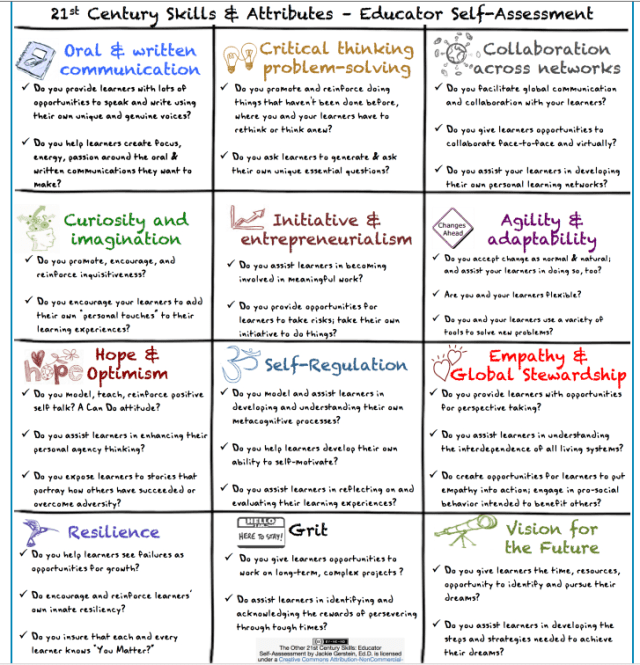
Jackie Gerstein

(Gerstein, The Other 21st Century Skills: Educator Self-Assessment, 2015)

The next sentence is not intended to diminish Jackie’s work. She provides us with many wonderful graphics such as this one on her blog, but the image above, and others like it, are focused on the teacher, what they establish,  and the various ICT tools and concepts to which they expose their students. It’s time to look at such constructs from a learning perspective, where the students are co-creators of the program (as far as mandated curriculum allows) and everyone shares the leadership and the solutions – which can be many and varied.

Here are two examples of student work (VCE History Revolutions) where building blocks were placed in the room in two piles with whiteboard markers nearby. Excitement came first, then question: – what do we do with them? Answer: what are we studying at the moment? Statement: let’s make timelines of our learning so far. Only imposition: write on one side of the blocks only (aiming for brief summary). Once the timeline was made, the suggestion was to change the order of  the blocks – ranking by importance.


Note the rows of small blocks deemed more significant than some of the bigger blocks


this group used all their blocks

Last year I had the amazing experience of working with a class where the students got the whole “sharing concept” and where the students taught me many things while I exposed  them to the VCE History Revolutions course. I blogged about the type of activities we did here: http://thinkspace.csu.edu.au/msimkin/2014/08/13/designing-thinking-tasks/ . I had taught many of these students in Year 9 (see https://9hist2012.wordpress.com/) and the learning from that experience had lived on.

QR codes in Historyy

In typically frustrating fashion, the class I have this year, a small group of 4 boys, 3 of whom were part of the same Year 9 cohort, won’t give any of these kinds of activities a go. I guess this is part and parcel of educating in a time of significant change. What do you think?

For my artefact for this subject I hope to create a film clip that will encourage my colleagues to have a go at connecting, collaborating and co-learning. Next year all our students will have a device in their hands, so, no doubt our school will be contributing to the data shown by Penny Stock in the graphic at the top of this page. With some judicious planning the data may also contribute knowledge to the wider learning community that is now accessible to most people on earth.

References

Gerstein, J. (2015, January 2015). The Other 21st Century Skills: Educator Self-Assessment. Retrieved March 30, 2015, from User Generated Education: https://usergeneratededucation.wordpress.com/2015/01/16/the-other-21st-century-skills-educator-self-assessment/

Penny Stocks. (n.d.). The Internet in Real-Time: How Quickly Data is Generated. Retrieved from Penny Stocks: http://pennystocks.la/internet-in-real-time/

Simkin, M. (2012). Retrieved from My Learning Journey: https://9hist2012.wordpress.com/

Simkin, M. (2014, August 13). Designing Thinking Tasks. Retrieved from Digitalli: http://thinkspace.csu.edu.au/msimkin/?p=158

Weinberger, D. (2011). Too Big To Know: Rethinking Knowledge Now That The Facts Aren’t Facts, Experts Are Everywhere, And The Smartest Person In The Room Is The Room. New York: Basic Books.


.

Social Media

Reflecting on Social Media in the Classroom:

As a possible topic for Assignment 1 and a basis for my artefact I am considering promoting Social Media. The work of Rheingold and his Attention, and Other 21st-Century Social Media Literacies (Rheingold, 2010), which contrasts effectively with Reclaiming the Students – Coping With Social Media in 1:1 Schools (Andersson, Hatakka, Gronlund, & Wiklund, 2014) is providing much food for thought.

In many ways the classroom can be seen as a marketplace, with multiple seductive attractions from the online world competing with physical presence, and the issue of teacher-managed circumstances is certainly critical, as Andersson et al discovered in their interpretive research based on content analysis obtained via surveys and interviews (Andersson, Hatakka, Gronlund, & Wiklund, 2014, p. 40). In their findings 42% of students and 74% of teachers indicated that social media (particularly Facebook) were a distractor requiring management (Andersson, Hatakka, Gronlund, & Wiklund, 2014, p. 42). Management ranged from the punitive removal of devices to suggestions for self-management (Andersson, Hatakka, Gronlund, & Wiklund, 2014, pp. 45-46).

Rheingold’s first focus: attention, reinforces this issue but examines it from a more positive perspective. He begins by highlighting the issue of Attention: affected by multitasking, or “continuous partial attention” or attention-splitting, or “hyper attention” (Rheingold, 2010).  Wirelessly-webbed, always-on media presents a constant smorgasbord of options with which students can be distracted, in the same way many of their teachers may also be lured off task or topic (Rheingold, 2010). Rheingold’s solution is to model and promote focused attention when necessary, additionally acknowledging that there are times when it is truly beneficial to task-switch (Rheingold, 2010).

We are currently teaching the first generation of young adults who have been raised with connective media devices since an early age, whose parents are also learning the concepts and parameters of such connectivity. Social mores for mobile phones in public spaces are still evolving and protocols for social media in public versus private settings are also in an emergent stage. This adds a degree of urgency to the debate about using such media as teaching tools and resources, which are now so much a part of the world beyond school, including work.

Participation is the next aspect Rheingold addresses. While acknowledging the amount of facile blogging and tweeting he also promotes the value of online participation in social media: “When you participate, you become an active citizen rather than simply a passive consumer of what is sold to you, what is taught to you, and what your government wants you to believe. Simply participating is a start” (Rheingold, 2010).

Inherent in teaching students to participate is the need to define the rhetorics of participation, to ensure that there will be sufficient numbers of well-educated citizens who are proficient at accessing and interpreting information allowing productive communication of their opinions in concert with other citizens – a literacy of participation (Rheingold, 2010). 

The next discussion revolves around Collaboration. It is important to note the distinction between collaboration, and collective action, something educators find difficult to construct lessons to really address. The 21st Century Literacy project defines Collaboration as one of five fluencies that today’s students need to master. Microsoft have developed an app which enables teachers to assess the degree to which a planned task is truly collaborative and not just “group work” (Moffitt, n.d). Collaboration offers educators a very powerful tool with which to engage students in some real world learning from experts beyond the classroom walls.

Moffitt's Microsoft app for Windows 8
Moffitt’s Microsoft app for Windows 8

Network Awareness

Online social networks are a relatively recent addition to something which has always been an essential part of being human,. No longer do teachers have the physical limitations on which people and how many people we could include in an educational network.

David P. Reed , cited by Rheingold, noted that there are at least three kinds of value that networks can provide:

  1. the linear value of services that are aimed at individual users,
  2. the ‘square’ value from facilitating transactions,
  3. and the exponential value for facilitating group affiliations(Rheingold, 2010).

It is the third value that offers the greatest learning opportunities for educating students to appreciate the notions and nuances of reputation and diffuse reciprocity, which are increasingly important online (Rheingold, 2010).

On her blog post about back-channeling in the classroom, Edna Sackson refers to the case of teacher Silvia, who is introducing Today’s Meet to her class as being their own chat room; once the lesson has progressed she “switches to the ‘front channel’ to discuss what’s going on in the back channel” (Sackson, 2015).  Teachable moments arise when students post inappropriately, which Silvia happily seizes ion by educating her students about audience and purpose. (Sackson, 2015).

Critical consumption

“Critical consumption, or what Ernest Hemingway called “crap detection,” is the literacy of trying to figure out what and who is trustworthy—and what and who is not trustworthy—online” (Rheingold, 2010). The critical need is for education in assessing validity, accuracy and authority. Collecting and curating information is another vital tool that must be modelled and incorporated.

Darren Draper, with some sadness, comments in relation to the much touted technological education adoption model SAMR the “In SAMR-ry,5 I think many of us in education are frustratingly stuck in Gartner’s trough of disillusionment, trying to understand why million dollar purchases are only being used as textbook and bubble sheet alternatives (SAMR’s beloved S!) (Draper, 2014) “.  Many educators await the day when research catches up with vision, and greater enlightenment more fully translates into more meaningful transformation of classrooms into spaces that are opened up by access to devices for enhancing learning activities with meaningful connectivity well beyond the local community (Draper, 2014).

References

Andersson, A., Hatakka, M., Gronlund, A., & Wiklund, M. (2014). Reclaiming the Students – Coping With Social Media in 1:1 Schools. Learning, Media and Technology, 39(1), 37-52. doi:10.1080/17439884.2012.756518

Crockett, L., Jukes, I., & Churches, A. (2011). Literacy is Not Enough, 21st-Century Fluencies for the Digital Age. Corwin.

Draper, D. E. (2014, February 22). That Time When SAMR Gets Us Into Trouble. Retrieved March 21, 2015, from Drape’s Takes : Openness, Education; Technology: http://drapestak.es/that-time-where-samr-gets-us-in-trouble-2/

Moffitt, L. (n.d.). 21st Century Learning Design App. Retrieved from http://windows.microsoft.com/en-au/windows-8/apps

Rheingold, H. (2010, October 7). Attention, and Other 21st-Century Social Media Literacies. Retrieved March 21, 2015, from Educause: http://www.educause.edu/ero/article/attention-and-other-21st-century-social-media-literacies

Sackson, E. (2015, March 14). Back-channelling in the Classroom. Retrieved March 21, 2015, from What Ed Said: https://whatedsaid.wordpress.com/2015/03/14/back-channelling-in-the-classroom/


1.2 New Culture

A new culture of learning

The new culture of learning described by Thomas and Brown resonates with many aspects of the Master of Education Knowledge Networks and Digital Innovation course that many students of this subject are undertaking. They define this culture as invisible, without traditional structure but operating in a defined environment which encourages the freedom to research (Thomas & Brown, 2011, pp. 17-18). Acknowledgement is given that playing in such a culture leads to the development of passions and ideas (Thomas & Brown, 2011, p. 18). This style of framework for learning cultivates citizenship, generates feedback leading to improvement for future students, and establishes the use of rich and highly textured examples of cross referencing and communication to form a learning community from the teachers and students within the group (Thomas & Brown, 2011, pp. 22-25).

So many new “friends” who are also peers and collaborators have been introduced to each other in a virtual sense through the shared work on the study modules that guide our learning. Sharing a “creative coffee” for INF536 proved incredibly valuable in ways beyond imagination (thanks Deborah and Liz!). Encouragement from Heather Baillie saw me enrol in this subject, and commentary through Twitter #feeds (Simon Keily) supported me through frustrations and celebrations. Sharing blog posts and video footage of our concepts and workplaces was akin to a site visit (thanks Matt Ives), and gentle encouragement from our subject coordinators provided a platform from which to launch our own practical applications. For me, as a lone practitioner in a small regional school, the new culture of learning has provided a much loved and respected “faculty” from which to draw inspiration and strength.

For students in my Year 12 History Revolutions class, I have attempted to create a similar environment. Working through collaborative learning activities using a range of techniques in 2014 was amazing, and similarly to Douglas Thomas, I felt that my students taught me far more than I taught them (Thomas & Brown, 2011, p. 25). This year a new tool, collaborative Microsoft OneNote, is encouraging a valuable mix of formal teacher notes (like those provided in CSU’s Blackboard), individual student notes, which are visible to me as the teacher, and shared working space which has superseded the Interactive Whiteboard activities paper-based work of the past. Giving feedback through audio recording that moves down the student’s page as aspects are identified for improvement or congratulations is amazingly powerful.

In terms of difference from the case studies provided by Thomas and Brown, my one formal class is restricted because it is a VCE course examined externally in November. This precludes a higher degree of personal control than Sam experiences through his involvement in Scratch, Douglas’ Massively Multi-player Online Games course, or Allen’s self-taught programming skills (Thomas & Brown, 2011, pp. 22-28). It also makes creation of an online sharing community such as Diabetes Daily more problematic (Thomas & Brown, 2011, pp. 29-30). The very nature of the Australian Tertiary Assessment Ranking system makes students at this level very wary of sharing too much due to a fear of reducing their own results or enabling another to supersede their position within the statewide cohort. Even teachers guard their own material closely, and in some schools Principals are reluctant to allow their staff to share work in case it affects enrolments in a negative fashion.

Within the more open library skill based programs offered to both teachers and students, however there is a glimmer of potential through such a culture of learning.

References

Thomas, D., & Brown, J. (2011). Arc-of-Life-Learning. A new culture of learning, 17-33.

1.1 Connected students

Being a student in the connected world.

Reflecting on the Slideshare put together by Penelope Coutas for her studies in 2010 – several sides resonated with both the subject readings we are undertaking at present, and also my lived experience in the connected world. The slides that impacted on my thinking the most were:

Slide 5

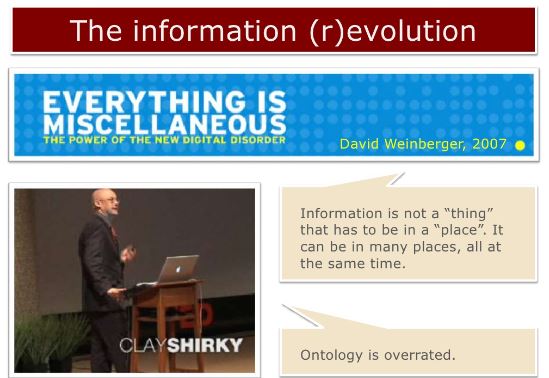
The Information revolution


It is interesting to muse on the fact that ontology deals with the nature of being, yet the “place” that comprises virtual reality is doubted in terms of its multi-locational presence, criticised for it’s apparent disorder, and challenged for its “authenticity. Compare the concepts of The dark Side of information overload, anxiety and other paraxes and pathologies (Bawden, D., & Robinson, L. 2009) with De Saulles more optimistic New Models of Information Production (De Saulles 2012)


Slide 12 Personal Learning Environment and Personal Learning Network

PLE and PLN
PLE and PLN

This slide shows the complete integration of peoples’personal learning  environment within a networked world. Technological tools and artefacts provide the link between the way information is able to be collated, recreated and used to create new information which is then, in turn, shared. The spirit that exists in a knowledge networked society is pervasive and encouraging, and subjects such as Knowledge Networking for Educators continue to demonstrate this in its full capacity. These learning realities are well summed up in Microsoft’s ATC21S (2014) and are gradually taking hold within Australian educational settings.

online friends
online friends


Part of slide 26, which is a diagrammatic representation of people’s interactivity. It shows names of people who have become experts in sharing information and modelling social learning interactivity. Among the names shown are: CSU’s Judy O’Connell, Victorian educator, Jess McCullogh, online content creator for education Bryn Jones from Perth, and Jim Mullaney, Google expert from RMIT university.

Study skills
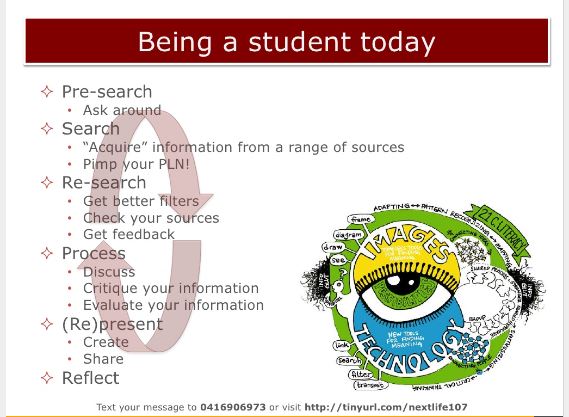
Study skills

Slide 27 “Being a student today”  shows the skills and processes that must be worked through in order to produce successful results. Brown and Duguid spend much time analysing the limits, redefinition and oversimplification (as demonstrated by models such as the 6Ds described on page 22) of information in its broadest sense (Brown & Duguid, 2000 pp. 11-22)


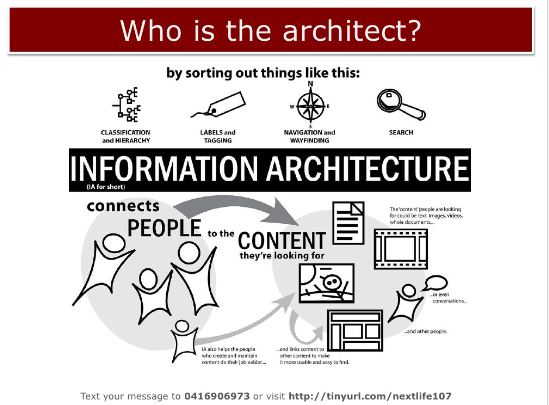
Who is the architect?

Slide 36 is the a valuable insight into the relationship between who is sorting things out and for what purpose. The focus has been on the tools for quite some time, but the tools are of lesser importance that the information provided by them, the connections they enable between people and the learning they facilitate. It is in the facilitation process that information specialists such as teacher-librarians have a clear role to play within twenty-first century schools, facilitating the cultivation of imagination through assisting learners of all ages to harness information appropriate to their quest (Thomas & Brown, 2011 p.31).


References

Assessment and Teaching of 21st Century Skills (ATC21S). (2014). Retrieved March 4, 2015, from Microsoft Education: http://www.microsoft.com/education/en-au/leadership/Pages/assessment.aspx

Bawden, D., & Robinson, L. (2009). The dark Side of information overload, anxiety and other paraxes and pathologies. Journal of Information Science, 35(2), 180-191.

Brown, J., & Duguid, P. (2000). Limits to Information. In J. Brown, & P. Duguid, Social Life of Information (pp. 11-33). Boston: Harvard Business School Press.

Coutas, P. (2010, October 8). New Sources of Information. Retrieved March 7, 2015, from Slideshare: http://www.slideshare.net/pcoutas/new-sources-of-information

De Saulles, M. (2012). New Models of Information Production. Information 2.0: New Models of Information Production, Distribution and Consumption., 13-35.

Thomas, D., & Brown, J. (2011). Arc-of-Life-Learning. A new culture of learning, 17-33.


Introduction

Knowledge Networking for Educators:

Another semester begins and a new subject beckons, for me it is the penultimate unit. I am looking forward to the new learning that will ensue; ongoing networking with previously “met” comrades: Julie Lindsay and Heather Baillie and others yet to reveal themselves from previous subjects; and networking with new people as yet unknown to me. Let the knowledge networking begin!


Critical reflection

INF530 has presented wide ranging, far-seeing, ideologically challenging and educationally inspiring material. The content modules have provided extensive opportunities for professional growth.

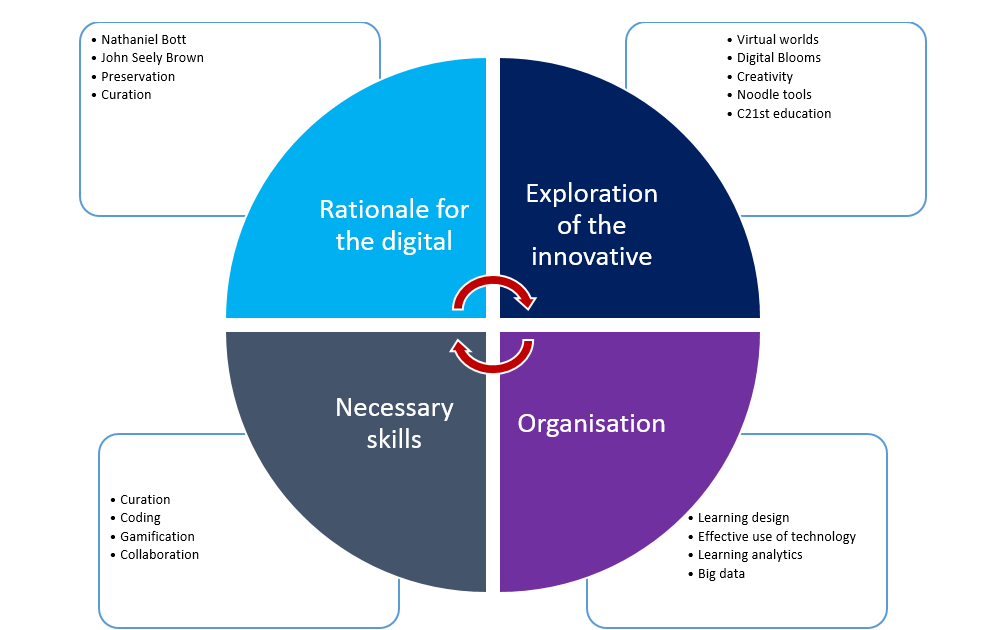
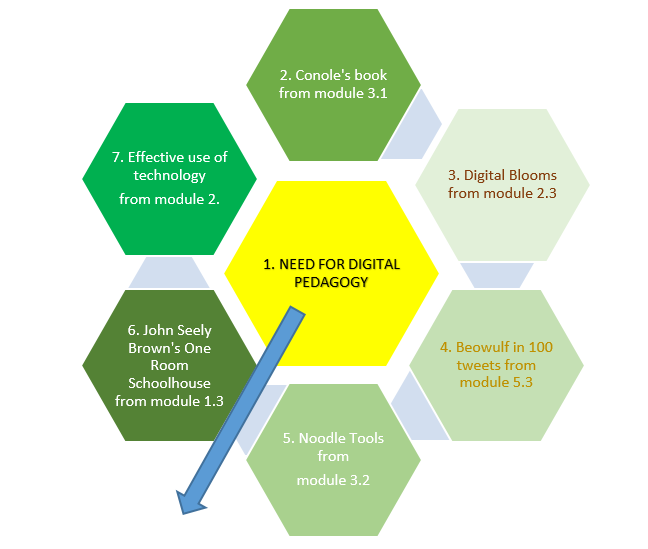
A summary diagram of this course might look like this:

Summary pf my learning


Each segment draws  together my learning from the subject modules.. The interweaving and interaction of the various topics  has combined into a powerful ideology of knowledge networks and digital innovation applicable to my practice. The pedagogy within each module has been delivered in a multimodal manner, where the modality has resulted in an ensemble of connected parts, in comparison to the linear mode of traditional academic discourse  (Kress, 2010, p. 93).

References and key learnings for this diagram:

Rationale for the digital:

  •   Nathaniel Bott   School is boring  (21st century learning: Nathaniel Bott at TEDxLaunceston, 2013)

https://www.youtube.com/watch?v=UI9TiuVHc0A&feature=youtu.be

  •   John Seely Brown: Teachers need to create epiphanies for kids (Brown,    2012)

http://youtu.be/fiGabUBQEnM

  •   Preservation is vital (even for Tweets!) (Allen,    2013)

http://blogs.loc.gov/loc/2013/01/update-on-the-twitter-archive-at-the-library-of-congress/

  •   Curation needs teaching (Conole, 2012, p. 48)
Exploration of the innovative:

  •   Virtual worlds:   Student  metaverse experiences versus ours (O’Connell    & Groom, 2010, p. 40)
  •   Digital Blooms:  ties it all together (Iowa State University Center for Teaching and Learning Excellence, 2011)

http://www.celt.iastate.edu/teaching/RevisedBlooms1.html

  •   Creativity (Bellanca & Brandt, 2010): referred to by most contributors.
  •   Noodle tools (Abilock,    2014)
  •   C21st education (Crockett,  Jukes, & Churches, 2011)
Necessary Skills:

  •   Curation (Conole, 2012, p. 48)
  •   Coding: “The next Darwin is more likely to be a data wonk” (Weinberger, 2011, p. 195)
  •   Gamification: the ultimate conversion of C21st skills  (O’Connell    & Groom, 2010, p. 48)
  •   Collaboration  ubiquitous recommendation (Bellanca    & Brandt, 2010) (Crockett,    Jukes, & Churches, 2011)
Organisation:

  •   Learning design: Compendium LD etc. from Chapter 9 (Conole, 2012)
  •   Effective use of technology: focuses on the desired outcome

http://blog.williamferriter.com/2013/07/11/technology-is-a-tool-not-a-learning-outcome/  (Ferriter, 2013)

  •   Learning analytics and big data: powerful combination for refining learning experiences and outcomes


The Internet  provides a pivotal platform for innovative teaching, yet too many teachers are not investing in a meaningful manner. Effectively utilising this limitless and powerful resource would solve Nathaniel Bott’s boredom at school (21st century learning: Nathaniel Bott at TEDxLaunceston, 2013) https://www.youtube.com/watch?v=UI9TiuVHc0A&feature=youtu.be and enable the development of C21st skills: collaboration, creativity, digital literacy, solution fluency and information fluency (Crockett, Jukes, & Churches, 2011, p. 16). However, the new should not be confused with the effective: http://thinkspace.csu.edu.au/msimkin/2014/05/17/confusing-the-new-with-the-effective-brabazon-dear-greene-purdy-2009-p-170-blog-post-4/

This reluctance to implement technological solutions in the classroom is leading to a professional “digital divide” which is of enormous concern as discussed at: http://thinkspace.csu.edu.au/msimkin/2014/03/22/a-very-big-hurdle/ . Further investigations within the learning modules indicated the range of tools available to teachers to design, plan and deliver meaningful C21st lessons (Abilock, 2014). Ultimately, education needs to develop a philosophy of practice based on the new paradigm: a digital pedagogy.

Choosing a digital essay topic


Choosing a digital essay topic


Digital essay: http://pedagogyfornow.weebly.com/

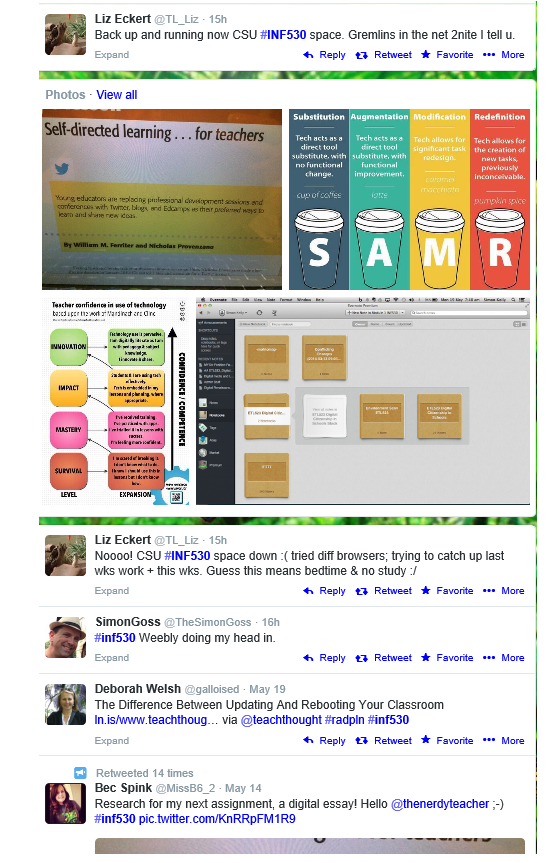
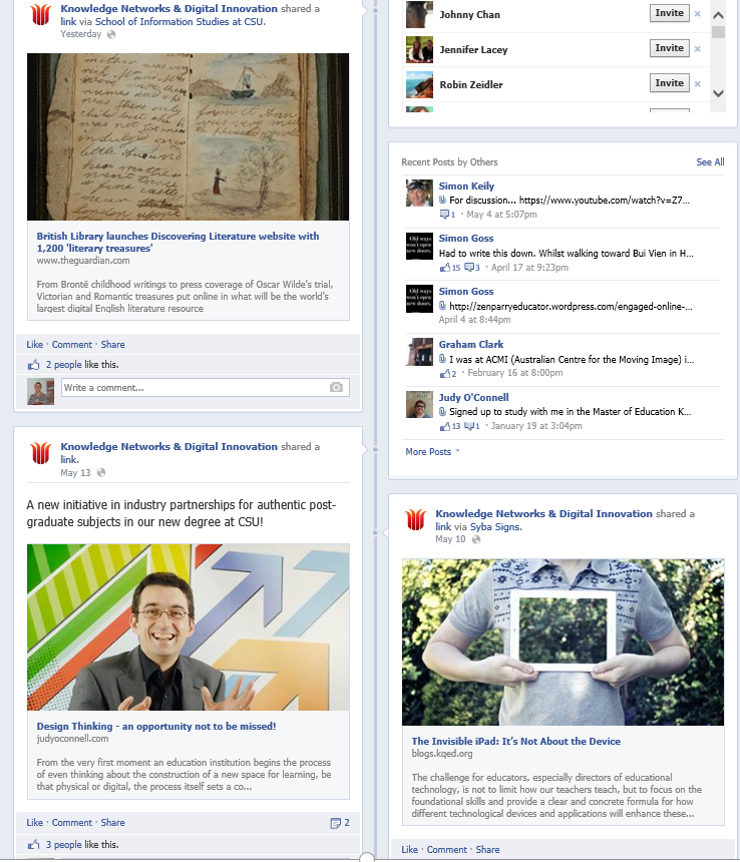
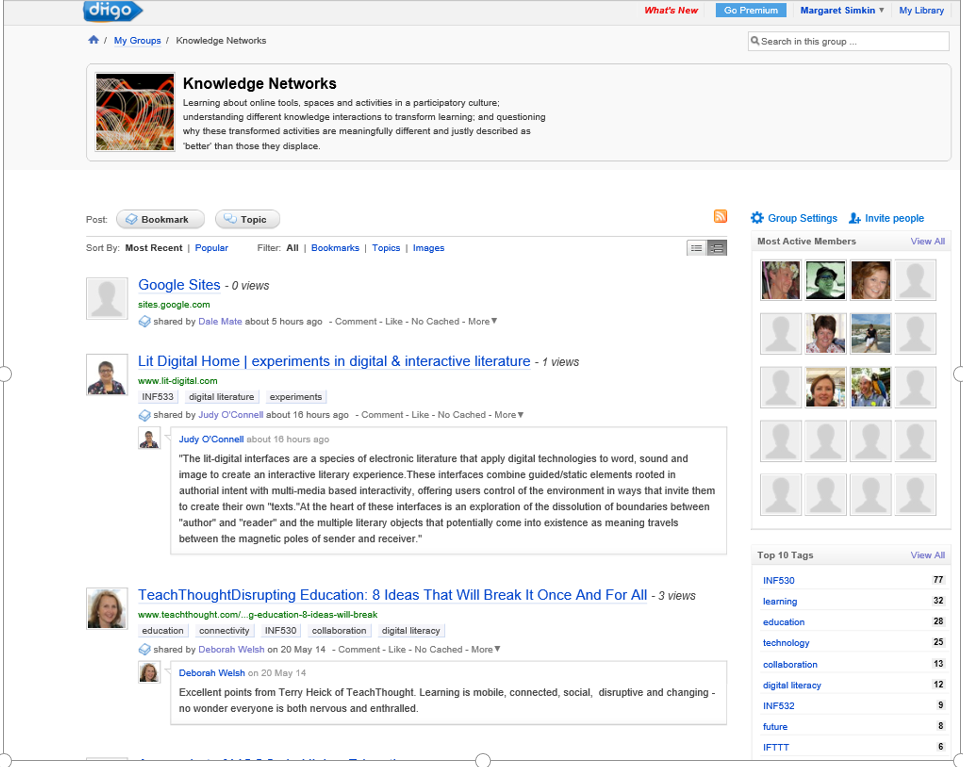
The practical application our learning has resulted from participatory practice: blogging, forums and collaborative curation. The subject has enabled transfer of developing skills to the range of work places represented by the student body. The power of the INF530 professional learning networks can be demonstrated by these screen shots of our networked practice:

Twitter connections
Twitter connections


Facebook interaction
The most powerful of all - the blog roll
Resource sharing Resource sharing with Diigo
The most powerful of all - the blog roll
The most powerful of all – the blog roll

Taking such infinite issues and converting them into one digital essay has been a challenge, and the end product is controlled by the restraints of the chosen medium (Weebly) and the word limit. The same frustrations arise with preparing this critical reflection.

These are the realities we, in turn, impose on our students. The opportunities for immersion in one sphere of inquiry, the need to brush off the skills of referencing and citing, and the need for sustained reading of a range of information has all promoted personal growth, as can be seen in the peer to peer “discussions” and the development of my skill set as evidenced within my thinkspace blog. The challenge now is to apply my newfound knowledge to improve education beyond my  own teaching, because I have been given some wonderful keys to unlock the potential of C21st students.


References

21st century   learning: Nathaniel Bott at TEDxLaunceston. (2013, December 5).   Retrieved March 10, 2014, from You Tube:   https://www.youtube.com/watch?v=UI9TiuVHc0A&feature=youtu.be

Abilock, D.   (2014, January 29). Information Literacy. Retrieved March 23, 2014,   from Noodle Tools: http://www.noodletools.com/debbie/literacies/information/1over/infolit1.html

Allen, E. (2013,   January 4). Update on the Twitter Archive. Retrieved March 16, 2014,   from Library of Congress Blog: http://blogs.loc.gov/loc/2013/01/update-on-the-twitter-archive-at-the-library-of-congress/

Anderson, M.   (2013, September 8). ICT Evangelist. Retrieved April 24, 2014, from   Teacher Confidence In Using Technology:   http://ictevangelist.com/teacher-confidence-using-technology/

Bellanca, J.,   & Brandt, R. (Eds.). (2010). 21st Century Skills: rethinking How   Students Learn. Bloomington, United States.

Brown, J. (2012,   September 18). The Global One Room Schoolhouse: John Seely Brown (Highlights   from JSB’s keynote at DML 2012). Retrieved March 16, 2014, from https://www.youtube.com/watch?v=fiGabUBQEnM&feature=youtu.be

Conole, G.   (2012). Designing for Learning in an Open World. New York, United   States of America: Springer.

Crockett, L.,   Jukes, I., & Churches, A. (2011). Literacy is Not Enough, 21st-Century   Fluencies for the Digital Age. Corwin.

Ferriter, W.   (2013, July 11). Technology is a Tool, NOT a Learning Outcome.   Retrieved May 26, 2014, from The Tempered Radical:   http://blog.williamferriter.com/2013/07/11/technology-is-a-tool-not-a-learning-outcome/

Iowa State   University Center for Teaching and Learning Excellence. (2011). A Model of   Learning Objectives. Retrieved March 17, 2014, from Iowa State University   Center for Teaching and Learning Excellence: http://www.celt.iastate.edu/teaching/RevisedBlooms1.html

Kress, G. (2010).   Multimodality, A Social Semiotic Approach To Contemporary Communication.   Abingdon, Oxon, United Kingdom: Routledge.

O’Connell, J.,   & Groom, D. (2010). Virtual Worlds: Learning in a Changing World.   Camberwell, Victoria, Australia: ACER Press.

Weinberger, D.   (2011). Too Big To Know: Rethinking Knowledge Now That The Facts Aren’t   Facts, Experts Are Everywhere, And The Smartest Person In The Room Is The   Room. New York, New York, United States Of America: Basic Books.


Envisaging a new future

So much of my thinking and reading keeps coming back to the way in which we design the tasks we as educators set to empower the learners for whom we share or take responsibility in our classrooms. I reflect back on our early module 1.5 where we listened to Nathaniel Bott: ” boredom and disengagement is too big a part of the modern classroom”

I also reflect on all the extra reading I did for module 3:

and the wonderful work of people like Graine Conole in relation to learning design (Conole, 2012) and I try to isolate the things that matter most to include in my digital essay on Digital Pedagogy! Even with  “affordances of the web” I am struggling with the restrictions of a word limit because teachers need to know all this NOW!

I have decided that the following references are critical to my task (and every time I think I need to stop finding new resources I damn well find more!). So this list is a starting point of material that is very useful for our subject (each of these titles really links our work as educators to our practice.

References

Bellanca, J., & Brandt, R. (Eds.). (2010). 21st Century Skills: rethinking How Students Learn. Bloomington, United States.

Brabazon, T., Dear, Z., Greene, G., & Purdy, A. (2009). Why the Google Generation Will Not Speak: The Invention of Digital Natives. Nebula, 163-181. Retrieved April 16, 2014, from http://www.iiav.nl/ezines/IAV_607294/IAV_607294_2010_3/BDGP.pdf

Chase, Z., & Laufenberg, D. (2011, April). Embracing the Squishiness of Digital Literacy. Journal of Adolescent and Adult Literacy, 535-537. doi:10.1598/JAAL.54.7.7

Conole, G. (2012). Designing for Learning in an Open World. New York, United States of America: Springer.

Crockett, L., Jukes, I., & Churches, A. (2011). Literacy is Not Enough, 21st-Century Fluencies for the Digital Age. Corwin.

Cronin, J. G. (2010). Too Much Information: Why Facilitate Information and Media Literacy. International Journal Of Humanities & Arts Computing, 4 (1/2), 151-165. doi:10.3366/ijac.2011.0014

O’Connell, J., & Groom, D. (2010). Virtual Worlds: Learning in a Changing World. Camberwell, Victoria, Australia: ACER Press.

Reviewing the Trajectories of e-learning. (2014, January 15). Retrieved May 13, 2014, from e4innovation.com: E-Learning innovation; research, evaluation, practice and policy: http://e4innovation.com/?p=791


Reflecting on metadata

What’s the most important point that struck you in your readings?

Investigating RDA as the new cataloguing, and having a presentation from OCLC about their cataloguing system last year brought some of these concepts to my attention. There is a big difference between knowing something exists and understanding it and I am still struggling with that. I can see the value of where metadata is heading but I don’t fully understand how to create it for best effect. I also worry that there amount of data will become a problem for retrieval rather than assisting us to find things.

What is the value of Web 3 to your learning and teaching?

I think it is important to record or note the good things that we come across so that we can find them again. Collaboratively locating valuable sources is a great way to save time and energy while contributing to the learning process.

Do you engage in tagging, indexing, or any other information organisation strategy?

I have been a long time “collector” of sources adding them to a wiki for teachers at my school: http://www.esandbox.wikispaces.com/ but, like the Internet itself, my organization of the data is not the best as additions are made in spurts and often spasmodically while tagging tends to be overlooked. I add to my Diigo library often, usually by favouriting tweets, which automatically records them. I have good intentions of going in to Diigo and adding tags but often don’t get around to it. My library : https://www.diigo.com/user/msimkin has 3268 untagged items (which is rather embarrassing!)

Do you embed metadata into your pdf documents (for example)?

It has never occurred to me to embed metadata into documents that I produce, and frat this stage I am not sure how I could manage this.

Do you have an organised approach to organising metadata?

I am afraid that I am little ad hoc (unless I am actually cataloguing something in the formal sense).

Digital Essay proposal

The Topic:

Digital Pedagogy

An Investigation into digital literacy and its significance for improving teaching and learning outcomes.

The tools and spaces to be used:

Weebly – a web building site will be the host for embedding a range of tools enabling the essay to be presented in a manner that can be read traditionally in a long-form style, or through a multimedia offering that would be a connected series of offerings on the various aspects of this topic. Each offering would equate to a paragraph within the long-form option.

Rationale:

Contemporary educators should embrace C21st Century Skills: Rethinking How Students Learn (Bellanca & Brandt, 2010), and the 21st Century Fluency Project (Crockett, Jukes, & Churches, 2011) in order to create the best learning outcomes for their students.

Information and Communication Technology skills and devices supporting them have been available long enough to be moving long the slope of enlightenment in Gartner’s Hype Cycle (Sharples, et al., 2013).  However, the spread of teaching practices considered in the light of the Revised Technology Adoption Life Cycle (Moore, 2002, p. 17) is increasing, and the chasm between Innovators, Early Adopters and Early Majority teachers and the rest of their peers shows no sign of being reduced. This ‘Great Divide’ is a critical pedagogical concern raised in http://thinkspace.csu.edu.au/msimkin/2014/03/20/knowledge-searching-and-understanding-a-starting-point/ .

Today, access to quality free and open access resources to support Australian classrooms is easy. Such resources are a pressing reason to get more teachers on board with C21st skills. The work of Conole (Conole, 2012) highlights the importance of the design process for improved learning outcomes, and offers suggestions for how this can be achieved.

The worth of investing in redesigned curriculum to incorporate these skills will be outlined. Links will be prvided to examples, suggestions and evidence of improved learning to support the contention that digital pedagogy is vital, vibrant and able to be implemented now. Literacy is Not Enough (Crockett, Jukes, & Churches, 2011) highlights the dimensions added by utilising the power of interconnections afforded by the Internet for life long learning.

References

Will be based on such titles as:

Bellanca, J.,   & Brandt, R. (Eds.). (2010). 21st Century Skills: rethinking How   Students Learn. Bloomington, United States. Retrieved April 2014

Brabazon, T.,   Dear, Z., Greene, G., & Purdy, A. (2009). Why the Google Generation Will   Not Speak: The Invention of Digital Natives. Nebula, 163-181.   Retrieved April 16, 2014, from   http://www.iiav.nl/ezines/IAV_607294/IAV_607294_2010_3/BDGP.pdf

Conole, G.   (2012). Designing for Learning in an Open World. New York, United   States of America: Springer. Retrieved April 2014

Crockett, L.,   Jukes, I., & Churches, A. (2011). Literacy is Not Enough, 21st-Century   Fluencies for the Digital Age. Corwin. Retrieved from http://www.fluency21.com

M. (2014, January   5). Digital Literacy, Social Networking, Blogs, Wikis, Social Bookmarking.   Retrieved March 23, 2014, from M’s Multimedia Blog:   http://cbltmultimedia.wordpress.com/2014/01/05/digital-literacy-communities-of-practice-and-social-media/

Moore, G. A.   (2002). Crossing the Chasm; Marketing and Selling Disruptive Products to   Mainstream Customers (Revised ed.). New York, United States: Harper   Collins. Retrieved May 2, 2014

Pang, A. (2008). Knowledge   Tools for the Future. Retrieved March 2014, 2014, from Institute For The   Future: http://www.iftf.org/our-work/people-technology/technology-horizons/knowledge-tools-of-the-future

Sharples, M.,   McAndrew, P., Weller, M., Ferguson, R., Fitzgerald, E., Histr, T., &   Gaved, M. (2013). Innovating Pedagogy Report 2013; Open University   Innovation Report 2. Retrieved March 15, 2014, from Open Access UK:   http://www.open.ac.uk/personalpages/mike.sharples/Reports/Innovating_Pedagogy_report_2013.pdf

Weinberger, D.   (2011). Too Big To Know: Rethinking Knowledge Now That The Facts Aren’t   Facts, Experts Are Everywhere, And The Smartest Person In The Room Is The   Room. New York, New York, United States Of America: Basic Books.


Blog Post #2 Digital information ecology and knowledge networks:


In this information age in which we live, which is exciting, fast-paced and scary all at the same time a range of definitions need to be examined, elaborated on and finally agreed to by enough educators to be meaningful in terms of our profession and to impact on student learning outcomes.

Much of the terminology being developed comes from quite different areas, for example, ecology is usually a term used by Biologists. When it is applied to Information and Communication Technology those of us working in this sphere need to pause and consider what the implications are for us.

Educators and information professionals view the world through numerous lenses, unlike some professions where the focus can be more one dimensional. This image, of the historical Kingscote Lighthouse light, represents the varied ways educators have to adapt concepts and theories to their role in guiding student learning.

Photo M Simkin

 
Photo M Simkin

Digital Media and Learning is a phrase used by Gee (DMAL) (Gee, 2010). Gee argues that the “learning” aspect will not evolve until real coherence of terminology and practice develops through collaboration and the ‘accumulation of shared knowledge’. (Gee, 2010, p. 6) He acknowledges the importance of this as:

‘a truly important and yet tractable theme around which the area can organize. Does digital media and learning have such a theme? One candidate would be this: the ways in which digital tools have transformed the human mind and human society and will do so further in the future. This certainly seems a big and important theme. The question, then, becomes whether there are shared tools and perspectives we all can develop to study it and whether it is tractable, that is, whether deep study will lead to real results’. (Gee, 2010, p. 6)

While we are referring to terminology, here’s another example: Gee quotes ‘Ong’s classic 1982 book … started the discussion of the effects of digital media on traditional literacy and said it constituted a form of “secondary orality’ (Gee, 2010, p. 7). Orality resonates with the concept that digital story telling is so valuable for assisting students to make sense of their world. It ties in with the work of Stephen Heppell and his students, which can be seen here: http://www.heppell.net/bva/ (Heppell, n.d.)

Be Very Afraid


Beyond defining the terminology, there is benefit to educators perusing models and translating words to action in the classroom.

Digital Literacy Model


(Hague & Paton, 2010)

This diagram reminds teachers of why it is important for them to be present and active in their lessons (whether as sage on the stage, guide by the side, or as co-learner). Students cannot be expected to just know the implications of the qualifying words such as critical, effective, functional and utilised here. In order for projects such as Stephen Heppell’s to be quality educational end products, deep understanding of these 8 areas is necessary. Students may achieve that through effective collaboration and networking with each other, but having the teacher as co-learner is the most effective way of achieving this.


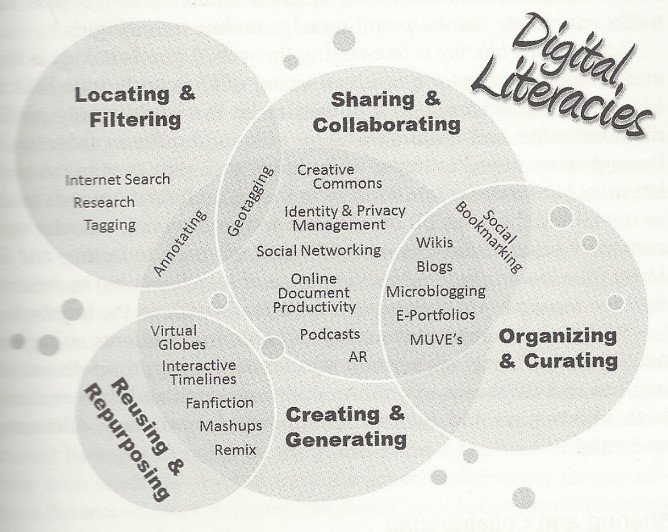
Summey (2013, p 15 cited in (M, 2014) provides a diagrammatic representation of these:

Cited in M's Blog

 
Cited in M’s Blog

References

Gee, J. (2010).   New Digital Media and Learning as an Emerging Area and “Worked   Examples” as One Way Forward. Cambridge, Massachusetts, United States of   America. Retrieved March 22, 2014, from http://www.scribd.com/doc/18943052/New-Digital-Media-and-Learning-as-an-Emerging-Area-and-Worked-Examples-as-One-Way-Forward

Hague, C., &   Paton, S. (2010). Digital Literacy Handbook. Bristol, United Kingdom.   Retrieved March 23, 2014, from http://www.futurelab.org.uk/sites/default/files/Digital_Literacy_handbook_0.pdf

Heppell, S.   (n.d.). About BVA. Retrieved March 26, 2014, from Be Very Afraid: http://www.heppell.net/bva/

M. (2014, January   5). Digital Literacy, Social Networking, Blogs, Wikis, Social Bookmarking.   Retrieved March 23, 2014, from M’s Multimedia Blog: http://cbltmultimedia.wordpress.com/2014/01/05/digital-literacy-communities-of-practice-and-social-media/