I am a Teacher of History working part time as I consider options for my future. For many years I have been a Teacher-Librarian at a small regional cooeducational college. While now working with three classes of History I continue to develop information literacy and digital skills as a Microsoft IEE and also a Fellow. It is critical ifor educators to keep tabs on new technology and its educational application. I am lucky to work in a school where technology is supported.
For a long time people have forecast the end of teaching as we know it – but surely we are entering an era where options will morph into something other than the known, something better, something more open and flexible?
In this short film, Christian Long raises a number of questions including:
What are the options tertiary students will face in 2025?
What will it mean to go to school?
He raises some questions that are unanswerable at this present time, but which will affect students currently at school, and for whom we are still providing something more like the experience of our medieval forebears,rather than the agility that the connected world provides.
He reminds us that it is hard to measure the return on investment for attending a tertiary institution now, let alone into the future, even if that is as close as his chosen time frame of eight years.
He challenges tertiary institutions to think about what they are and what they should be; university campus planning should allow for more agile uses, including partnering with other organisations. “Place” will be less bricks and mortar, rather than something that will form part of a fabric of choices ranging from face to face, several days immersion, virtual attendance, flexible spaces and incubators. Just in time learning at scale rather than a set time-frame resulting in a specific degree; adding up to an ongoing and learner driven life long education.
Our schools would do well to be thinking along similar lines.
References
Long, C. (2012). Imagining Tertiary education in 2025 [Motion Picture]. Retrieved July 5, 2017, from https://vimeo.com/50512142
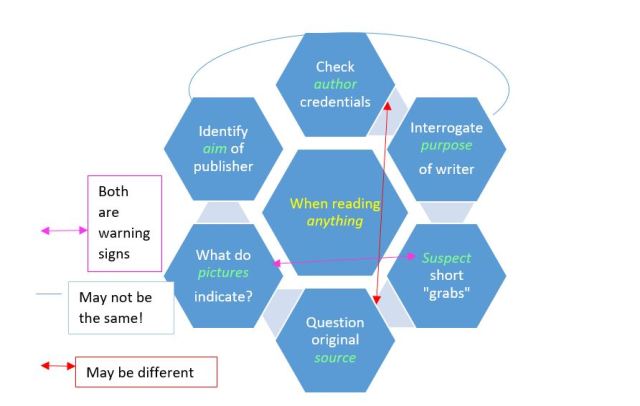
We are living in an era where information is readily available, easily created, generally unedited or moderated, and widely shared. It is vital that readers have the capacity to appraise the calibre of content they encounter. Yet, it would appear that even students entering renowned universities cannot apply even the most basic of filters to images or documents presented to them (Weinberg, 2016).
Some simple starting points:
Based on Some Rules of Thumb – a guide to assessing online news and adapted to suit all types of information (Valenza, 2016).
Without applying a filter, or lens to what we read we run the risk of spreading misinformation, thereby perpetuating deliberately created and often specifically targeted fabrications which may be destabilising to governments or undermining to individuals. Far from choosing to be part of such a process, many are inadvertently passed on because people aren’t taking the time to evaluate sources (Tiffany, 2016).
Teacher-librarians such as Valenza promote their role as critical in educating more news literate and savvy information consumers. Tiffany states that this is more effective the earlier that students encounter such educators (Tiffany, 2016).
Coupled with the relatively recent rise in the spreading of “untruthiness”, is the concept held by many that free press equates to neutral information (Valenza, 2016). History teachers are adept at demonstrating that the underlying perspective of the creator, or interpretation of the historian affects the way in which the information s viewed. Much harder to teach, however, is the effect our own attitudes and biases affect the way in which we read and often lead us to ignore viewpoints that differ from our own (Valenza, 2016).
Teaching younger students about appraising calibre and authenticating content is made a little easier by using a resource such as the TED talk on “How to choose your own news” (Brown, 2014) – an engaging animation.
There is no doubt that there has been an exponential increase in the publication of extreme, untrue and misleading “fake news” since the rise of social media such as Twitter and Facebook, partly due to the fact that the number of clicks may equate to real income for the posters (Garun, 2016). This poses a real issue for the founders of such sites, such as Facebook’s Mark Zuckerberg, who has expressed concern at the site being forced into becoming arbiters of truth (Liptak, 2016). The sites on which such “untruthiness” is spread have become known for fostering click bait (Zimdars, 2016).
There have also been allegations that social platforms influenced election results in several countries in 2016 (Garun, 2016). This of itself may not be all bad – but it does indicate the serious need for teaching readers how to negotiate the publications of our time by understanding the underlying purpose of the publications to which they are exposed, and to question the authenticity of what they read, in much the same way that commercial transactions advise that the buyer must be aware. It is critical that leading universities such as Stanford do not continue to find that their students are vulnerable to fake news (Weinberg, 2016).
It is crucial that Australian students are able to learn within their own context about the ways this can be an issue locally, as well as seeing information relating to the United States in particular. We need to be developing Australian resources to support teaching the necessary skills.
As a teacher-librarian and History teacher I am up for the challenge – are you? Join the conversation at #truthinessEDU
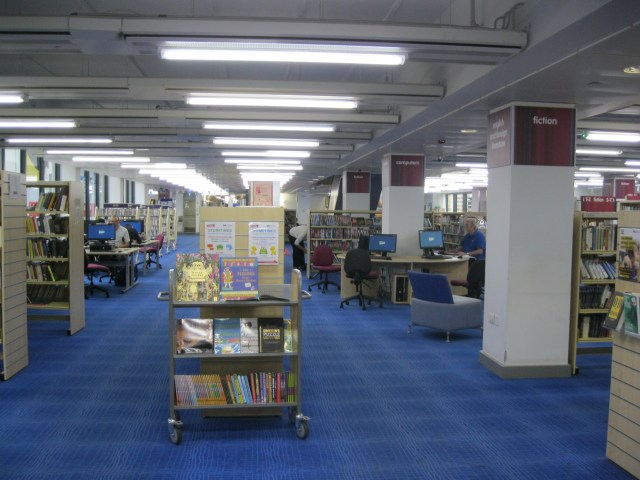
On a recent visit to the United Kingdom, I visited the Cambridge Library (not the university version – the public offering) which is part of a large new shopping centre in the town. As with most modern libraries, it had lots of natural light and was furnished with light coloured shelving. There were large numbers of users of all ages, reading, using computers (their own or the facility’s) and consulting with staff. Staff were spread through the building and were proactive in offering assistance.
Materials were shelved as Fiction and Non- fiction in the adult and young adult section, and Fiction or Information in the children’s area. Face out displays were well used and material was generally shelved in order.
A view through the first floor.
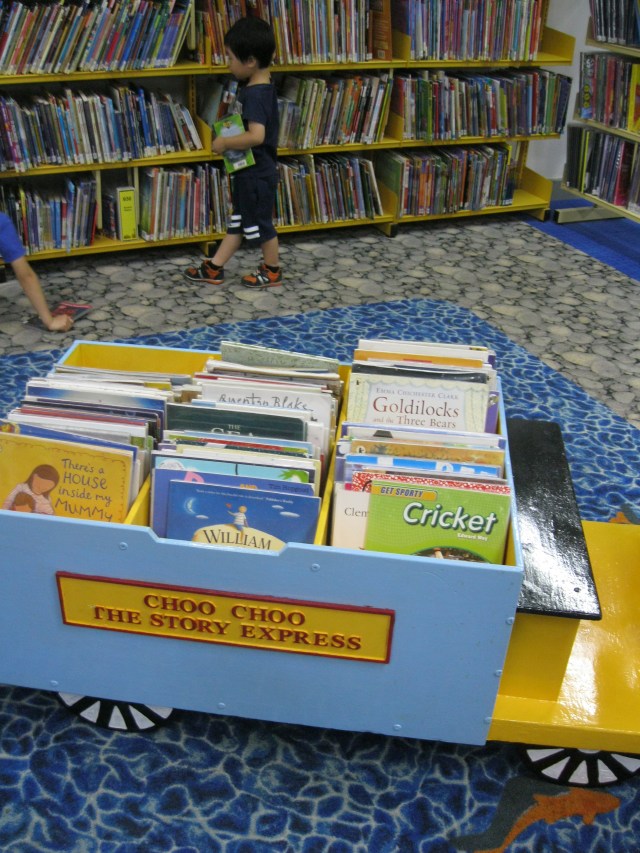
Children’s offerings:
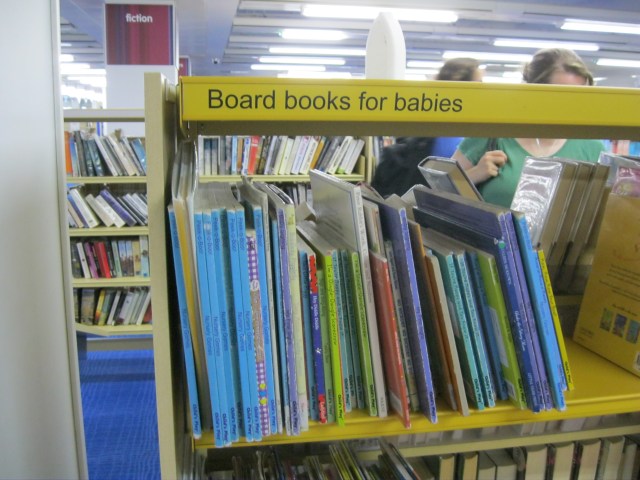
Each section in the train was shelved in author orderParenting material was located in the children’s section.Babies had their own spaces (but parents had to reach them!)A view through the first floor.
The adult section was diverse and much larger than the children’s collection space.
What I really liked about this library was its quiet sense of purpose, its focus on users, and the fact that books were shelved in precise order but obviously being well used as they were not pristinely upright!
Perhaps the lack of spine labels on Fiction materials leads to better attention to shelving? Something to ponder.
A visit to the British Museum provokes the question – why are these sculptures from the Parthenon in London? What are these artefacts? Are people like Mrs Clooney right in saying they are in the right place?
This slideshow requires JavaScript.
Also worth debating is the explanation of all the friezes and the original state of the building.
Would Greek people feel that the British Museum was the right place for these to be housed?
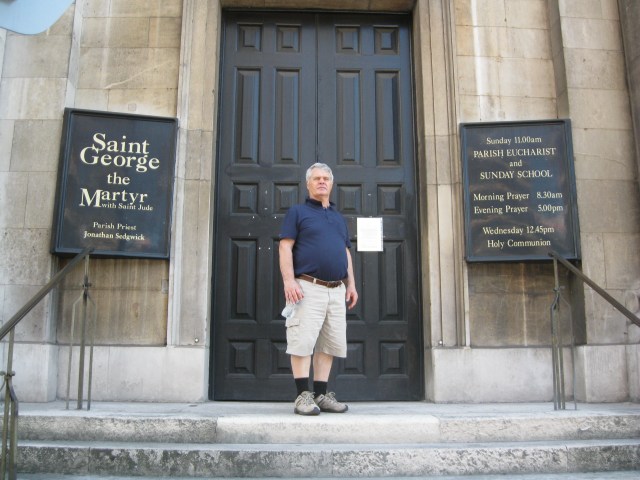
Eliza Stubbing/s came from this area prior to sailing across the globe with her husband, George Simkin. Two visits to the area, and we located a church that would have been there when she was a girl. The Borough markets and the Thames are nearby, as is Shakespeare/s Globe theatre.
A large green space of calm reflection lies just up the road from our accommodation. It holds the evidence of many lives. It is open from early in the morning until 8pm, and people walk there, rest there and visit some of the more recent graves. Crows, pigeons and squirrels share the space with humans. It is heartening to see the volunteers working to maintain this large and old site. An unexpected refuge from the heat and the urban flurry.
First full day of our trip to the UK and Ireland. Much is different since 1976!! Most noticeably for us is that London’s not the cold, dull place it was then. The fact that this is not a winter visit is obviously part of the reason. Trees have leaves on them, and it is the middle of a heat wave. Sights like these were impossible in January:
The buildings have also been cleaned. St. Paul’s gleams, the riverside buildings are spruced up. The buses, while still red and double decker, are clean and rather “green” although the tube is a little tired.
Staying in a hotel brings a stark contrast to home: heating is available, but air conditioning only in the communal areas. No fridge in the room!
Trains are “cooled” by opening windows. Underground is stifling. Most shops seem to just open their doors.
Today’s visits included Lambeth, The Imperial War Museum, and the Thames.
There are a number of ways to get students up and active, sharing notetaking and working together.
A3 paper:
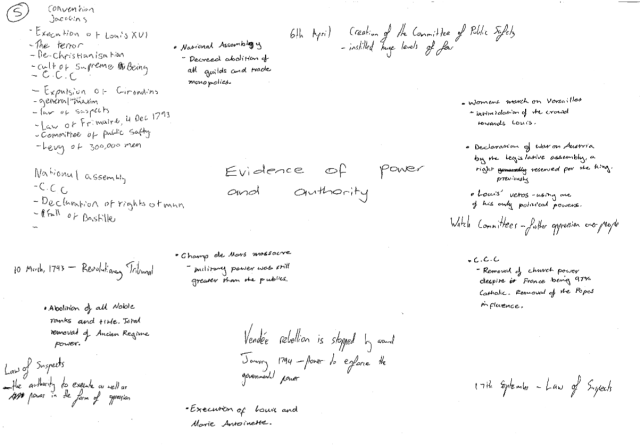
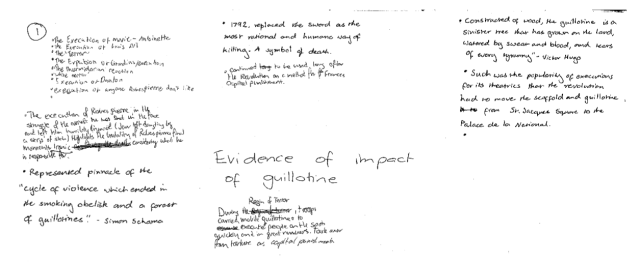
This can be a wonderful tool for getting information out of their minds and into shared space. Some examples, which may be hard to read, but which give you an idea of how it works are below. They come from a VCE History revision lesson in 2015. Preparation involved picking up on the skills that were lacking – in this case the provision of evidence to support contentions that had been made – and writing a target in the middle. Each student then had a time frame of 2 minutes per page, before they had to move on to the next page.
Collaborative cube:
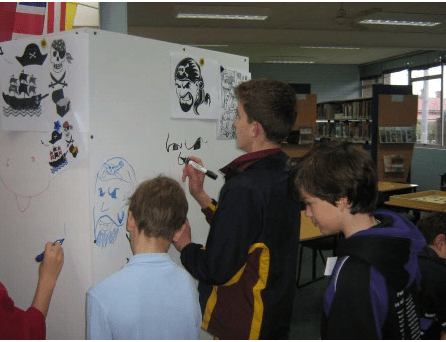
This was a recommissioned TV trolley which a colleague and I decided to use as a frame for four sheets of whiteboard material. We kept the wheels so that it could be moved as required. Students of all ages and genders really enjoy using the markers to complete tasks.
This was an activity with mixed age groups from Years 5 – 8 and from a range of schools, where they had the opportunity to draw pirates!
A4 paper:
Getting students in pairs to list ideas relating to a topic within a really tight timeframe can provide an active change of pace, stimulates competition and often draws out concepts that I have not connected to each other in quite the same way enhancing multiple interpretations of the same content.
but only covering such aspects that interlink with others in this list!
I don’t claim to know it all, for, after all, there is too much to know! I don’t claim to cover it all – unfortunately I’m only human! You can read more about me here.
You can read more of my opinions below. If you like what you can see, you can share with others – collaboration is so enriching.
If you disagree, we can have a discussion. Discussion and debate help refine and improve ideas.
I take these tenets into my classrooms and my library every day.
I will gradually move all the links across to interlink within this site, as I am assuming that I will lose access to my CSU Thinkspace by the end of the year.






 Margaret Simkin